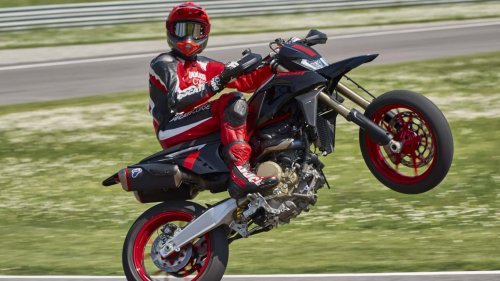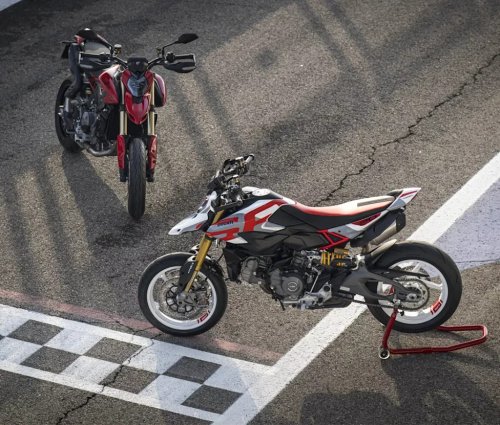
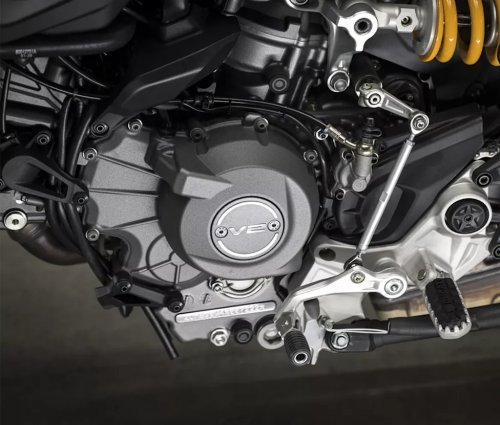
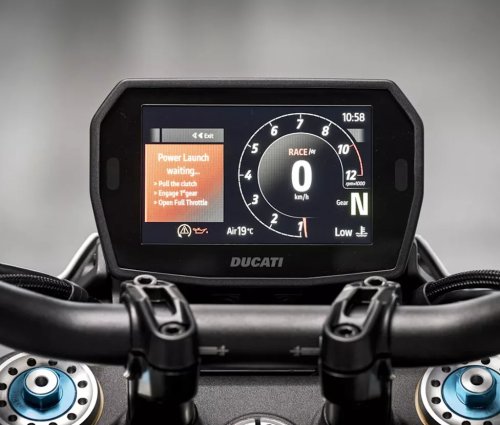
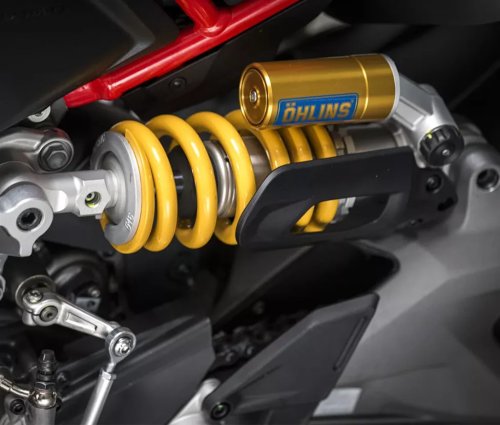
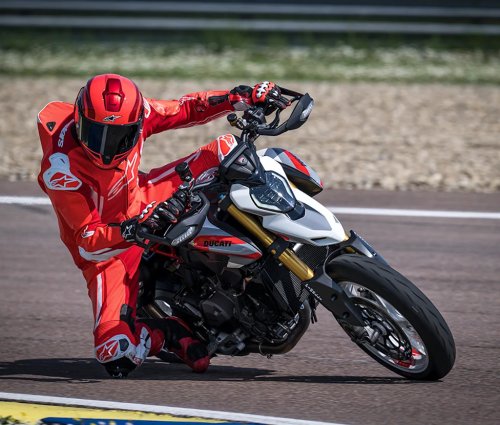
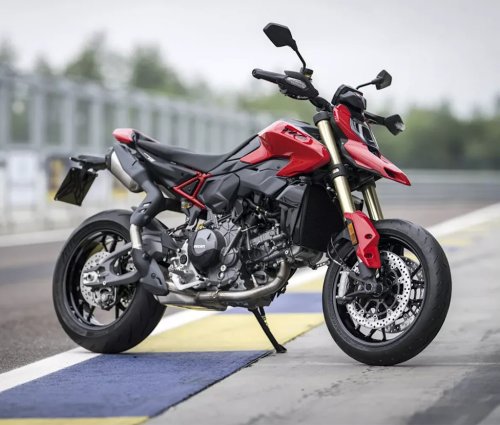



















Men's Journal aims to feature only the best products and services. If you buy something via one of our links, we may earn a commission. Prices are accurate and items in stock at time of publishing.The Ducati Hypermotard was peak hooligan when it stormed the gates two decades ago. Slim, snorty, and prone to ripping lurid wheelies, the so-called Hyper went viral when a press photo captured racer Rubén Xaus giving a casual thumbs up while sliding the bike on his knee. If this spicy dirt/track hybrid didn't lure you onto two wheels, nothing could.For 2026, Ducati completely reworked the formula, giving the Hypermotard V2 a lighter chassis, a new 890cc V-twin engine, and more advanced electronics designed to make it faster—and friendlier—for a wider range of riders. I traveled to Italy to ride it on track and find out whether Ducati softened its wild child or simply made it better.2026 Ducati Hypermotard V2 and V2 SPCourtesy ImageWhat's New for the 2026 Ducati Hypermotard V2?The TL;DR Ducati wants you to know about the new Hypermotard V2 is that it's lighter and more powerful than its predecessor. Which are good things. But there's more to the story than just "leaner and meaner." The Hypermotard's fundamental underpinnings have also been altered in the interest of a wider audience, aiming to straddle the fine line between edgy and accessible.AdvertisementAdvertisement"Ducati completely changed their approach in 2020," project manager Giacomo Davoli said of the brand's bike development process. He said this time around the development team used a so-called panel test that evaluated a wide variety of rider skills on a racetrack. The group was so diverse that their lap times differed by up to 25 seconds, a huge spread that addresses a broad range of skill levels from novice to expert. While past models offered razor's edge performance that was accessible mostly to advanced riders, the new V2 promises it can be ridden fast by many more.The Biggest Changes From the Previous HypermotardThe heart of the 2026 Hypermotard is a version of Ducati's new smooth-running 890cc V2 engine which has been tuned for responsiveness. Courtesy ImageThe second-gen Hypermotard (2013 to 2019) brought big changes with a liquid-cooled engine and a suite of electronics including traction control. But the newest Hyper gets a different type of extreme makeover. Gone is the bike's signature steel trellis frame, replaced with an aluminum monocoque (monoscocca if you're Italian) that weighs a whisper over 10 pounds. A rear trellis section was retained as an homage to the OG setup, but the overall look is a notable departure from the late, great Hypers we know and love.The heart of the bike is a version of Ducati's new smooth-running 890cc V2 engine which, while also found in several other models, has been tuned for responsiveness. Claiming 120 horsepower and a chunky 69 lb-ft of torque, the engine delivers 70 percent of its torque from a low 3,000 rpm and revs to 11,500 rpm. The bike also incorporates new hardware like a 5-inch TFT screen and advanced cornering ABS, traction control, wheelie control and a whole bunch of electronics trickled down from Ducati's lineup. In all, the standard V2 tips the scales 29 pounds lighter than its predecessor, while the V2 SP sheds 31 pounds in contrast to the outgoing SP equivalent. The Ducati Hypermotard V2 incorporates new hardware like a 5-inch TFT screen and advanced cornering ABS, traction control, wheelie control and a whole bunch of other electronics.Courtesy ImageHow the Ducati Hypermotard V2 Performs on TrackMy Hypermotard test took place at the Autodromo di Modena circuit in Motor Valley, not far from the go-fast headquarters of Ducati, Lamborghini, and Ferrari. I packed a plethora of safety gear for the track-only ride including Alpinestars' Tech V5 racing suit, a Supertech R10 helmet, and a track-calibrated Tech Air 5 airbag vest that it turns out would come in very handy. More on that later.AdvertisementAdvertisementWhile my borrowed gear totaled a pretty penny, Ducati's newest Hypermotard is also pricier than ever. The basic model starts at $16,995, while the SP version adds a slew of go-fast bits like Öhlins suspension, a Sachs steering damper, uprated Brembo brakes, lightweight forged wheels, and stickier Pirelli Diablo Rosso IV Corsa rubber for a notable $20,995. Available extras include copious carbon fiber bits, a track-only Termignoni exhaust ($3,213), cruise control ($365), heated grips ($450), and more. You'll want some of those optional carbon pieces, as some of the plastic trim bits look janky.The SP version adds a slew of go-fast bits like Öhlins suspension, a Sachs steering damper, uprated Brembo brakes, lightweight forged wheels, and stickier Pirelli Diablo Rosso IV Corsa rubber.Courtesy ImageMy test was confined to the delightful 11-turn, 1.3-mile circuit that offers clear sightlines. Ducati claims a seat height of 34.6 inches for both V2 and V2 SP, the first time the higher-spec model isn't a higher altitude, I found it surprisingly easy to manage the bike despite my 32-inch inseam. Credit the saddle shape and how its tapered corners merge with the fuel tank. Ducati arranged tire warmers for optimal grip, and after a tech briefing I threw a leg over and explored its limits. The Hypermotard V2's engine sound is present enough, though if you're craving a rowdier exhaust you'll find satisfaction in the pricey-but-sonorous Termignoni option mentioned above. The seating position is surprisingly comfortable, with my 5'11" frame fitting fine and lending me a good command of the controls. Unlike the chattery, vibey charisma of previous Hypers, this one is more resolute in its mission to lap a track swiftly. It's got plenty of grunt but not so much it's intimidating; it leans in predictably, and holds corners with stability.I Crashed the Ducati Hypermotard V2—Here's What HappenedMy first session inspired so much confidence, in fact, that I got a little big for my britches in the next session and lowsided, sliding across the track in a blaze of leather-scraping ignominy. The bike suffered minor damage and I was fine— fine enough, in fact, that I climbed back on rode it to the pits where it got freshened up with a few fresh cosmetic parts. Thanks to Alpinestars' prescient airbag vest, I was spared bruising or worse, a broken collarbone. The armored Tech V5 got a tad scraped up but saved my hide from abrasion.The Ducati Hypermotard V2 has plenty of grunt but not so much it's intimidating; it leans in predictably, and holds corners with stability. Courtesy ImageMy only physical effect from the slide was a slightly tender hand. I felt strong enough to go out for the next two sessions, knowing that with my airbag canister depleted I didn't have the luxury of crashing twice. I also recognized the irony of taking a spill on a bike that's more capable but arguably easier to ride than its fear-inducing predecessor. Is the Ducati Hypermotard V2 Worth It?Like most things raw and unrefined, Ducati's hooliganistic Hypermotard couldn't stay edgy forever. It's also worth noting that motorcycling needs more riders these days than ever. But the Hyper's newfound approachability demands a zoom-out for valuable context. I'm glad the Hypermotard V2 is lighter and more powerful than its predecessor, but I also wish it didn't ditch the model's signature trellis frame and desmodromic valves in the process.The Ducati premium might not make the 2026 Ducati Hypermotard V2 right for everyone, it most certainly holds more appeal to a wider audience than ever before. Courtesy ImageAlthough it benefits from the much longer valve service interval of 28,000 miles, longer than most will likely own the bike for, the new bike is also drifting slowly away from the aggressive quirks that made it so endearing in the first place. And while no standard V2s were available at the launch, the up-spec'd V2 SP requires a significant investment that puts it in a premium category. So while the Ducati premium might not make it right for everyone, it most certainly holds more appeal to a wider audience than ever before. 2026 Ducati Hypermotard V2 SpecsEngine: DOHC, liquid-cooled, 90-degree V-twin, 4 valves per cylinder, variable intake valve timingDisplacement: 890 ccTransmission: 6-speed with Ducati Quick Shift (DQS)Horsepower/Torque: 20.4 hp/69.0 lb-ftSeat Height: 34.6 inchesFuel Capacity: 3.3 gallonsWeight: 397 lbs (wet)Price: From $16,995From $16,995 at Ducati DealersThis story was originally published by Men's Journal on Jul 9, 2026, where it first appeared in the Gear section. Add Men's Journal as a Preferred Source by clicking here.