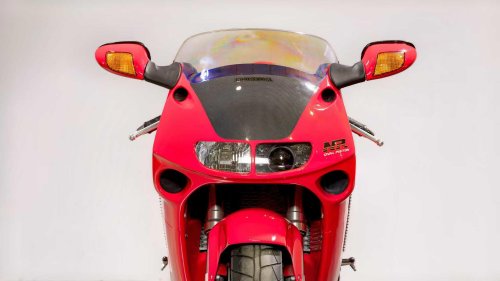
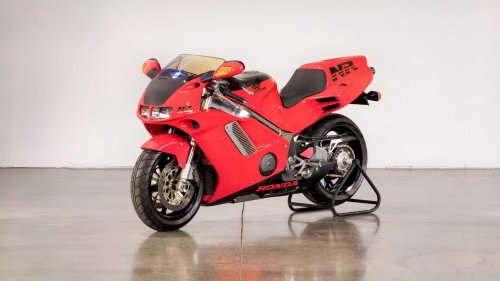
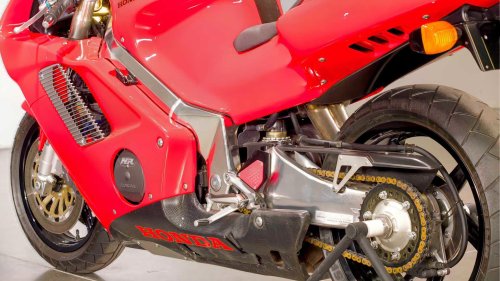
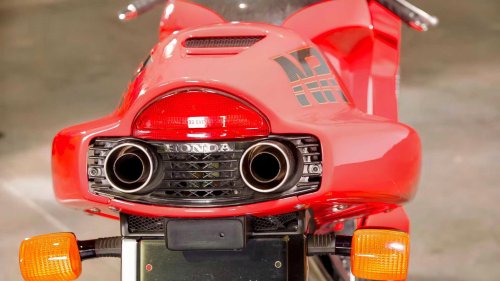
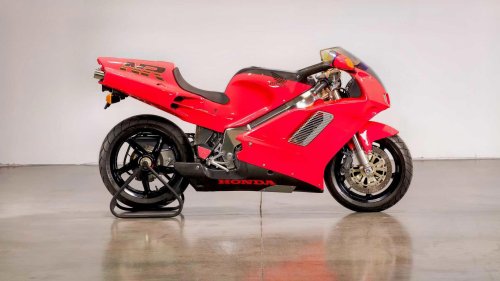
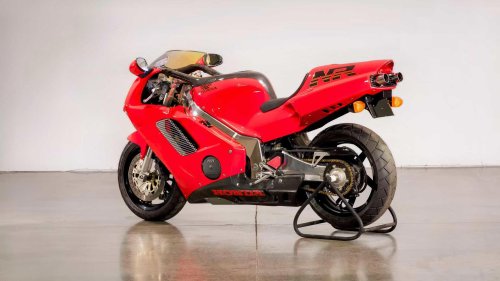
























In the late 1980s, the Japanese motorcycle industry reached a level of technical arrogance that the world has not seen since. It was an era defined by the "Bubble Economy," where engineering budgets were essentially bottomless, and the primary goal was to prove which manufacturer possessed the most capable R&D department. While competitors were refining traditional four-stroke designs, Honda decided to pursue a concept that everyone else considered a mechanical impossibility. They wanted the benefits of a V8 engine but were forced to work within the four-cylinder regulations of Grand Prix racing. UPDATE: 2026/03/04 13:09 EST BY JARED SOLOMON This article has been updated with current auction data and collector market valuations reflecting 2026 pricing.This project was born from a desire to dominate the racing world with four-stroke technology at a time when two-strokes were the undisputed kings of the track. The engineers involved were given a mandate to innovate at any cost. This led to a development cycle that lasted over a decade and produced some of the most complex components ever fitted to a vehicle with two wheels. It was a bike that cost more than a contemporary Ferrari and utilized materials usually reserved for aerospace applications. Despite its brilliance, it remains a technical dead end because the sheer cost and complexity made it impossible to replicate for the masses. The Legacy Of The Never Ready Project Mecum The origins of this machine can be traced back to the return of a certain manufacturer to Grand Prix racing in 1979. At the time, the racing world was dominated by lightweight, high-output two-stroke machines. Rather than follow the herd, the engineering team decided to stick to their four-stroke roots. To make a four-stroke competitive, they needed to maximize the valve area and increase the engine speed significantly. The rules capped the cylinder count at four, so the team devised a way to fit eight valves into a single cylinder head. This required a bore shape that was not a circle, but a flattened, elongated oval.This racing effort was initially a disaster. The complexity of sealing oval piston rings and managing the heat generated by such a dense valvetrain led to frequent engine failures. The racing press eventually dubbed the project "Never Ready" as a play on its internal designation. However, the engineers refused to scrap the concept. They spent the next decade refining the metallurgy and precision machining required to make an oval piston reliable. By the early 1990s, they had succeeded in creating a street-legal version of this racing ghost. This period of extreme Japanese engineering produced several icons, but none were as mechanically complex as this V4 experiment. The 1992 Honda NR750 And The Six-Figure Collection Tier MecumThe machine that finally emerged from this decade of defiance was the Honda NR750. When it debuted in 1992, it carried a staggering price tag of $50,000. Honda only produced approximately 300 units, though some estimates suggest the number that actually reached customers was closer to 200. This rarity, combined with the extreme engineering, has turned the NR750 into the most coveted Japanese motorcycle in the collector circuit.In the current 2026 market, the NR750 has ascended to blue-chip status. While a high-mileage example sold for $69,600 in 2024, pristine units consistently command much higher figures. Recent results from Iconic Motorbike Auctions show sales reaching as high as $150,000 for the most well-preserved models. The value is driven by the fact that no other manufacturer has ever attempted a production oval-piston engine. It is a unique chapter in history that will likely never be reopened. Collectors often compare the significance of this bike to the rarest limited edition motorcycles ever produced. The Technical Mastery Of The Oval Piston V4 MecumThe heart of the NR750 is a 748cc 90-degree V4 engine that functions like a V8. By using oval pistons, Honda was able to fit eight valves and two spark plugs into each cylinder. This doubled the intake and exhaust capacity compared to a standard circular piston. Each piston is supported by two titanium connecting rods, meaning the engine has a total of eight rods despite only having four pistons. The internal friction and reciprocating mass were massive hurdles, but Honda used gear-driven camshafts to ensure perfect timing at the 14,000 RPM redline.The power output was officially rated at 125 hp for the export models. While that number is surpassed by many modern middleweight bikes today, the quality of the power was different. The NR750 provided a linear, jet-like thrust that was remarkably smooth. It was a bike designed for high-speed stability rather than the flickable nature of a dedicated track bike. The gear-driven cams provided a distinct mechanical whine that has since become synonymous with Honda’s most elite V4 machines. The French Anomaly: The NR750 RC41 Spin-Off MecumWhile the standard NR750 is known internally as the RC40, there is an even deeper layer of rarity involving a specific regional spin-off known as the RC41. This variant was created specifically for the French market to comply with local power restrictions of the era. While the global RC40 was rated at 125 hp, French law at the time capped motorcycle output at 100 hp. To meet this legal requirement, Honda produced a handful of RC41 models with revised camshaft profiles and remapped PGM-FI ignition units.This variant is arguably the rarest iteration of an already scarce machine. Only about 20 units of the RC41 were ever produced. These bikes are a mechanical curiosity because they represent a factory-restricted version of a bike built specifically to showcase unrestricted power. In the modern market, an RC41 is a unicorn for collectors who prioritize production numbers over outright performance. A pristine RC41 was listed in the UK for £115,000, illustrating that the lower power output does nothing to dampen collector demand. Understanding these niche regional variants is a key part of navigating the collector motorcycle market. Aerospace Materials And Digital Innovation Mecum Honda didn't stop at the engine. The NR750 was a rolling showcase for materials that were unheard of in the early 1990s. The bodywork was constructed of carbon fiber and fiberglass composites. The windshield featured an iridium coating to reduce glare, a feature typically found on fighter jet canopies. Even the cooling system was advanced, utilizing side-mounted radiators to keep the bike slim while providing enough surface area to cool the high-revving V4.The dashboard featured a floating digital speedometer that projected the numbers into the rider's field of vision using a series of mirrors. This allowed the rider to check their speed without their eyes needing to refocus as much between the dash and the road. The bike also featured a single-sided swingarm and an under-seat exhaust system, design elements that would later be popularized by brands like Ducati. The NR750 Is A Permanent Fixture In Motorcycle History Mecum The Honda NR750 remains the ultimate proof that the most interesting machines are often those that make the least financial sense. Honda lost money on every single unit sold. They spent millions on development for a production run that barely reached 300 units. However, the goal was never profit. The NR750 was built to show the world that Honda’s engineers could solve any problem, no matter how many oval pistons it required.For the modern collector, the NR750 is a museum piece that happens to be street-legal. It is a time capsule from the peak of Japanese industrial power. As the industry moves toward electrification, the 32-valve, 14,000 RPM NR750 stands as a monument to mechanical complexity. It is a motorcycle that was truly too advanced for its time. It serves as a reminder that when the engineers are given a blank check, they can create something that haunts the dreams of collectors for decades. Many modern superbike technologies still owe a debt to the risks Honda took with this machine. The NR750 By The Numbers: A Development Timeline What makes the NR750's development timeline so extraordinary is the sheer stubbornness it represents. Most manufacturers would have abandoned the oval-piston concept after the first few seasons of racing humiliation. Honda doubled down for over a decade. The company internally estimated that the NR program cost somewhere in the region of hundreds of millions of dollars when adjusted for modern values, all to produce a motorcycle that was never intended to turn a profit. It was, in the words of former Honda engineers, an exercise in corporate pride disguised as product development. That obsessive refusal to admit defeat is precisely what separates the NR750 from every other collector motorcycle in existence. No other production bike carries with it a decade of failure, refinement, and ultimate triumph compressed into a single chassis. That backstory alone justifies the six-figure price tags seen at auction today. Sources: Iconic Motorbike Auctions, Classic.com, RM Sotheby's, Bonhams, Honda Global, Hagerty, Mecum, Farnham Honda.