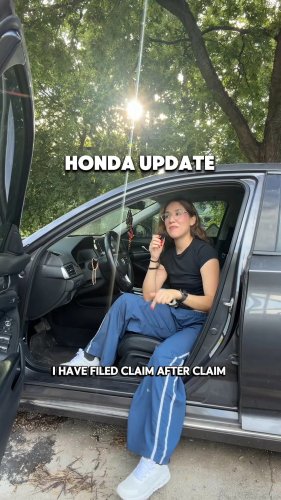


















Honda's Entire Safety Suite Runs Through One Camera. Guess What Keeps Failing.Beverly Mason didn't get a recall notice. She got a $2,933 repair bill. That gap — between what should trigger a fix and what actually does — is the real story hiding inside her new lawsuit against Honda, not the lawsuit itself.Mason, a Virginia resident, bought her 2018 Honda Clarity Plug-In Hybrid new in 2019. Last December, according to a complaint she filed in federal court in California, her dashboard lit up with warning after warning tied to Honda Sensing, the company's suite of driver-assist features. Adaptive cruise control. Lane-keeping assist. Collision mitigation braking. All of it, gone at once.The cause, per the complaint, traces back to a single component: the front sensor camera mounted behind the rearview mirror, wedged against the windshield. It's a small piece of hardware doing an outsized job.AdvertisementAdvertisementHonda Sensing runs on two main inputs — a radar unit low in the front bumper, and that windshield camera. The camera alone is responsible for reading lane markings, road signs, and shapes ahead of the car well enough to feed adaptive cruise control, lane-keeping assist, road-departure mitigation, and collision-mitigation braking. Break the camera, and you don't lose one feature. You lose the whole suite, all at once, mid-drive.Mason's suit, filed July 16 in the Central District of California and first reported by Autoblog, seeks class-action status on behalf of anyone who bought or leased a 2018-2025 Odyssey, 2018-2025 Pilot, 2022-2025 Civic, 2023-2025 HR-V, or 2018-2021 Clarity Plug-In Hybrid. That's not a niche complaint about one unlucky minivan. It spans two body styles, a plug-in hybrid Honda already discontinued, and the Civic, a nameplate Honda's own factories have struggled to keep building this year.Here's the part that should worry Honda more than one plaintiff's invoice: this isn't the first time a federal complaint has accused Honda Sensing's camera-and-radar setup of failing dangerously. A separate class action, Cadena v. American Honda, has been grinding through the same California federal court since 2018, covering 2016-2020 Accords and 2017-2020 CR-Vs. That case alleged the opposite failure mode, the system braking when nothing was there, rather than quietly giving up. A federal judge let most of those claims survive a motion to dismiss back in 2021. Eight years later, it's still Honda's problem in court.Honda has recalled for this kind of thing before. In 2015, according to court filings, the company recalled certain Acura RLX models specifically because the collision-mitigation braking system was prone to false alarms. So Honda clearly knows how to issue a fix once a defect crosses into unreasonable-risk territory. It just hasn't decided that's the case here: not for the CR-Vs and Accords accused of phantom braking, and not for the Odysseys, Pilots, Civics, HR-Vs, and Clarities now accused of losing their safety features altogether.AdvertisementAdvertisementThat's not corporate stubbornness. It's a function of how the system is classified. Honda Sensing is a Level 2 driver-assistance suite, legally a convenience feature layered on top of a car a human is still fully responsible for driving. It isn't equipment mandated by a Federal Motor Vehicle Safety Standard, the way seatbelts or brake lights are. When mandated equipment fails in a way that creates a safety risk, NHTSA has a clear path to force a recall. When an optional driver-assist camera fails, that authority gets murky fast, and automakers get a lot more room to treat the problem as a warranty dispute instead of a public-safety obligation. It's the same structural gap that let a Subaru labeling problem linger for seven years before regulators caught up.When the brakes fail, Honda mails you a recall notice. When the camera that operates the brakes fails, Honda mails you a repair bill.There's a second lesson hiding in that $2,933 figure, and it has nothing to do with the price of a camera. A basic automotive image sensor isn't expensive. What costs money is everything around it: diagnostic time to confirm which module actually failed, the replacement part, and then aiming and calibration, a procedure that typically needs dealer-level equipment to teach the new camera exactly how the road looks from that specific windshield. Mason's complaint puts it bluntly, alleging Honda "has failed to provide an effective permanent remedy for the Defect."That labor-heavy calibration step is quietly becoming one of the more expensive routine repairs in modern car ownership, and it isn't limited to Honda. Replace a windshield on any car with a camera mounted to it, and that same recalibration has to happen, which is why insurers and body shops now routinely add a few hundred dollars to what used to be a simple glass claim. General Motors, facing a comparable choice this year, split the difference on a different defect: some owners got a warranty extension, others got a lawsuit instead.AdvertisementAdvertisementHonda isn't unique here, and that's the uncomfortable part. Subaru's EyeSight, Toyota's Safety Sense, GM's Super Cruise: nearly every mainstream driver-assist system on the road leans on the same basic architecture, a windshield camera doing the reading, radar doing the ranging. Automakers keep patenting increasingly exotic ways to make cars watch the road, but bundle enough features behind one camera and you've built a single point of failure that can take out four or five advertised safety systems on one bad sensor day. Honda is simply the automaker currently answering for it in federal court.So no, this column isn't really about a Virginia woman's repair bill, or even about Honda specifically. It's about what "safety technology" means once it's wired through a single camera that isn't legally treated as safety equipment at all. The number worth remembering isn't $2,933. It's eight, as in eight years Honda has now spent litigating claims about this same camera-and-radar suite, across two lawsuits and at least seven nameplates, without a single recall attached to either one. Before you option a car up with the full driver-assist suite, ask the dealer a less exciting question than whether it has adaptive cruise: what happens, and who pays, when the one camera running all of it quits. You can check whether your own vehicle has an open recall at NHTSA's database.Join our Newsletter, follow our Instagram page, and connect with us on Facebook.