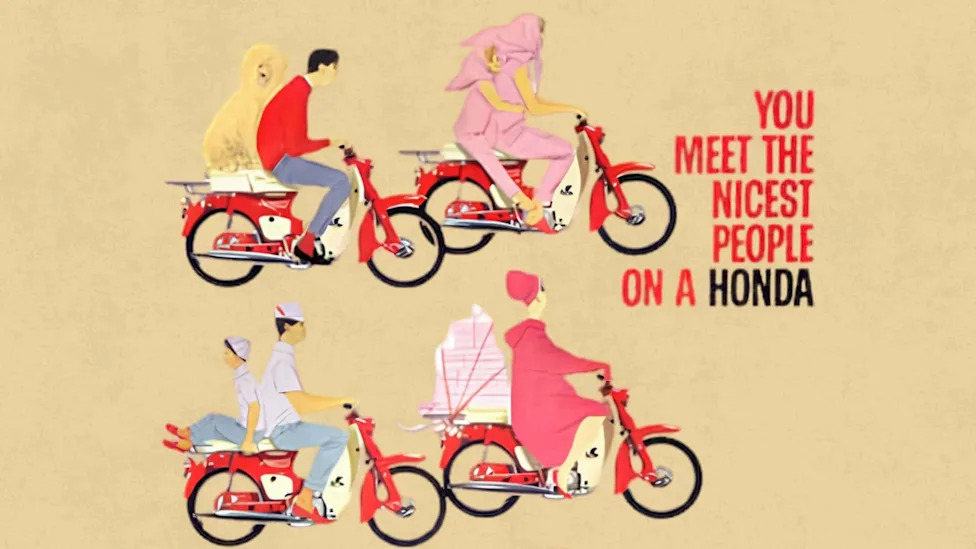
Honda Super Cub AdvertisementA new exploration of the globally recognized innovations at the heart of the Honda Super Cub makes some important points, but misses others.When examining history, both good and bad, it's often difficult to tease out the precise details you want to share. What do you leave in? What do you take out? What details and minutiae do you list in depth, and what do you gloss over because you don't think they're important, or you're concerned about derailing the story you want to tell?And that's only considering the facts, and not any sort of spin you want to put on them when you're telling the story you want to tell.I'll be honest, I went into reading this Harvard Business Review piece, titled What the Honda Super Cub Can Teach Us About Designing For Global Markets, with one eyebrow already half up. As a motorcycle history nerd, and one who's particularly interested in Honda's history, I genuinely wondered why we're discussing something of a motorcycle (and general product design) unicorn as a case study given the original Honda Super Cub was released in 1958.That means that as I type this, we're just two years shy of the Super Cub's 70th birthday. The fact that it's remained in production to this day, and is beloved all over the world, is truly both amazing and rare. And yet, it's because of that rarity, both in the motorbike world and in the realm of product design more generally, that I'd think most (or even all) of what we can learn from it isn't exactly a secret, you know?And maybe that's true, but just like someone is always discovering William Carlos Williams or Sylvia Plath for the first time, it's also important for all of us (including me) to remember that not everyone knows all the details. Curious people of all ages tend to keep learning new things as we go on. And so, what's firmly in one person's rearview mirror is frequently front and center of another person's hyperfocus of the day.(Hey, I don't make the rules! It's how we function as humans.)Back to the Harvard Business Review's examination of why the Super Cub was such a smashing, unheard-of success, and what others seeking to innovate can learn from this particular unicorn.Cub-Shaped BookendsGive Me This Adorable Honda Super Cub Tokyo Limited '80s Edition Right NowThis Historic Honda Cub F Is Where Everything StartedIn the piece, they call out the importance of not going into designing a product with preconceived notions about the market you're trying to reach. They also discuss the idea of what they term "reverse innovation," which they go on to describe as taking the traditional, tough image of motorcyclists in America and turning it on its head with the famous "You meet the nicest people on a Honda" campaign.Which very neatly brings me to a key factor that I think the HBR authors left out in their analysis. When discussing Honda history, most of the time we talk about the genius of Soichiro Honda (as we should). But the Super Cub was, is, and remains such an indelible force in both motorbike history AND product design history because of Honda's frequently undersung business partner, Takeo Fujisawa.How undersung was he during his lifetime? The guy didn't even get officially inducted into the Automotive Hall of Fame until 2023, long after his death in 1989! Madness, if you don't mind my saying so.Now, to be fair to HBR, it doesn't specifically talk about Soichiro, either. It talks about Honda as a whole (which was primarily driven at this point by both Honda the man, as well as Fujisawa). It discusses the fact that Honda (the company) seemingly understood from the start what delivery riders needed, and then designed their product from there. At the same time, while keeping affordability in mind, Honda also didn't commit the cardinal sin in consumers' minds by taking away useful features to simply build to a price point. After talking about how the Super Cub was designed to work for so-called "emerging markets," they also go on to talk about the genius of the "You Meet A Nicest People On A Honda" repositioning to bring the Super Cub to the US.It's all well and good to talk about Honda's innovation as a company this way, but what seems to have made the partnership between Soichiro Honda and Takeo Fujisawa unique is that they both brought completely different skill sets to the table. Honda, as is well documented, was An Engineer. Maybe even THE Engineer, depending on where you stand.But if you ask Honda (the company) itself, absolutely none of this could have happened without Fujisawa's input and guidance, as he's the reason why the Super Cub was such an unconventional, thoughtfully-designed game-changer of a motorbike. I'll just let Honda (the company) describe this period in its own words here.In pursuit of Honda's quantum leap to greatness, Takeo Fujisawa made plans for a small, convenient and comfortable form of mobility which could be easily mass-produced and which everybody — regardless of age or sex — could ride. Soichiro Honda developed the Super Cub to be precisely the sort of mobility Fujisawa had in mind.When first released, this unique motorcycle became an instant hit, exactly as planned, and sold like nothing ever before. So it would be no exaggeration to say that both Soichiro Honda and Takeo Fujisawa had extraordinary skills and insight into both product development and marketing.The next paragraphs go on to enumerate exactly what a sales success the Super Cub immediately was. It sold 24,000 units in the first five months of production, and a further 167,000 the next year. And all of that is well before any of the classic Super Cub advertisements entered the picture. If you can believe it, Honda didn't sign its fateful contract with Tsugio Ogata, who then formed Tokyo Graphic Designers (and who, along with Fujisawa, should rightfully get the credit for the "You Meet The Nicest People On A Honda" campaign) until 1960.Looking at this information through a 2026 lens, it seems almost insane. And yet, Fujisawa's reasoning was that he wanted the Super Cub to stand on its own merits for those first couple of years. There were a few small newspaper ads, but nothing like the full-scale ad blitz you'd see for such a release now.You know those really annoying and almost inescapable waves of ads covering every conceivable audiovisual plane every time a new flagship smartphone comes out now? That could never be the Super Cub, and that's an important part of its charm and enduring legacy, too.It was Fujisawa and Ogata who not only decided to feature a soba delivery driver (a delicious type of noodles, for those unfamiliar) in their first round of ads; they also had the foresight to put ads in magazines aimed at women, in addition to more general interest magazines. Here's how the Super Cub can make everyone's lives better, you see!The ads that followed didn't let up on that idea. Instead, they expanded it. Need a little motorbike that can easily perch aboard a ferry (an important thing for would-be Japanese riders at that time)? Super Cub. Need the perfect motorbike to support your fishing habit? Super Cub. Need to handle unpaved roads with reasonable ease and comfort? Super Cub! By showcasing the bike in all of these scenarios, Honda and Tokyo Graphic Designers didn't just advertise the product; they educated about the product.And that's the key. The question is, can this thing meaningfully improve my life? It didn't matter if Honda believed it; it mattered if potential customers did. The series of advertisements that Honda specifically ran in women's magazines also gets major points for not talking down to or at their intended demographic. Instead, they had the audacity to treat women like people who simply may not have ridden a motorcycle before, and might find it fun and/or useful. Imagine that!It wasn't just one decision, or one person. Instead, it was an entire way of looking at the product, and designing it to solve an array of very real problems that potential customers were facing (as opposed to creating a problem that could only be solved by X Miracle Product, which as a strategy only tends to breed cynicism).Is it any wonder that by 1966, Honda had sold five million Super Cubs worldwide? That is, incidentally, three entire years after the "You Meet The Nicest People On A Honda" campaign had been dreamed up and implemented by the masterminds known as Ogata and Fujisawa. The idea was to show that all kinds of people could (and maybe even should) ride motorcycles, not just the born rebels. The key here was in recognizing how the culture in the US at that time differed, and where the Super Cub could fit in that landscape.The fact that the Super Cub used a centrifugal clutch from the start also probably didn't hurt, as it significantly lowered the barrier to entry for new riders (kind of like Honda's E-Clutch tech is working to do in 2026). Keep in mind that at the time, automatic transmissions in cars weren't really a thing, so the ease of operating a Super Cub might seem even more appealing to those new to the road for that reason.While the HBR isn't wrong that there are things to be learned from the Super Cub, what that piece also leaves out is the combination of societal and socioeconomic circumstances that made its seemingly instant success and meteoric rise possible. Of course, it's easy to say this now, with nearly 70 years of hindsight to draw upon, but there's a certain amount of "right place, right time" involved in this story as well.Still, in an era where an awful lot of things are made to a price point rather than to a customer, that's really the most important point that the HBR analysis identifies.Good product design, in any era, should reflect the wants and needs of the customers it seeks to attract, whether it's a motorcycle or a spatula. No one is saying that companies shouldn't make money; only that it shouldn't be their sole reason for being. The enduring success of the Honda Super Cub shows that it's definitely possible to both give customers the value and features they want, and also to make a bunch of money at the same time. And then, everyone's happy!Oh, and also cement an unmatched legacy in the process. No pressure, modern product designers. No pressure at all.

















 +46 others