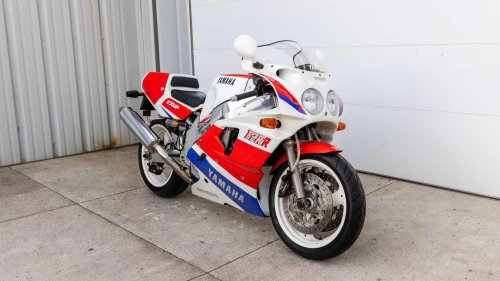
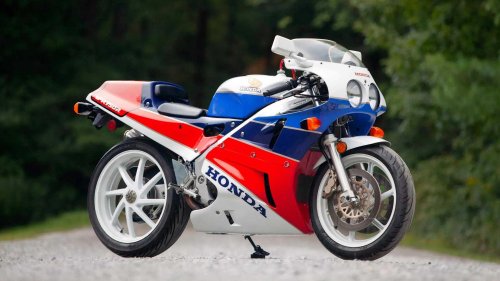
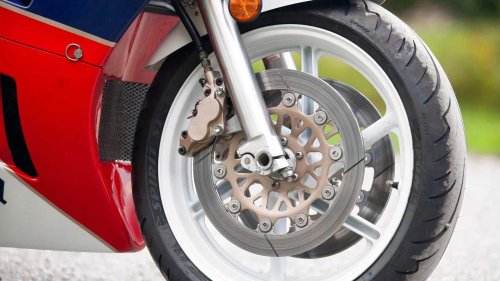
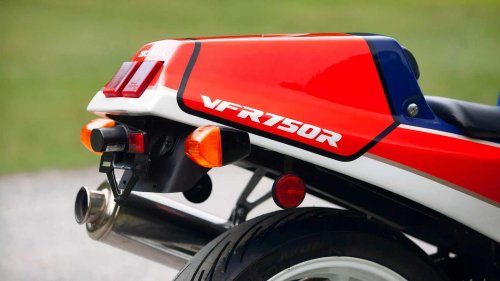
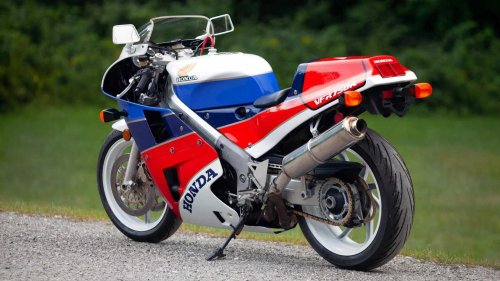
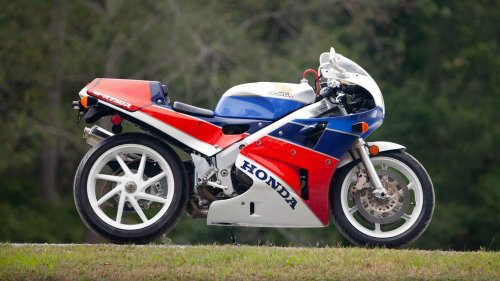









In 1988, fans of two-wheeled motorsports got a genuine treat with the founding of FIM’s Superbike World Championship, also referred to as WorldSBK or simply WSBK. Whereas the motorcycles competing in MotoGP were purpose-built race machines to their core, World Superbike required them to be based on actual production models available to the public. This key difference between the two disciplines brought us the concept of a homologation special, which refers to motorcycles intentionally produced in limited quantities to meet WSBK rules. And as many of you already know, it led to the creation of some truly remarkable sportbikes over the years. Race Bikes, But With Lights And License Plates MecumThey're collectible treasures and race-bred, unadulterated crotch rockets at the same time—just about as close as you can ever get to a road-legal race bike. Notable examples include the Yamaha FZR750R (OW-01) and YZF-R7 (OW-02), Kawasaki’s ZX-7RR and the 916 SPS from Ducati, but the list could go on and on. These are all extremely rare and highly sought-after among collectors, who will happily throw more cash at one such specimen than they would at a brand-new car. Big manufacturers had to build 2,000 copies in order to comply with FIM homologation rules back in the day, but that number has since dropped significantly to just 500.An initial run of 125 units needs to be produced for inspection, followed by just as many during the first year and another 250 over the course of the second one. But modern WorldSBK racing isn’t what we’re here to talk about today, as we will instead be looking back at where it all started. So which motorcycle was the very first homologation special to bring its racing pedigree onto public roads? Those of you who are well-versed in motorsport history might already know the answer, so let’s dive straight in without further ado. A Racing Legend Is Born Bring a TrailerEven though Ducati was the company to really take things to the extreme with more race-bred editions than you can shake a stick at, the first one to apply this formula was Honda for the 1988 WSBK season. That’s when HRC (Honda Racing Corporation) came up with what would go on to become a legend of Superbike racing — the mighty VFR750R more commonly referred to as the RC30. It was essentially a race replica of the RVF750, and demand was so high that Honda ended up selling a total of 4,885 units worldwide. In fact, some specimens destined for Japan's domestic market were even sold by lottery, as customers snapped them up like there was no tomorrow. WSBK Becomes The RC30’s Playground Bring a TrailerThis was despite the VFR costing about twice as much as your regular 750cc two-wheeler at the time, but its success wasn't limited to the commercial side of things. On the contrary, the bike proved itself to be an absolute beast on the racetrack, and not just in the Superbike World Championship. We might as well start with that, though, because WSBK is practically the reason why the RC30 was created in the first place. It had everyone else playing catch-up during the first two seasons, both of which ended with American racer Fred Merkel becoming champion and Honda taking the manufacturers title. Racing Success Beyond WorldSBK Bring a TrailerMoreover, the VFR750R made waves at the Isle of Man TT in 1988, when it helped Joey Dunlop win the Formula One TT with an average speed of 116.25 mph. The AMA Superbike Championship got a taste of the RC30’s vigor, too, as Miguel Duhamel rode his way to a Daytona 200 win in 1991. It also dominated in endurance racing and national superbike series, enabling privateers to consistently go toe to toe with factory teams. That’s all part of what made it the legend it is today, but we’re yet to talk about the characteristics which made it so special on a technical level. What Made The RC30 So Good? Bring a TrailerBroadly speaking, the Honda RC30 was developed specifically for racing rules by HRC right from the start, not adapted to them down the line. It came with a liquid-cooled 748cc V4 engine at its core, featuring dual, gear-driven chromoly camshafts, titanium connecting rods and an unconventional big-bang firing order. In addition, the mill benefited from a compression ratio of 11:1, four Keihin CV carburetors and a 12,500-rpm redline. It could summon up to 112 hp at 11,000 revs, sending this force to the rear wheel by way of a six-speed close-ratio gearbox and a slipper clutch. Ultimately, it translated into a top speed of 153 mph.The chassis was equally over-engineered, with magnesium wheels, high-grade Showa suspension and Nissin braking hardware all thrown into the mix. A single-sided Pro-Arm swingarm occupied the rear end, allowing the wheel to be swiftly removed for quick pit stops during racing. Honda made use of a light but sturdy aluminum twin-spar frame to hold everything together, while fabricating the bodywork out of fiber-reinforced polymer. Exotic materials were used extensively on the VFR750R, setting a new benchmark for every rival to aspire to and laying the blueprint for future homologation specials. Manufacturers like Ducati were left with no choice but to improve and adapt, so we may have never gotten a 955 SP or 916 SPS without the RC30 raising the bar earlier on. From Racetrack Weapon To Cult Classic Icon Bring a TrailerIt blurred the line between your everyday sport bike and a fully-fledged racer to such a degree that people still can’t stop talking about it even today. Of course, all this historical significance and racing pedigree makes the VFR an extremely desirable collector’s item, which tends to attract some hefty piles of cash when changing hands. It’s far from uncommon to see these gems sold for over $50k on sites like Iconic Motorbike Auctions, but Hagerty notes that a 1990 model was even able to rake in £65,250 (around $87,000) via Silverstone Auctions in 2022.That's a true testament to the RC30's reputation and collectibility, as well as a reminder of times when Honda used to make much bolder moves than it does today. And the VFR750R’s story will forever remain interwoven with WorldSBK history as a whole, because you simply cannot talk about one without the other. Few motorcycles have managed to have the same kind of impact on the racing landscape, so the legacy of this incredible machine is unlikely to be overshadowed anytime soon. The great Soichiro Honda passed away soon after the dust had settled, but we’re glad he was still alive to witness yet another massive success pulled off by the company bearing his name.