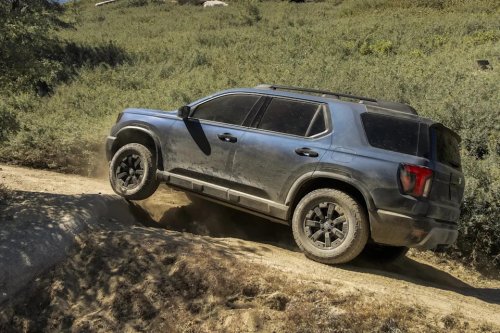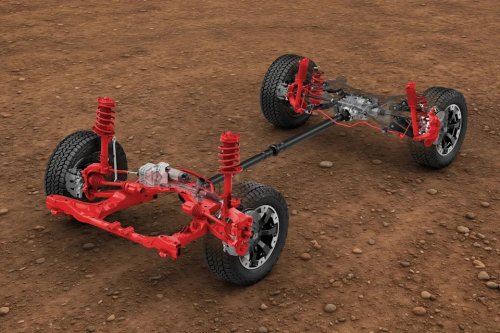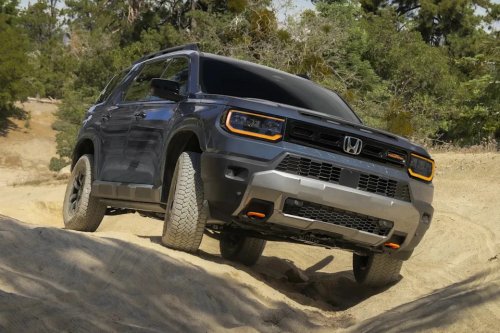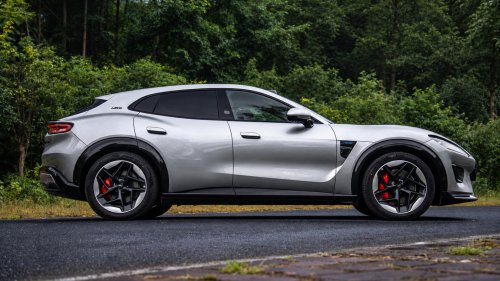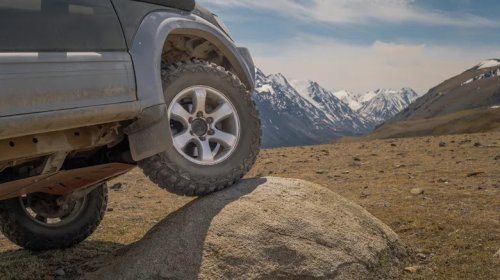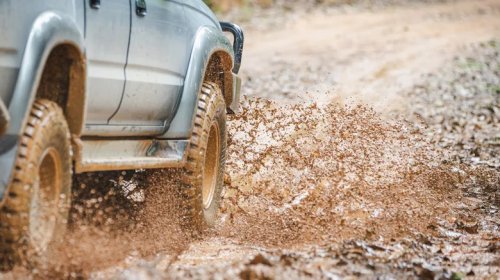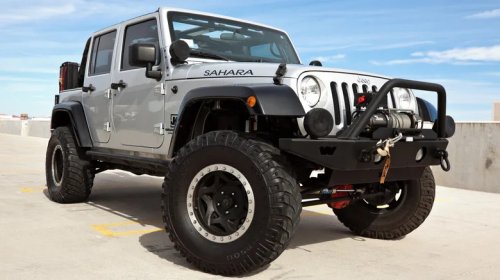

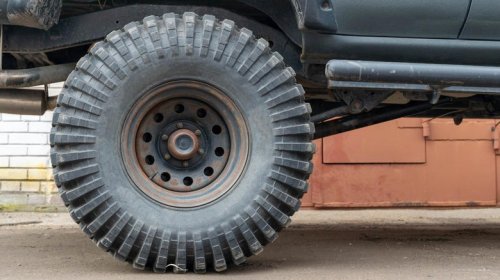
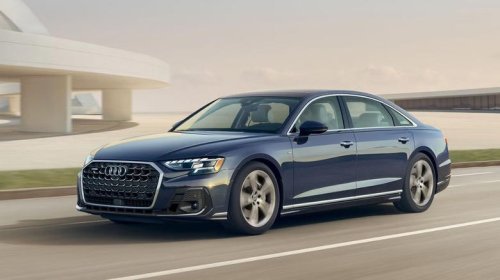





















An SUV with a raised suspension and big off-road tires parked on a city street - VPales/ShutterstockAre you thinking about lifting your SUV? Maybe you like to take it off-road, and you want to increase your ride height enough to clear more rocks and avoid bottoming out. Or maybe you want to pimp your ride by raising it enough to put some big gnarly wheels on it so you can look like a boss as you roll through town. We respect both motivations, just know that lifting your SUV's suspension could have a deleterious effect on its gas mileage.When it comes to fuel economy, raising an SUV's height can make it less aerodynamic, causing the engine to work harder. Then there's the extra weight of all the things you needed to add for your lift kit. That's going to cause your engine to use even more fuel. Lowering your car a couple of inches could have the opposite effect and slightly improve your gas mileage. In fact, some new cars today come with an active suspension that automatically adjusts the ride height depending on the speed. There are just some of the many ways that suspensions affect your SUV's fuel economy.Read more: Never Jump Start A Modern Car Without Checking For These Things FirstHow ride height affects aerodynamicsA Suzuki Samurai with lifted suspension and off-road tires - Karolis Kavolelis/ShutterstockYou probably know that if a vehicle isn't aerodynamic and if air doesn't flow around it easily, it's likely going to be less fuel efficient. There is something called the drag coefficient, which indicates how much drag, or air resistance, is produced by an object. The lower the drag coefficient of a vehicle, the better its fuel efficiency is likely to be. While some cars have a drag coefficient of less than 0.30, pickups are usually over 0.40, while SUVs typically land somewhere in the middle. Another metric is drag area, which is the drag coefficient multiplied by the vehicle's frontal area. These numbers generally go up when an SUV is lifted.AdvertisementAdvertisementWhy would lifting an SUV make it less aerodynamic? Think about all the things that are more exposed to the wind when a vehicle is lifted. More of the wheels, suspension components, and underbody meet the rushing air, causing more resistance, which makes the engine work harder to move the SUV, and thus use more gas.It's not just the lifted suspension; it's everything around itA big mud tire on a lifted vehicle - audiznam260921/ShutterstockThen there's the added weight that comes from additional suspension components, larger rims, and high-profile off-road tires that often accompany a lifted suspension. Of course, the more weight an engine has to push around, the harder it has to work, and the more gas it uses.Speaking of tires, one of the reasons drivers often get SUVs lifted is to go off-road. Wider tires with massive tread made for grabbing the trail or climbing out of mud ruts usually go along with that. However, your choice of tires also directly impacts fuel economy. When it comes to larger tires, the larger the unsprung mass of the tire, the harder the engine has to work to turn the wheels, and the more fuel it uses to do so. Off-road tires with large tread are great for traction, but aside from being heavier, they are also not great for gas mileage because they grab the road surface too well, increasing rolling resistance.How active suspension helps with fuel economyA dark blue Audi A8 sedan driving on the road. - AudiSome cars come with suspensions that will automatically raise or lower their height, depending on speed, or allow the driver to adjust the ride height manually. The Tesla Model X is an electric SUV that does both. Its adaptive air suspension has five settings: very high, high, medium, low, and very low. If the suspension is set to medium or higher, it will self-adjust to low once the vehicle reaches 55 mph. This increases the SUV's aerodynamics and makes it easier to handle at those speeds. A cool part of this feature is that it will remember your location, like an off-road trail, when you set the suspension to high or very high. When you return to that location, the SUV will adjust the suspension to your preferred setting automatically.AdvertisementAdvertisementAudi offers a similar feature as an optional alternative to its sport suspension. Its adaptive air suspension can adjust the vehicle's height, depending on the vehicle's speed and the driver's preferences. This system uses air springs that surround the shock absorbers on the front axle, but sit separately from the shocks on the rear axle. Audi's active suspension can even lift the car to protect you before a crash.Meanwhile, General Motors (GM) has been offering this kind of suspension on some of its SUVs since 2021. That would include Chevy SUVs like the Tahoe and Suburban, GMC SUVs like the Yukon, and Cadillac SUVs like the Escalade. Jeep has gotten into the game as well, offering its Quadra-Lift air suspension in the Grand Cherokee.Damping is different from height adjustmentA lexus drive mode selector wheel - LexusAdvertisementAdvertisementSome systems dynamically dampen the suspension. This isn't the same as height adjustment, though some suspension systems do both. Adaptive damping involves making the suspension stiffer or softer to match road conditions. Often, it's part of a driving mode. For example, the SPORT S+ mode in a Lexus causes the suspension to become firmer. This feature serves to reduce body roll and improve handling.The Tesla Model X is another SUV that features suspension that could be adjusted this way. It allows the driver to choose from three comfort levels when adjusting the suspension: comfort, standard, and sport. The system could be set to adjust itself, as long as self-driving was engaged. Audi's adaptive air suspension not only adjusts the vehicle's height, but also performs damping, providing for what it calls a range between a "smooth" ride of a long-distance and "sporty" handling for maximum performance. Does a built-in adaptive damping improve your car's gas mileage, though? No. In fact, it might do the opposite if it's a part of sportier driving modes that, by definition, don't prioritize fuel economy like Eco mode does.Should you just lower your SUV to improve your gas mileage?A lowered Pugeot SUV - Roberto Resston Fo/ShutterstockIf raising your SUV's suspension can decrease your gas mileage and lowering it can improve it at high speeds, why not just get an aftermarket lowering kit and lower your suspension long-term for better fuel economy? As with most things, it's not quite that simple.Lowering a vehicle does make it more aerodynamic, since less air is hitting the tires. That should help with fuel economy, in theory. However, there are so many possible cons to lowering your SUV as well. For example, there's the risk of your tires scraping. You'll also have lower clearance and a stiffer ride, and it may even void your warranty. And if you need coilovers to do the job, you're looking at a cost of over $1,000 in parts alone.AdvertisementAdvertisementThe upside is that if your SUV is bigger, you've probably got so much clearance to play with that you won't have to worry about bottoming out or problems with using a standard jack, which is an issue if you lower a car. And you don't need to lower a vehicle much to see a change in handling and fuel economy.Want more like this? Join the Jalopnik newsletter to get the latest auto news sent straight to your inbox, and add us as a preferred search source on Google.Read the original article on Jalopnik.