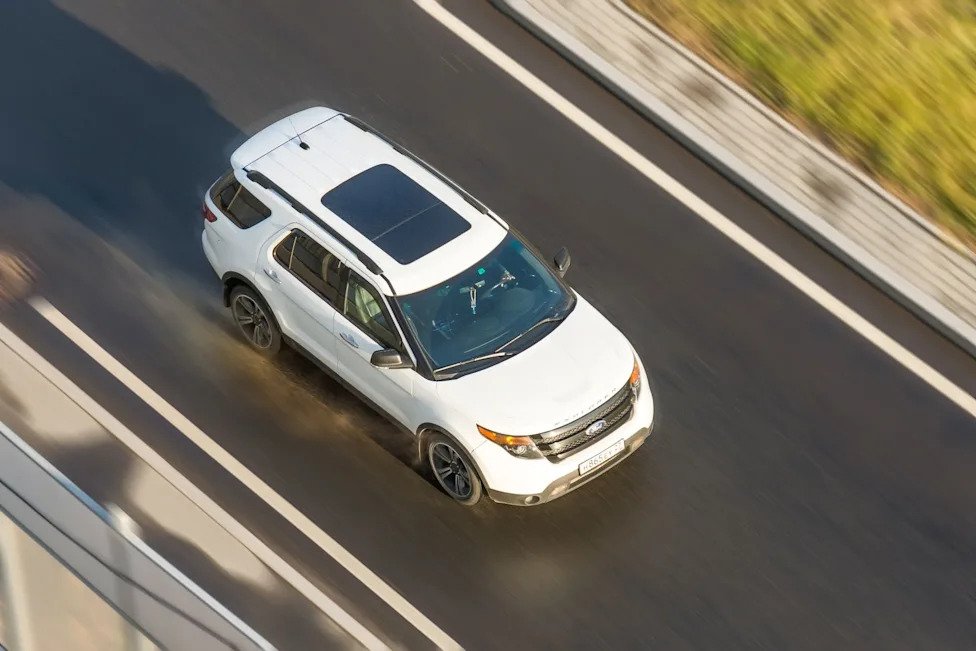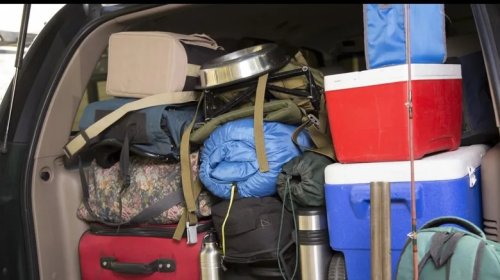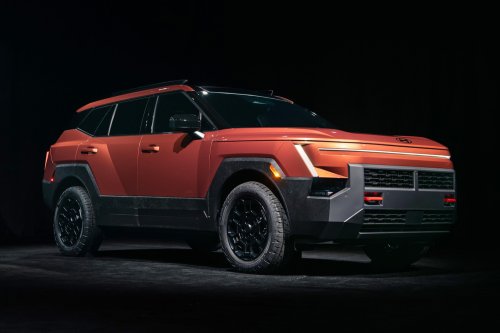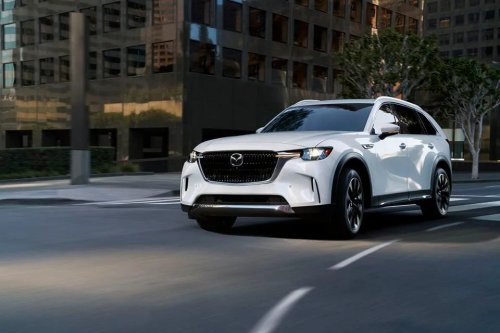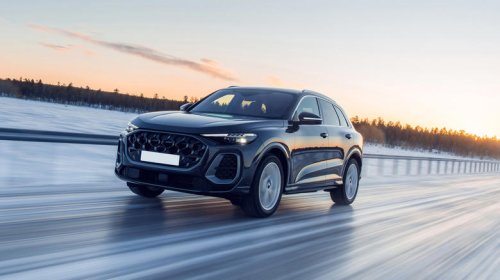
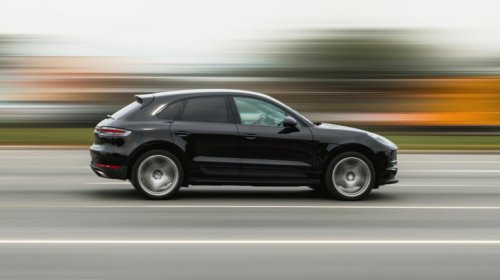

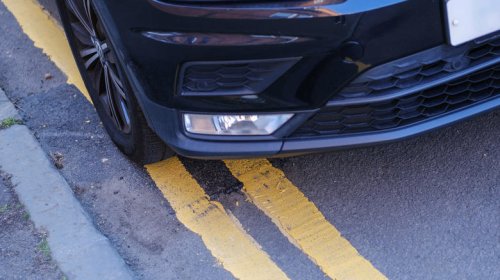
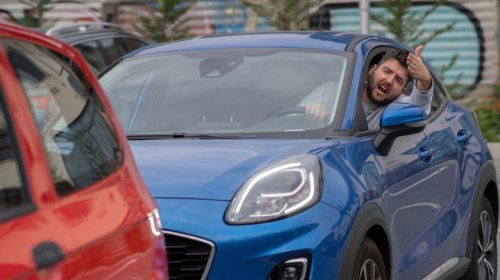



















An SUV speeding on an icy highway - Sanket27/ShutterstockOdds are, if you pull into any American suburb or shopping mall parking lot, you'd likely spot a lot of SUVs. They're exceptionally popular in the United States, with trucks and SUVs accounting for over 80% of new car sales as of 2021. As their dominance on American roads became demonstrably clear, virtually every walk of life is finding reasons to hop on the SUV train, from families needing extra cargo space to commuters wanting a more commanding view of traffic.While SUVs can instill a sense of safety with their features and space considerations, things can get risky if drivers don't avoid certain behaviors. As of 2021, the average mid-size SUV weighed roughly 5,000 lbs (via JD Power). That weight, along with their high ground clearance, makes them very dangerous to other road users. In fact, according to a study from the European Transport Safety Council, vehicle collisions involving SUVs increase the risk of serious injury for occupants of the other car by 20%, while that same risk reduces by 25% for the SUV. These statistics are alarming, and that's why The Observer and online commentators call for reform.With this in mind, if you own (or are planning to purchase) an SUV, you need to make a conscious effort to stop doing certain things in the best interests of yourself and other road users. We're covering five of the most dangerous habits.AdvertisementAdvertisementRead more: 5 Things You Need To Stop Doing If You Drive An Automatic CarHard AccelerationA car speeding down the highway with blurred trees in the background - Armands Photography/ShutterstockWe get it, powerful engines were made to be pushed to the limits. Mashing your accelerator pedal to feel that rush of juice can be exhilarating, especially in SUVs on the upper end of the horsepower scale. That's doubly true if you accelerate from dead stops. However, while you might get away with that indulgence in sedans and wagons, SUVs have some sustainability concerns beyond the obvious environmental impact.One can practically draw a straight line between the rise in SUV popularity and an increase in passenger car fuel demand. According to the International Energy Agency, SUVs already consume about 25% more energy than mid-sized cars due to their engines, weight, and increased wind resistance from their bulky shapes.Hard acceleration only worsens fuel economy, as most of the energy is expended as heat rather than actually moving the vehicle forward when you floor the accelerator. Research shows that hard acceleration can reduce mileage in stop-and-go traffic by up to 40% and 30% at highway speeds. Over the course of a year, that wastage adds up quickly and can balloon into hundreds of dollars. The mechanical toll on your car can't be overstated either; aggressive acceleration stresses the drivetrain, CV joints, and tires. It also shortens engine lifespan as the effects add up over time.Overloading your vehicleA pickup truck overloaded with items - Olga.Batrakova/ShutterstockWhen you get an SUV, particularly a powerful one, you can be tempted to volunteer to tow just about anything you can get your hands on. Moving houses? Why use U-Haul services when you can stash a truckload of items in your bed? Going to a lake for the summer? Hook the boat or camper to your trailer hitch, or maybe even strap a bike to your roof racks. After all, you did splash all that money on the extra cabin space and performance for a reason.AdvertisementAdvertisementHowever, you should be cautious about putting too much weight on your vehicle. Overloading increases your car's center of gravity, and since SUVs already sit high off the ground, making them top-heavy can increase the risk of a rollover.Furthermore, not all SUVs are built with heavy-duty frames. Every car has a limit to what it can carry, and going beyond that limit can have ugly consequences like brake failure or a loss of control — not to mention legal implications, too. Consult your owner's manual before making any commitments to know the exact maximum towing capacity — the last thing you want is to buy a trailer or boat and still have to outsource the towing because you didn't ensure your car could tow it in the first place.Overspeeding and careless drivingA car crossing illegally over a double yellow line - Mr Doomits/ShutterstockSUVs have more than a few extra inches of ground clearance. That elevation has its benefits; you can get a wider field of vision and see traffic (and obstacles) much earlier than drivers in a sedan. However, it also has its risks. First, your situational and spatial awareness can be compromised, especially if the SUV is your first. If other cars aren't staring you directly in the face, it's easy to forget they're there.There's also hubris to consider. Sitting above the flow of traffic, especially if your SUV is particularly high off the ground (take a 2025 Land Rover Defender with its 12.1-inch clearance, for example), you could subconsciously develop a sense of superiority that endangers everyone around you. If left unchecked, this effect can lead to overspeeding, tailgating, and a really common bad habit: forcing right of way. As a driver, chances are you've encountered a large SUV on the road just bullying its way into lane changes, forcing smaller vehicles to adjust.AdvertisementAdvertisementAs mentioned, collisions between smaller cars and SUVs can be devastating for the smaller vehicle. This was even more prevalent a few years ago, when the fenders and other energy-absorbing features of smaller cars were lower than SUV bumpers. While they're more aligned these days, SUVs are still a danger to passenger cars and pedestrians alike.TailgatingAn impatient driver yelling at the car in front of them - Noiel/ShutterstockTailgating is universally despised — it's one of the telltale signs of a bad driver. Worse, it can quickly transition from annoying to costly when an SUV is involved. Sometimes it might not be a deliberate thing; you could be running a little late for an errand, and the car in front of you isn't moving quickly enough for your liking.That's not enough of a justification, though, as while tailgating is dangerous for any car, it's especially dangerous for larger SUVs. According to Consumer Reports, mid-sized cars and SUVs are practically tied in stopping distance at 133 and 134 feet, respectively, but large SUVs can take up to 143 feet to come to a halt. Logically, that gulf in asphalt coverage is due to momentum — large SUVs are significantly heavier and thus need more time to stop completely.If you're tailgating a smaller sedan and the driver ahead of you suddenly slams their brakes, it would take a miracle to avoid a violent rear-end collision — and even if you manage the maneuver, there's a good chance of a rollover happening with all the swaying from side to side at high speeds. Your vehicle's 4WD system, no matter how advanced you think it is, does nothing to help braking. So the next time you feel the urge to tail someone's bumper to shave a few minutes off your commute, remember your SUV's limitations.Letting size lead to overconfidenceA driver using their mobile phone while driving with one hand - Perfectlab/Getty ImagesAs mentioned earlier, the sheer size and bulk of your SUV can insulate you from the outside world if you let it. As such, some drivers can subconsciously let their guard down. In a 2004 New Yorker piece, automotive engineer David Champion gave a first-hand account of how an SUV can provide an illusion of safety and compromise a driver's attention. AdvertisementAdvertisementChampion admitted to driving his Range Rover too fast on a snowy day when other cars were spinning out. For a moment, he felt smug with his four-wheel-drive configuration — not knowing it was robbing him of feedback. Then, when he needed to come to a halt at a stop sign, he discovered he didn't have any grip at all, and he slid across a four-lane road.Sure, SUVs have gotten even safer for their occupants since then, but there are still risks. For instance, if you're relaxed while driving, it's not out of the ordinary to hold the steering with one hand. However, research has shown that SUV drivers are substantially more likely to be relaxed than those in sedans, hatchbacks, and other smaller vehicles. Given the longer braking distance and higher center of gravity, an SUV driver should actually be more alert, so don't let overconfidence creep into your driving.Want the latest in tech and auto trends? Subscribe to our free newsletter for the latest headlines, expert guides, and how-to tips, one email at a time. You can also add us as a preferred search source on Google.Read the original article on SlashGear.