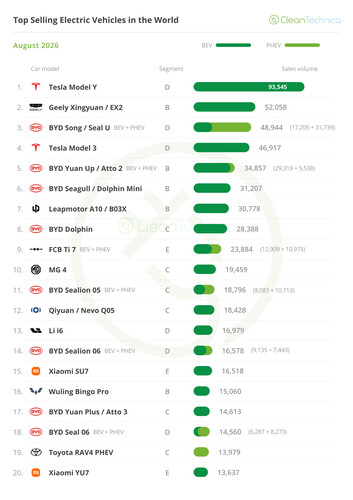
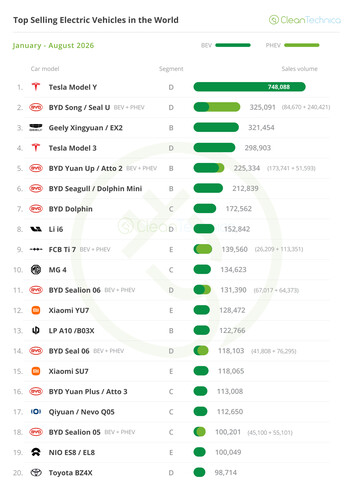
Aiden Hall · 6 months ago@aidenhall77Global EV Sales Growth to Hit Six-Year Low at 13% in 2026 Liked by+61 othersBYDTeslateslaPost commentRelated PostsEurope EV Sales Report: Record Month — BEVs Reach 30% Market Share!Daniel Green · 21 days agoAll the Great Car Names Have Been TakenAva Labelle · 13 days agoThis Chinese Car Brand Was Co-Created By Mercedes-Benz (And Is Now Competing With Them Directly)Owen Fortin · 21 days agoBack in the real world: electric equipment is saving job sites BIG MONEYMia Walker · 13 days agoUK EV sales surge 36% to record 99,199 as Tesla Model 3 leadsOwen Tremblay · 22 days agoAs electric semi truck race heats up, SoCal is getting another charging hubAudrey Wilson · 13 days agoFord's $30,000 EV pickup production launch faces uncertainty 35 · Owen Green · 23 days agoTesla owner drove 1,857 miles in 31 days, says charging cost $136 and saved $235 on gasClaire Fortin · 13 days agoChina's 2,250kW chargers are already in service, while US thinks about 750kW next year 13 · William Scott · 24 days ago6 New Cars With Payments That Cost Less Than $500 Per MonthOliver Lewis · 13 days agoMy Trip To Brazil To See The Rapid Rise Of Chinese Cars, Part 1 47 · Matthew Campbell · 24 days agoIn the US, new Tesla Model 3 and Model Y orders can now back up a home during outagesLiam Girard · 13 days agoNew BMW i3 gets a huge £10k price cut with arrival of 40 xDrive model 75 · Oliver Rogers · 24 days agoKia Bets the $30,000 EV3 Becomes Its Top U.S. SellerJenna Carter · 13 days agoNew BMW i3 gets a huge £10k price cut as entry-level 40 xDrive model arrives 27 · Noah Turner · 24 days agoThe GAC Aion V Looks Odd But Is Incredible Value | ReviewAudrey Nelson · 13 days agoMazda 6e — Japanese Carmakers Fight Back in Australia 80 · Morgan White · 28 days agoHonda Is Burying 150-kW Wireless Chargers Under Japanese Highways, and Big Rigs Are the TargetKaitlyn Moreau · 14 days agoBYD sets launch date for flagship Han EV with 1,000+ km range 22 · Jenna Brown · 29 days agoJaguar reveals a $130,000 all-electric vehicle. Why?Jenna Anderson · 14 days ago




 +61 others