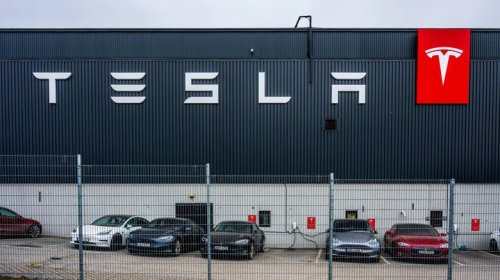
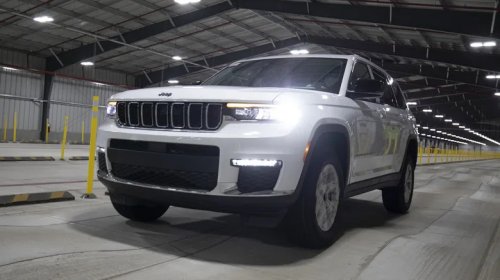
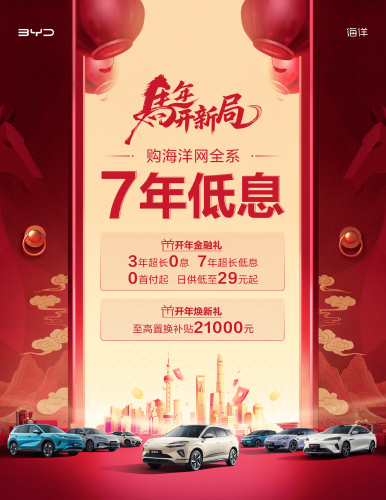
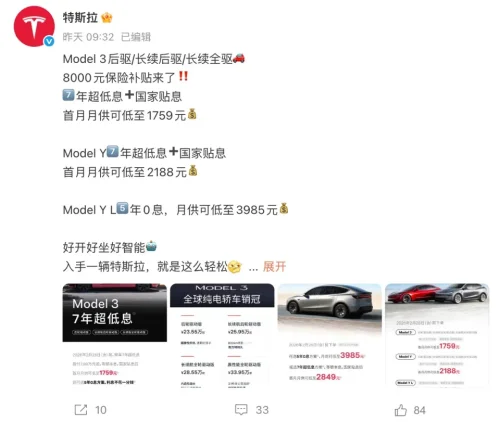
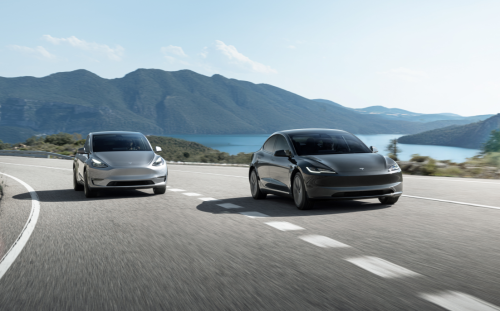
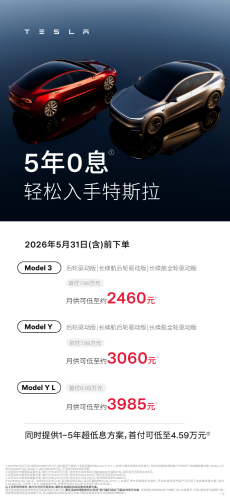
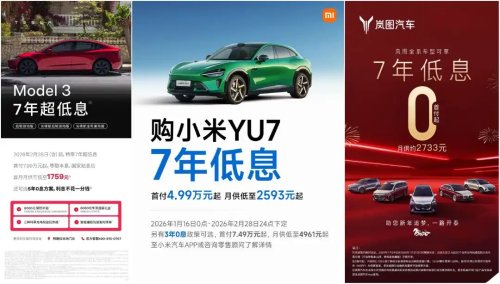
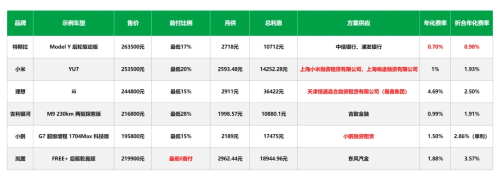
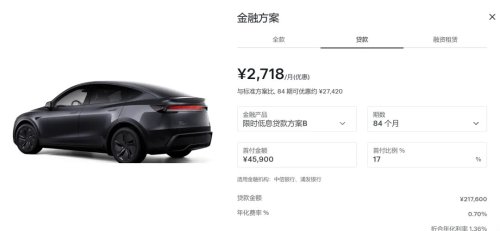
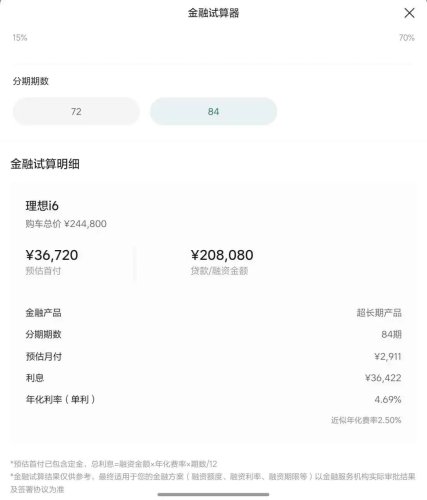
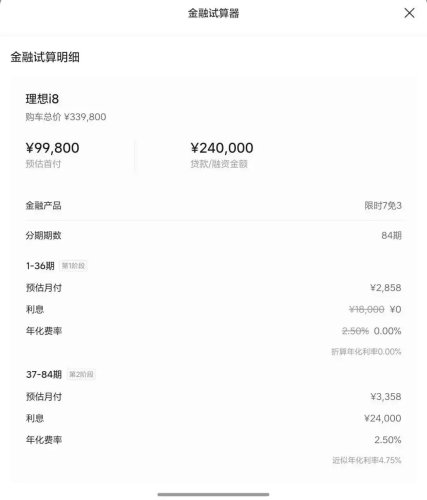
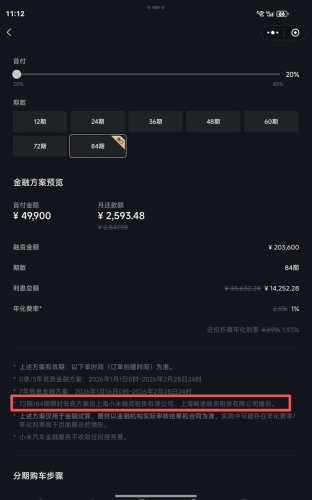
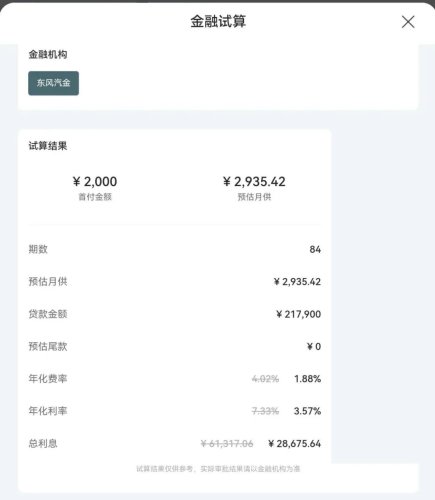
Tesla and other automakers in China have introduced seven-year low-interest financing plans to stimulate demand amidst declining sales, lowering monthly payments and down payments. On January 6, 2026, Tesla kicked off its “seven-year low-interest” auto financing campaign in China. With loan tenors extended to 84 months, minimum down payments for the Model 3, Model Y and Model Y L fell to RMB 79,900 ($11,186), while monthly payments dropped to as low as RMB 1,759 ($246) after applying equal principal-and-interest repayment and government subsidies. Ten days later, Xiaomi founder and CEO Lei Jun announced during a Xiaomi Auto livestream that the company would follow suit with its own seven-year low-interest plan. It allows consumers to purchase the Xiaomi YU7 with a minimum down payment of RMB 49,900 ($6,986) and monthly payments starting at RMB 2,593 ($363). As of now, Xpeng, Li Auto, Geely Galaxy and Voyah have also rolled out seven-year low-interest financing programs. Several automakers rolled out seven-year low-interest financing programs Among them, Voyah offers zero down payment options and applies the policy to its full lineup except the Dreamer Mountains and Heritage editions, further lowering the barrier to vehicle ownership. Apart from Xiaomi, most brands offering seven-year low-interest loans have applied the policy across a broad range of models. Li Auto has gone a step further by introducing a “seven years, three interest-free” option for the MEGA and i8, allowing three years of zero interest within a seven-year installment plan. By launching ultra-long-term low-interest financing, automakers aim to stimulate demand by reducing monthly repayment pressure and upfront costs, thereby unlocking a broader customer base. The rapid rollout of seven-year financing plans reflects broader market conditions. With purchase tax incentives halved and demand in late 2025 having been heavily front-loaded, signs of fatigue began to emerge in China’s auto market at the start of 2026. According to data from the China Passenger Car Association, retail sales of new energy passenger vehicles totaled 312,000 units nationwide between January 1 and January 18, down 16% YoY and 52% MoM. Reviving market momentum has become an urgent task for automakers. Yet behind the seven-year low-interest offers, some less visible issues remain. What advantages do seven-year low-interest plans offer compared with conventional auto financing, and what should consumers watch out for before committing to such long-term loans? A closer look follows. Price cuts beyond the price war Before diving into details, the key terms of current seven-year low-interest programs offered by major automakers are summarized below in chart form. Six automakers’ seven-year low-interest programs Voyah offers the lowest down payment ratio, allowing zero down payment, with a nominal annual rate of 1.88% and an effective annualized rate of 3.57%. Using the Voyah FREE+ rear-wheel-drive Qiankun edition as an example, monthly payments amount to RMB 2,962.44 ($415), with total interest of RMB 18,944.96 ($2,652). As noted earlier, ultra-long-term low-interest financing effectively functions as a form of “implicit price cut.” Take the Tesla Model Y rear-wheel-drive version, priced at RMB 263,500 ($36,890). Under the seven-year low-interest plan, the minimum down payment ratio is 17%, or RMB 45,900 ($6,426), with total interest of about RMB 10,712 ($1,500). According to Tesla China’s official website, the seven-year low-interest option offers savings of roughly RMB 27,420 ($3,839) compared with its standard financing plan. Tesla’s financial program Likewise, purchasing the Xiaomi YU7 under the seven-year low-interest plan results in total interest of approximately RMB 14,252 ($1,995). This is nearly half the cost of a popular 60-month conventional loan with a 2.5% annual rate, 15% down payment and total interest of about RMB 26,934 ($3,771). Li Auto’s plans carry the highest total interest among the brands surveyed. For example, the Li Auto i6 features a nominal annual rate of 4.69%, an effective annualized rate of 2.5%, and total interest of RMB 36,422 ($5,099). Li i6’s financial program For models such as the MEGA and i8, Li Auto’s “seven years, three interest-free” plan appears more attractive. Under this scheme, buyers make a down payment of RMB 99,800 ($13,972), pay zero interest for the first three years, and face a 2.5% annual rate for the remaining four years. Total interest amounts to RMB 24,000 ($3,360), still higher than a five-year zero-interest plan but nearly half that of conventional financing. Li i8’s financial program Overall, seven-year low-interest plans generally reduce total interest costs while spreading repayments over a longer period, lowering monthly payments and creating an “effective price reduction” for budget-conscious consumers. As the Lunar New Year approaches, Voyah may not be the last new energy brand to introduce seven-year financing. To offset the impact of reduced purchase tax incentives, more automakers could follow. However, online reactions to these programs have been mixed. Some users warn against overextending consumption, while others argue that the terms lack transparency and may introduce hidden risks despite headline savings. Online reactions to these programs Those risks may stem from the fact that seven-year low-interest plans involve more than simply extending loan terms to 84 months. Hidden traps or genuine discounts? In most cases, automaker financing plans are structured as credit or secured loans in partnership with banks. Unlike conventional programs, however, some seven-year low-interest plans are not provided by commercial banks. Among the six new energy brands currently offering such plans, only Tesla sources its financing through banks, namely China CITIC Bank and Shanghai Pudong Development Bank. Xiaomi EV’s financial institution Most other seven-year plans are offered through in-house finance arms or affiliated leasing companies. Xiaomi, Xpeng and Li Auto disclose their financing providers in their official app-based calculators or fine print. Xiaomi’s seven-year plan is backed by Shanghai Xiaomi Leasing and Shanghai Changtu Leasing; Xpeng’s by Xpeng Leasing; and Li Auto’s by Tianjin Hengtong Jiahe Leasing, a subsidiary of Yixin Group. Voyah’s financing partner is Dongfeng Motor Finance Co., wholly owned by Dongfeng Motor Group. While its business includes auto loans and leasing, Voyah’s official calculator lists only “Dongfeng Auto Finance,” with details finalized at purchase. Voyah’s financial institution According to analysis by Chaping X.PIN, purchasing a vehicle under a seven-year low-interest plan is effectively equivalent to ultra-long-term leasing, with ownership retained by the automaker and the buyer holding usage rights. Once repayments are completed, buyers must pay additional fees to lift the lien and transfer ownership. During the lease period, any changes requiring vehicle registration, such as color modifications, also incur extra costs. While seven-year low-interest plans lower entry barriers and monthly payment pressure, risks may arise if borrowers encounter repayment difficulties or if leasing companies face financial trouble, potentially complicating ownership rights. Based on CPCA data, China’s auto market started 2026 on a subdued note. Model Y Falling sales suggest limited incremental demand in January, with some deliveries likely carried over from previous months. How automakers can “get off to a strong start” in 2026 and advance toward annual sales targets remains a central challenge. Despite transparency concerns, seven-year low-interest financing offers one way to ease purchase pressure, allowing lower-budget buyers to stretch toward higher-positioned models. Regardless of policy design, cars remain major purchases. Consumers are advised to clarify all terms with sales representatives, carefully review contracts and ensure full understanding before signing. With increased scrutiny and regulatory refinement, issues surrounding transparency and ownership under seven-year financing may gradually be addressed. What do you think of seven-year low-interest auto loans? Would such offers influence your decision to buy a car before the Lunar New Year? Share your views.




















 +55 others