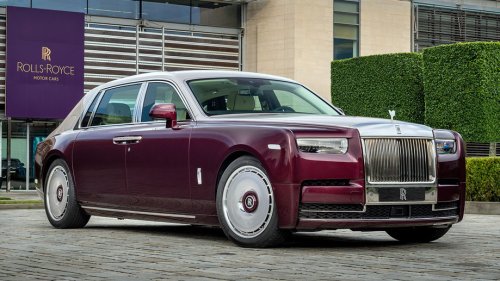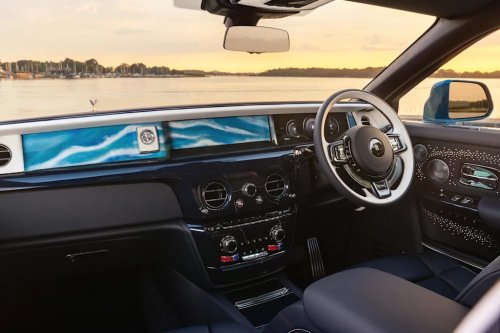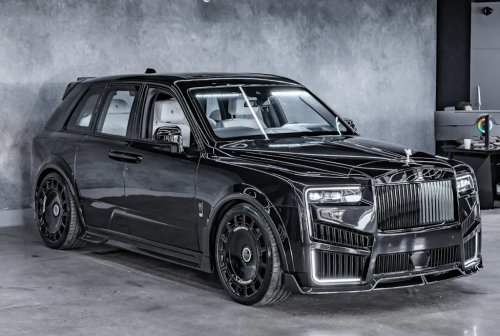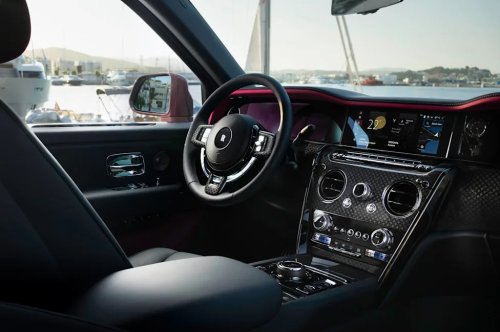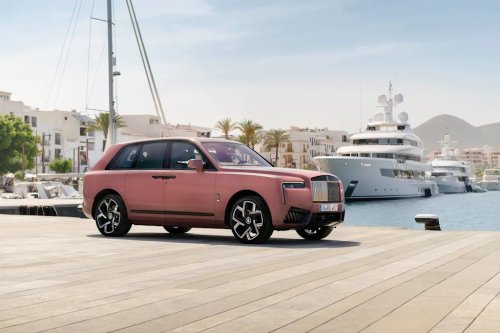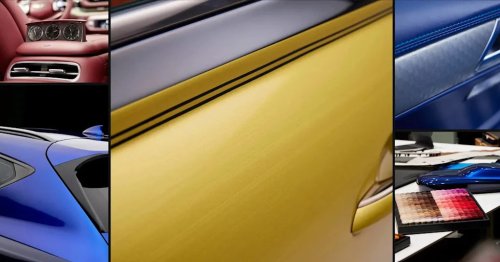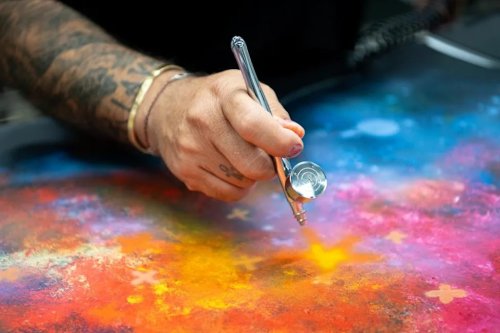
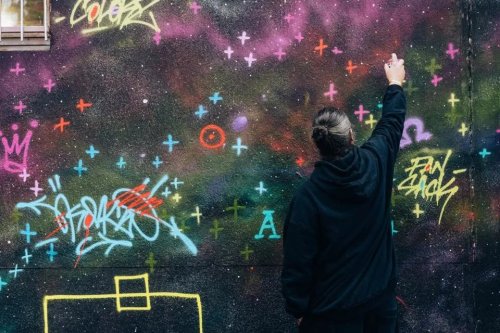
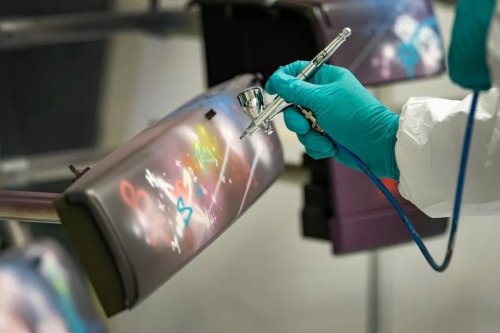
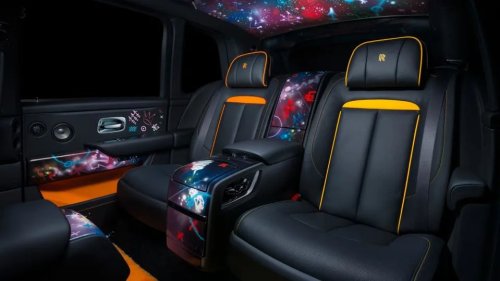














Cyril Kongo hand-painting the Starlight Headliner at Rolls-RoycePhoto courtesy of Rolls-Royce Motor CarsStanding beside Cyril Kongo inside Unlocked Shoreditch in East London this May, it is impossible not to be swept up by the artist’s excitement. He’s orbiting a single, spectacular Rolls-Royce Black Badge Cullinan, whose bodywork glitters in a deep blue crystal over black finish, the surface catching light like a nocturnal sky scattered with stars and reflecting his celestial masterpiece painting studded with mathematical formulas, symbols, pyramids, atoms and imagined planets. Across the exterior, the Gradient Coachline becomes a defining gesture: on the left side, phoenix red dissolves into forge yellow; on the right, mandarin softens into turchese—each side carrying Kongo’s unmistakable tag woven in.Kongo speaks with the satisfaction of someone who knows he has reached a defining moment in a four-decade career spent pushing graffiti beyond the street and into the worlds of contemporary art, fashion, design and collectible luxury. Created as one of several projects marking the 10th anniversary of the Black Badge family—first introduced with the Rolls-Royce Black Badge Ghost in 2016—Black Badge Cullinan by Cyril Kongo transforms Rolls-Royce’s most rebellious model into a fully immersive contemporary artwork. Produced in a series of five vehicles, they carry Kongo’s hand-painted interventions across the fascia, center console, rear waterfall, doors, picnic tables and the marque’s iconic Starlight Headliner, bringing Kongo’s colorful “Kongoverse” universe into motion.What makes the project especially remarkable is the unprecedented level of artistic involvement behind it. Introduced to Rolls-Royce through S&S Group, the Vietnamese conglomerate of companies operating in the luxury, real estate, automotive, arts and fashion industries, Kongo became the first artist ever embedded within the brand’s Goodwood factory. Over the course of two months, he worked inside dedicated studio spaces created within its bespoke facilities, collaborating daily with engineers, designers and master craftspeople, while painting every element by hand. The result is a series of historic Rolls-Royce firsts: the first Gradient Coachline, transitioning between vivid shades across each side of the car; the first Starlight Headliner featuring eight different star colors and a shooting star spanning the entire length of the ceiling; the first interior divided into four distinct chromatic zones; and even four differently colored brake calipers.AdvertisementAdvertisementYet perhaps most strikingly, Kongo never met or spoke with the collectors themselves. Already sold pre-launch through Rolls-Royce Private Offices to clients in the United States, Vietnam, the United Kingdom, Cyprus and Belgium, the cars have been acquired not as traditional bespoke commissions tailored to client tastes, but as fully authored works that asked buyers to step entirely into Kongo’s own artistic universe set within the uppermost tier of luxury craftsmanship. I sit down with the artist to learn more about his new collaboration.Cyril Kongo paints the Kongoverse on the walls of his studio in the suburbs of ParisPhoto courtesy of the artistYou’ve often said you want your work to move beyond the “graffiti” label. Did this collaboration with Rolls-Royce feel like a culmination of that journey?I think even graffiti deserves to be connected to contemporary art and not just reduced to street art or urban art. I find that it limits our potential for expression. People love putting us into categories, and I made the choice to move beyond that, even if, in my DNA, it’s still within me. I’ve always tried to take graffiti out of its urban framework, but with this collaboration, I think we’ve reached the result I’ve been working toward for the last 15 years. That’s what’s crazy. It’s not easy to escape that box. For me, this project isn’t about graffiti anymore—it’s about vision and contemporary art. Today, I know I can tell any story with any universe, while still keeping my identity. I’m never going to do something disconnected from who I am, but now I feel completely in control of my art. I started at 16 years old, and today I’m 57. After 40 years of work, I feel like I’m at the peak of my career.Did working on a Rolls-Royce redefine your idea of the canvas?AdvertisementAdvertisementIt didn’t redefine my notion of the canvas—it simply introduced a new medium. It pushed me to create a new series of paintings. With Chanel, for example, I created paintings and Karl Lagerfeld interpreted them onto bags and dresses. With Rolls-Royce, it was similar, except this time I had much more influence over how my work would be interpreted and sublimated inside the car. I call these cars “my babies” because they came from a real conversation with the Rolls-Royce craftsmen. I hand-painted, then decided where the stars would go in the Starlight Headliner. I added gold and silver sparkles, I played with depth, while their experts guided me: “Be careful, this paint color will stop this other color from breathing.” It became a true discussion between two experts. What Rolls-Royce brought was this vision of excellence. There’s no compromise. Once they say yes to a project, they go all the way. I’m tiny compared to Rolls-Royce—at any moment they could have decided to stop. But that never happened. They completely embraced my universe, the “Kongoverse”.Kongo dressed in a paint suit for dust control as he paints one of the Rolls-Royce Black Badge Cullinan's wooden componentsPhoto courtesy of Rolls-Royce Motor CarsWhy was the Black Badge Cullinan the right Rolls-Royce for your universe?The Black Badge Cullinan was obvious. It was the easiest model to interpret through my universe and my past as a graffiti artist. It matched my energy. A Phantom or a Ghost are more established, more presidential. The Phantom is the pinnacle—the car of heads of state and CEOs. But the Black Badge Cullinan is the rock star of the family. It resonated with me immediately. We didn’t need long discussions about it. It was self-evident. What I loved is that I could push Rolls-Royce outside its comfort zone, and that’s saying something. It’s great to be able to push institutions like that, people who are so professional, towards something a little more relaxed, and I think that’s what they liked. The Gradient Coachline was my idea—the first time they had ever done a coachline with color transitions. I wanted the blur of my tag on the coachline to remain imperfect and instinctive, so I spray-painted it by hand. I find that the coachline expresses our collaboration very well graphically because it’s the perfect line with my tag, which is my signature, and you feel that it’s handmade, it’s done instinctively, it’s not vectorized, it hasn’t gone through a machine, there’s no filter between the surface and me. Graphically, that coachline represents the collaboration perfectly: the precision of Rolls-Royce meeting the spontaneity of my gesture.The project feels incredibly immersive. What experience do you want passengers to have inside the car?AdvertisementAdvertisementI want passengers to feel immersed inside the Kongoverse—inside my painting. That’s why I don’t even call it a car. For me, it’s an art installation. It’s a mix between video installation, physical installation and performance art. You have the sensation of movement, speed, the road passing by, the shooting stars, the reflections of the paintings around you. Everything comes alive. When I worked on the Starlight Headliner, I constantly changed seats to imagine the experience from every angle. I would think: “A shooting star should appear from behind you, move diagonally across the ceiling, then disappear.” I pushed Rolls-Royce to create a shooting star that crosses the entire roof—something it had never done before. The engineering behind it was incredibly complex because the Headliner is made from three leather panels with hidden structures behind them. They guided me constantly: “Don’t place too much detail here; it won’t be visible. This line must align perfectly with the stitching.” That’s what was beautiful. They stayed completely faithful to my vision while bringing their technical mastery to it.Passengers are immersed in the Kongoverse inside the Black Badge Cullinan by Cyril KongoPhoto courtesy of Rolls-Royce Motor CarsYou spent two months last summer embedded at Goodwood with the Rolls-Royce teams. What stayed with you most from that experience?They received me like a king. Honestly, they gave me so much respect, so many possibilities to express what I wanted. Every morning I arrived with an all-access pass—even into the EX Vault, where employees themselves normally can’t enter because it’s where they work on future projects. I took over a quarter of that space with my tables. I was completely immersed in their world. Some people even postponed their holidays to stay and work with me on the project. If I had one word to describe this collaboration, it would be love: love for work well done, love for craftsmanship, love for the project, love for pushing our respective worlds further together.You emphasize that your collaborations are never purely decorative. What values do you share with Rolls-Royce, and what do you appreciate about your collaborations within the luxury sector, whether with Hermès, Chanel, Airbus Corporate Jets, Richard Mille, Daum or La Cornue?AdvertisementAdvertisementWhat deeply moves me in these collaborations is, above all, the human connection with women and men who have dedicated their lives to a specific craft. I recognize myself in this obsession with gesture, detail and the constant pursuit of excellence. Whether at Rolls-Royce, Hermès, Richard Mille, Daum or La Cornue, I find artisans, engineers and workshop masters who devote their lives to perfecting one single thing. This is exactly my relationship with painting. After decades of painting every day, I understand what it means to seek the right balance, the right energy, the precise gesture. Beyond disciplines, we ultimately speak the same language: that of passion, patience and exacting standards.This article was originally published on Forbes.com