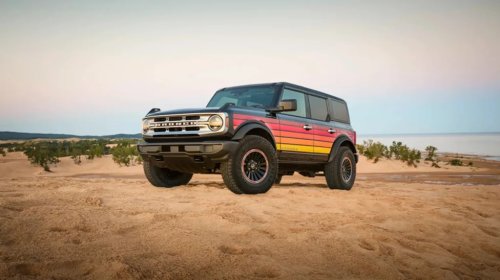
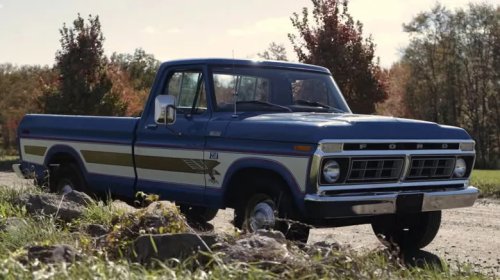
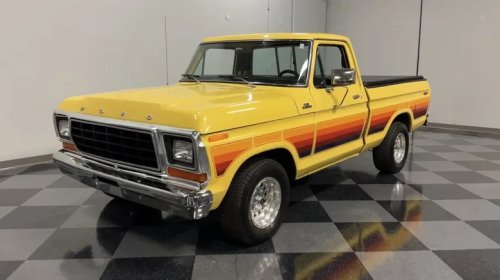
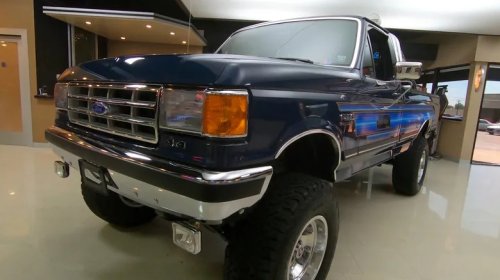
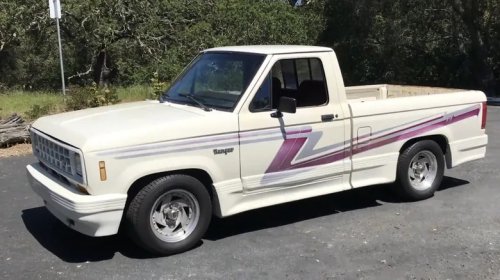
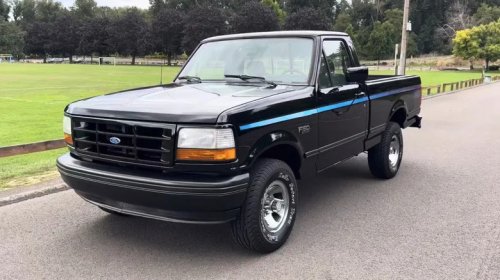
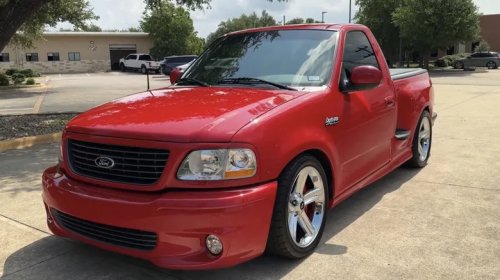
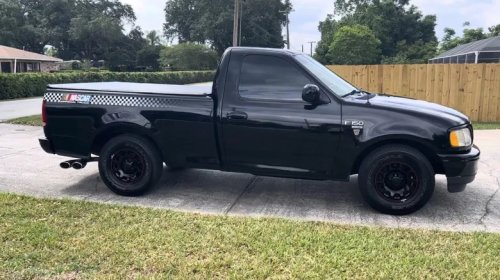
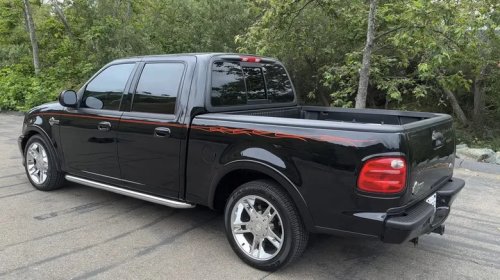
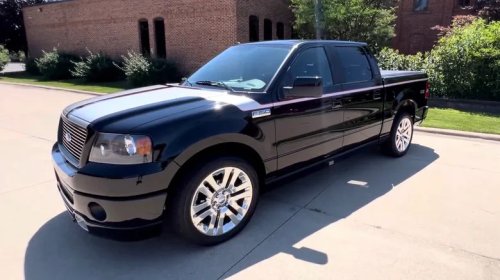
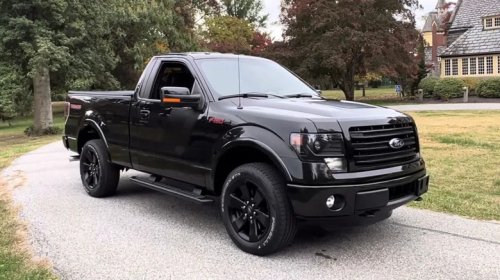
Ford's Coolest Special Edition Trucks Throughout The YearsJalopnikJosh WestSat, September 12, 2026 at 8:45 PM UTCAdd us on GoogleFordWhile some automotive special editions are great, others feel like cynical attempts to capitalize on a brand partnership, usually with superficial styling elements that don't have much to say about the substance of the vehicle. Ford has put out plenty of examples in both categories, but today we're going to talk about the good ones, specifically the good truck ones.So we won't throw shade at the Dallas Cowboys edition (spoiler alert: it's mostly paint and badges) or spend much time on the rolling stereotype that is the Cabela's edition Crew Cab (yes, there's a locking gun compartment, and a poorly implemented one at that). Instead, we're going to talk about some of Ford's very best.We're sticking to special-edition trucks Ford either sold itself or directly sanctioned. That rules out some objectively fun trucks like the Saleen S331, which was developed and modified by Saleen, and the Shelby F-150, which is a Shelby American creation built from Ford's starting point. We're also leaving out short-lived trims and model variants that are perhaps spectacular, but also not quite what we're talking about here. The Raptor R, for example, sits within Ford's Raptor lineup, rather than existing as a proper special edition program. That still leaves Ford with plenty to choose from, ranging from patriotic 1970s graphics packages to supercharged street trucks and one epically problematic Bigfoot tie-in. Off we go.AdvertisementAdvertisementRead more: Ford Once Made A Mile-Long Factory To Build Bombers Faster Than Anyone Thought PossibleFord F-Series Bicentennial Option Group (1976)1600Veloce/YouTubeComing through the semiquincentennial amid a climate of political nonsense, it feels nice to imagine some American anniversary special editions that felt nonpartisan and apolitical. 1976 was a simpler time, when few would have disagreed that adding a screaming-eagle decal to an as-American-as-apple-pie pickup was an entirely appropriate way to mark the occasion. The Bicentennial Option Group for F-Series pickups joined the wave of red-white-and-blue pomp and circumstance that marked the country's bicentennial.Awesome eagles notwithstanding, Ford showed a little restraint on this one, at least by 1970s standards. The package was available on F-100 through F-350 Custom Styleside pickups in regular-cab and SuperCab configurations, with a few exceptions. The defining exterior feature was a blazing gold stripe that ended in a flying-eagle graphic with red and blue touches. If that sounds subtle, remember this was an era when putting an eagle on something was considered a perfectly normal way to improve it.The theme carried inside, where Ford fitted patriotic plaid cloth seats and another eagle on the glovebox, because obviously. That combination of historically relevant timing, unmistakable graphics, and genuine factory packaging is exactly what makes an ostensibly cosmetic special edition work. Sorry, Dallas Cowboys. "America's Team" might have gotten a special edition, too, but this was America's truck.Ford Free Wheeling F-Series (1977 to 1981)Streetside Classics/YouTubeThere are tasteful appearance packages, and then there's Free Wheeling. The Free Wheeling treatment was, to be fair, primarily a cosmetic upgrade and, to be more fair, was objectively awesome. This was not a shy little pinstripe running along the beltline. Depending on the truck and year, the graphics could range from a tasteful giant rainbow stripe to even more eye-catching designs that climb dramatically up the sides of the body, making the whole thing look like it was designed by a talented but pointedly unsubtle teenager and then dubbed a factory finish.AdvertisementAdvertisementThe stripe package got some help from the rest of the truck. Free Wheeling models also wore blacked-out mirrors and other bits, which gave all that color an appropriately dramatic backdrop. On later F-100 and F-150 versions, buyers could step up to packages that added things like fog lamps, a handling package, rad steel wheels, and extra-sporty instrumentation.None of that changes the basic appeal. Free Wheeling was Ford deciding that a pickup could be sold on personality alone and then committing fully to the bit. It didn't need extra horsepower or some grand motorsports connection to justify itself and, with little more than some unabashed striping, became one of the most iconic factory-offered graphics packages of all time.Ford Bigfoot Cruiser (1987)Vanguard Motor Sales/You TubeThe '80s were a time when monster truck hype was at a fever pitch, even if at that point the general perception around monster truck events was that they were destructive, muddy, and loud. (We're sorry if you were hoping for a truck based on a cryptid in the Pacific Northwest.) Monster truck icon Bigfoot was based on a Ford, so naturally the company was in a great position to capitalize on Bigfootmania. And that's what they did.The resulting Bigfoot Cruiser package was offered on the Ranger, F-150, and F-250. Ford teamed up with Scherer Truck Equipment for the modifications, adding the hardware that turned ordinary pickups into showroom-ready Bigfoot tributes. In addition to the graphics, the modifications included larger wheels and tires plus some other items, such as upgraded shocks, roll bars, and a winch, depending on the truck. It was a cool-looking thing.AdvertisementAdvertisementIt was also a little disastrous. The suspension lift wasn't sufficient to clear the bigger tires, and improper lug nuts made the wheels susceptible to literally falling off while driving. The winches and aftermarket bumpers were also bad and needed to be uninstalled, with all of the above falling under a comprehensive recall that essentially declared nearly every piece of the Bigfoot package to be defective or dangerous in one way or another. The paint and decals were fine, probably. Either way, the result is that intact examples are pretty hard to come by.Ford Ranger GT (1986 to 1989)TFL Classics/YouTubeThe Ford Ranger Raptor is exactly what you want it to be, and the Ranger GT was as close as you were going to get in the late '80s. Ford launched the first Ranger GTs in Southern California in June 1986, before expanding availability more broadly for 1987. The idea was simple enough: take a rear-wheel-drive Ranger and give it the hardware to make the whole thing feel more serious than the average compact truck.Under the hood was a 2.9-liter V6 making 140 horsepower and 170 lb-ft of torque paired with a five-speed manual. Ford also gave the GT an aggressively sporty suspension suited for spirited road use and some grippy Goodyears to match.Later trucks became more visually obvious. By 1989, the Ranger GT was easy to spot with a full body kit and body-painted bumpers. It was still not especially quick by modern standards, but that misses the point. Ford had taken one of its smallest trucks and built an honest factory sport package around it years before fast trucks became a much bigger part of the performance landscape.Ford F-150 Nite (1991 to 1992)Affordable Classics Inc/YouTubeFord didn't need much hardware to make the Nite memorable. The formula was mostly attitude. The color was called Raven Black, naturally, and the package included some Nite-themed interior accessories, plus some very early-'90s exterior stickers. There were even some performance-related touches, including wheels and tires, plus an upgraded suspension. The name itself contributed to the whole aura. "Nite" sounds less like something dreamed up in a product-planning meeting and more like the name of a doomed nightclub.AdvertisementAdvertisementLike so many '90s cars that probably aren't as great as you remember, the Nite is probably best remembered through nostalgia-colored glasses. Regardless, it appeared in 1991, available only on the standard-cab F-150, expanded to other body styles (plus the Bronco) in 1992, and then vanished into the neon-tinted night. That short life is probably part of why the Nite is so fondly remembered today.Ford didn't keep the name around long enough for it to become another permanent trim level, nor did the special edition overstay its welcome like a "Saved by the Bell" spinoff — rooted in radness and likewise heavy on the neon, but without much left to say culturally. A year later, the SVT Lightning would arrive and pursue the sporty-F-150 idea with way more horsepower. The Nite had already proved you could get plenty of attention with considerably less. But no, seriously, let's talk about the Lightning immediately.Ford F-150 SVT Lightning (1993 to 1995; 1999 to 2004)What's Up With Your Car Guy? Adam J Singer/YouTubeBefore the Ford F-150 SVT Lightning and the Ram SRT-10 were duking it out for ownership of the pre-Raptor fast-truck segment, and way before the shockingly good electric F-150 Lightning was even technologically conceivable, the OG Lightning was helping pave the way for serious performance trucks on, well... pavement.The Lightning was where Ford stopped merely making the F-150 look sporty and decided to make it properly quick. The first-generation truck arrived in 1993 with a 5.8-liter V8 making 240 horsepower and 340 lb-ft of torque, just living in the moment without a cell phone or turbocharger in sight. It bested the Chevy 454SS, at least as far as Car and Driver was concerned, and made a strong case that a cool Ford truck could go deeper than decals and marginal parts upgrades.AdvertisementAdvertisementThen Ford took a few years off and came back with something substantially less reasonable. The second-generation Lightning used a supercharged 5.4-liter V8 that eventually reached 380 horsepower and could clock a 5.2-second 0-to-60 time. Keep in mind that this is right on par with the Porsche Boxster S of the day and just a few tenths off Ford's own Mustang SVT Cobra from the same year, though we'd contend that Brian O'Conner never would have curbed the Cobra outside of The Racer's Edge.Ford F-150 NASCAR Edition (1998)zach singer/YouTubeBy 1998, NASCAR was big enough that Ford apparently decided being the series' official truck wasn't sufficient. It needed a commemorative F-150 people could actually buy, leaning hard into a cultural thread that winds through racing, moonshiners, and general Americana. The result was the 1998 NASCAR Edition, timed to coincide with NASCAR's 50th anniversary and limited to 3,000 trucks.Ford made sure it looked the part. The truck rode lower than a normal F-150 and wore black 10-spoke aluminum wheels wrapped in Goodyears with yellow lettering. Under the hood was the F-150's usual 4.6-liter V8 with the same output as the non-stock-car-related version, but the NASCAR Edition did get a 3.73 rear axle ratio, which would have provided a little extra pep off the line despite the unchanged engine output.The result feels more convincing than most corporate tie-ins because Ford actually committed to the theme. It looked like a NASCAR truck without pretending that a few decals had somehow created race-car performance, and the limited production run gave the whole exercise some actual scarcity. Are you taking notes, Cabela's?Ford F-150 Harley-Davidson Edition (2000 to 2012)Doug DeMuro/YouTubeHarley-Davidson is known for exactly one thing: iconic motorcycles that make history. And for being an obvious sign of a midlife crisis. Oh, and noise pollution and tons of questionable merch. Okay, fine, they're known for a lot of things, but if you're into it you're into it. Those who are can appreciate Ford's tribute to the bikes, which they first wrapped around a pretty standard F-150 but then iterated from there. The debut version in 2000 had 20-inch wheels, loads of Harley references inside and out, plus... saddlebags. Sort of. There are little pouches everywhere inside, like on a bike. Look, we said at the beginning this wasn't for everybody.AdvertisementAdvertisementFrom there, Ford started borrowing from the Lightning playbook. For 2002, the Harley truck picked up a supercharged 5.4-liter V8 producing 340 horsepower. That was still less than the SVT Lightning, but it gave the Harley Edition real performance credentials instead of asking a logo to do all the work.The partnership also lasted long enough to evolve with the F-150 itself, and, in fact, had the longest run of anything on our list. That longevity is part of what makes the Harley-Davidson Edition stand out. What could have been a one-year merchandising stunt instead stretched from 2000 through 2012, with multiple genuinely desirable versions along the way.Ford F-150 Foose Edition (2008)Showdown Motors/YouTubeChip Foose had already built a career turning other people's cars into rolling design exercises, but the F-150 Foose Edition was a different proposition. This one came straight from Ford, and it was the first time that Foose had worked directly with a manufacturer to produce a genuine production vehicle. That's why the Foose Edition is here on our list, while the Saleen and the Shelby from the beginning are not.The truck also had more going on than a famous signature, including a forced-induction 5.4-liter V8 making 450 horsepower and 500 lb-ft of torque. The accompanying visual treatment was appropriately unsubtle, with 22-inch wheels and Foose-specific bodywork making sure nobody confused it with a fleet truck.AdvertisementAdvertisementFor a car builder who has proved his bona fides on stunning yet reserved Jaguar E-Types and ground-up designs that would turn heads in any century, the F-150 had offered an unusually mainstream canvas. Ultimately, the Foose Edition did something many branded specials never manage: it gave buyers both a recognizable design and enough mechanical substance to justify the badge.Ford F-150 Tremor (2014)Sevag "Paul Sevag Motors" Motors/YouTubeThis last one is a bit of a "hear us out" entry. That's because the 2014 Tremor hit the streets during a painful period of transition when truck buyers were just being asked to swallow the concept that a V6 with great tech could outperform the V8 they probably wanted instead. Ford's EcoBoost V6 had just come out in 2011. In a very measured analysis at the time, Car and Driver said it "might as well be a hood-mounted tofu dispenser."So while some might roll their eyes and scoff at the V6-iness of this so-called fast truck, it does use the EcoBoost motor and it does it like a fox. We're talking about a 3.5-liter twin-turbo version that delivered 365 horsepower and 420 lb-ft of torque. That may or may not tickle your fancy or overcome your cylinder-count-related prejudices, but the Tremor paired that power with 4.10:1 gearing and a locking rear differential. That combination helped the two-wheel-drive version reach 60 mph in 6.0 seconds, respectable territory for a full-size pickup in 2014.What makes the Tremor interesting isn't that it reinvented the F-150. It's that Ford gave a familiar truck a sharply defined personality grounded in an engine philosophy the company has since committed to pretty deeply, naysayers be damned. That might make it one of the best kinds of special editions: one that takes the heart of what the truck is already about and pushes it somewhere novel enough that you actually want to see where it goes.AdvertisementAdvertisementWant more like this? Join the Jalopnik newsletter to get the latest auto news sent straight to your inbox, and follow us or add us as a preferred search source on Google.Read the original article on Jalopnik.