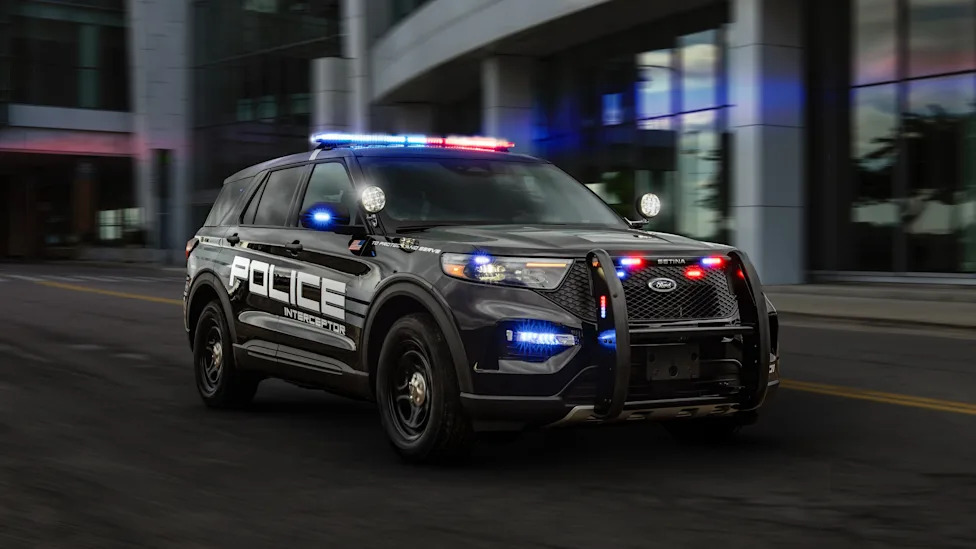



















A few recent Ford Motor Co. patents have raised concerns on social media around privacy and control of property as debate about a government "kill switch" and regulation meant to combat drunken driving get focus this election season.The patents that creators on social media have highlighted deal with technology that records biometrics information, for sharing vehicle data for usage-based insurance purposes and using vehicle data to influence in-vehicle advertisements. The Dearborn automaker, however, clarifies that just because technology is patented, doesn't mean it'll appear on products it sells, that customers have to opt into connectivity data sharing, that the company no longer shares information with insurers and that some patents are for particular uses like law enforcement vehicles.Some patents that Ford Motor Co. has filed discusses collecting biometrics information to be compared to a law enforcement database. This is for law enforcement fleet vehicles like its Interceptor model, according to the company."No matter what a patent application outlines, we will always put the customer first in the decision-making behind the development and marketing of new products and services," spokesperson Rebecca Grapsy said in a statement. "Our patent filings are not indicative of planning or production intent. In some cases, patents are filed so that Ford can assert readiness ahead of possible new regulation. In other cases, a company may simply be experimenting with what's possible. "AdvertisementAdvertisementThe conversation highlights the balance automakers face in leveraging technologies to offer features like voice commands, automated driving and personalized experiences while respecting consumers' desires for privacy protections and new legal requirements. Add on top of that, there's debate in Washington, D.C., about whether to finalize rules for technology that seeks to reduce the more than 10,000 annual U.S. traffic deaths from drunken driving crashes.Internet videos and messages from politicians decrying a government "kill switch" have raised concerns of delaying the implementation of such regulations or even move public opinion against vehicle safety technology."We shouldn't let implementation questions stall progress when there are very real answers to these questions," said Stephanie Manning, chief government affairs officer at nonprofit Mothers Against Drunk Driving. "If technology can save tens of thousands of lives and prevent hundreds of thousands of injuries a year, then the public safety benefit needs to be at the top of the list in terms of prioritization, and we can figure out how to solve for issues like privacy."One video that mentions patents Ford has filed over the past few years expresses concerns that a vehicle could refuse to move if it detects a driver has a high heart rate, that biometric data will be captured in a person's vehicle and sent to law enforcement, and that the vehicle will become a surveillance tool.AdvertisementAdvertisementFord disputes the characterization of its recent patents that has been seen in such videos. But concerns about vehicle data privacy across the industry has gained attention as more sensors and cameras are added.Hands-free driving technologies use in-cabin cameras to monitor eyes and head position to ensure drivers are staying alert in the event they need to take over."They're starting to get more sophisticated," said Sam Abuelsaid, vice president of market research for automotive communications firm Telemetry Group. "The problem with the original approach is you have a long highway drive, and you're traveling a couple hundred miles across Nebraska, your eyes can be looking that general election and not necessarily really be attentive. You get that thousand-mile stare."That kind of information should remain in the vehicle, Abuelsamid said, adding that drivers often have limited protections for what gets sent from their vehicle. There aren't comprehensive federal data privacy protections regarding the control that customers have over most of their automotive data.AdvertisementAdvertisementAlmost half of U.S. states have passed such measures since California adopted legislation that took effect in 2020 and was later amended. Specific rules and enforcement, however, can differ from place to place. Plus, vehicles present a unique challenge around consent, given that more than one person can occupy them."Vehicle data is swept up into these definitions," said Jennie Cunningham, counsel in New York who specializes in privacy and data protection in New York at law firm Nelson Mullins Riley & Scarborough LLP. "Without these comprehensive rules, there are different approaches on this."In Ford vehicles, customers can choose whether to share connected vehicle data with the automaker, Grapsy said. Using in-vehicle settings, customers can turn vehicle connectivity off entirely, which disconnects the vehicle from the cellular network. There also are more granular settings that control sharing vehicle data like odometer and oil levels, driving data such as braking, and location data with Ford."Privacy is central to our relationship with our customer and we take it extremely seriously," Grapsy said in a statement. "We hold ourselves to the highest standards of privacy and data protection."AdvertisementAdvertisementGrapsy added that regarding the HALT Drunk Driving Act passed in 2021 that directed the National Highway Traffic Safety Administration to create rules to require new vehicles have passive anti-drunken driving technology, nothing is more important than safety at Ford and that the company is pleased the agency is exploring the considerations involved in implementing the safety technology.Information sharing with insurance companies is not a new concern. A report in the New York Times in 2024 revealed General Motors Co. had been collecting driving data from millions of internet-connected vehicles and selling it to third-party data brokers, which insurance companies bought and raised drivers' premiums.GM agreed to a $12.75 million civil penalty for the illegal sale of the data of hundreds of thousands of California residents. It was the largest-ever settlement under the California Consumer Privacy Act.In June, Ford filed patent application No. 20260154570 describing a vehicle system for usage-based insurance that comprises devices "to provide memory-efficient and computationally efficient on-vehicle risk estimation" as opposed to expensively transferring the data to the cloud to be analyzed. It also notes it "transmits sparse data representations to an external usage-based insurance server, reducing data transfer costs and preserving privacy." That's because it avoids "the need to send raw or full-resolution driving data to the server."AdvertisementAdvertisementSince 2024, Ford hasn't shared vehicle data with insurers and doesn't plan to do so, Grapsy said. It had allowed customers to opt-in to data sharing with their insurers for a usage-based insurance program."Without a customer's explicit consent through this in-vehicle experience, Ford did not share any vehicle data with their insurance carrier," Grapsy said. "In 2024, we made the decision to phase out our support of usage-based insurance products and focus on other priorities."Other concerns have been raised over driver monitoring systems that lip read drivers. Patent application No. 20260095520 published in April describes a system when there is an environment where there are high ambient noise levels to better interpret audio input. The vehicle "may enable a lip reading mode and/or a gesture and facial detection mode in order to determine words spoken by a user of the vehicle," according to the application. It notes such information even could be stored and a gesture suggested as an alternative to voice command."This patent presents one potential aspect of a solution to an issue some drivers face in high-ambient-noise environments, but, again, is not indicative of future manufacturing plans," Grapsy said. "If ever implemented, this technology would be subject to the same rigorous privacy designs and controls as the rest of our connected vehicle products."AdvertisementAdvertisementPatent No. 12639979 approved last month and a similar application filed last spring describes a system that captures biometric information including facial features and transmitting the information to be compared to a database with previously collected information for the purpose of security events "such as locating of a missing person, the locating of a suspect of a crime, the detection of untrue aliases, or any other security event determined by comparing the information captured in the vehicle environment to stored or previously captured data for a security event cohort."Grapsy emphasized this technology is not applicable to retail consumer use."These explicitly state the system is implemented by 'security agencies, (e.g., police, border patrol)' and the user is 'security personnel, such as a police officer,'" she said. "These patents apply to law enforcement fleets in vehicles that we only sell to law enforcement such as the Interceptor, not consumer vehicles."Biometric information, however, is mentioned in patent application No. 20250258278 from August 2025. It describes using ultrawideband radars, a specific kind of sensor, to measure biometric characteristics like heart rate of an occupant in a vehicle's passenger compartment and have a component of the vehicle respond.AdvertisementAdvertisement"It is impossible to predict exactly which sensors will be useful or needed in concert with future technologies," Grapsy said. "UWB is one sensor technology being explored. Any future application of any sensor technology would strictly adhere to our privacy and consent commitments to our customers."Patent application No. 20240289844 filed in 2024 explores in-vehicle advertisements presentations on infotainment screens and audibly and make determinations on that based on vehicle information for a trip like navigation, speed, drive mode and traffic information as well as historical data."This patent explores how to manage information presentation in a way that minimizes driver distraction — for example, by adjusting when and how notifications are delivered based on vehicle speed, traffic, and cabin activity," Grapsy said. "Ford does not monitor in-cabin conversations or have plans for in-vehicle advertisements."Grapsy adds that Ford is among the top 50 entites awarded patents.AdvertisementAdvertisement"We patent a wide variety of technology, reflecting our investment in making vehicles better to both own and drive," she said. "Ford has succeeded in continually improving its vehicles for more than 120 years, and we have done that by consistently prioritizing doing the right thing for our customers. We don't just ask customers to trust us when it comes to privacy and how/if any of these patent technologies will be applied, we lean on a legacy of always making those choices and intend to show, not tell, that into the future."bnoble@detroitnews.comX: @BreanaCNobleThis article originally appeared on The Detroit News: Ford patents caught in government 'kill switch' debate