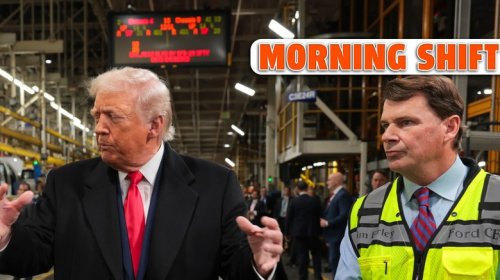
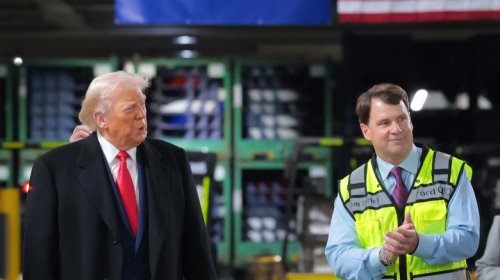
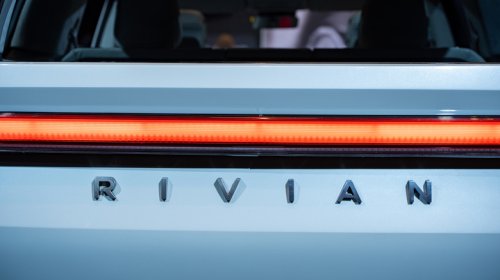
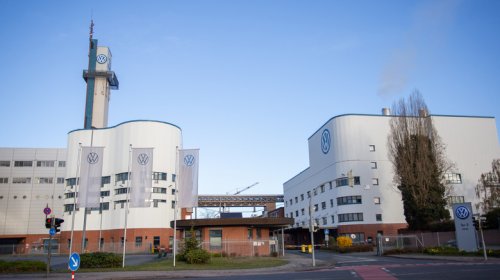
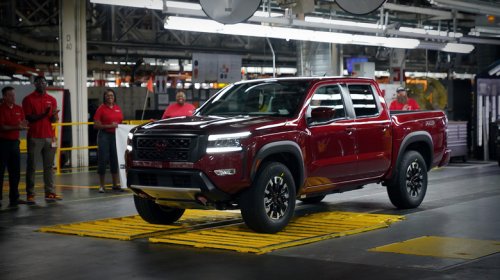
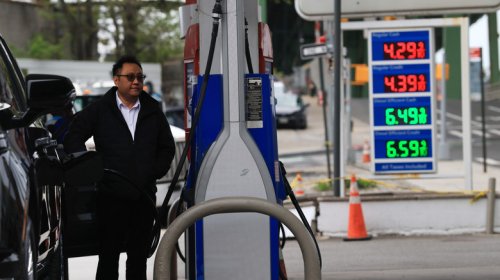



















Anna Moneymaker/Getty Images Good morning! It's Friday, May 1, 2026, and this is The Morning Shift, your daily roundup of the top automotive headlines from around the world, in one place. This is where you'll find the most important stories that are shaping the way Americans drive and get around. In this morning's edition, Ford CEO Jim Farley confirms that his company is in talks with the Trump administration about working on defense projects, Rivian is scaling back its Georgia plant capacity target as its federal loan shrinks by billions of dollars, Volkswagen is selling its plant in Osnabrück, Germany to a company that makes parts for Israel's Iron Dome, and Nissan is dropping its $500 million EV plan at its factory in Mississippi in a pivot back to gas-powered trucks. 1st Gear: Ford In talks with Trump on defense projects Anna Moneymaker/Getty Images Ford apparently sees all the fun General Motors is having with its defense contracts and wants to get in on the action. The Blue Oval is in early talks with the Trump administration about working on various defense (or is it war now?) projects, CEO Jim Farley confirmed. It signals a broader consideration from Ford to have a working relationship with the Pentagon. Military officials have long looked to commercial manufacturers to help build weapons and other pieces of military equipment that are currently only built by a small number of dedicated defense contractors like Lockheed Martin and General Dynamics. Jalopnik first reported on the Pentagon looking to court U.S. automakers a few weeks ago. From Bloomberg: "We are in early discussions with the US government on some defense-related projects," Farley said during the company's earnings call, adding that he can't offer any specifics. [...] On Wednesday, Farley said investors should expect Ford to play an "outsized role" in onshoring critical minerals and other components such as manufacturing-grade semiconductors. "Our supply chain is heavily engaged not only with our government, but new companies that are starting to emerge in our country to onshore some of this capability," Farley said. "Perhaps in the short term, that's the biggest role Ford can play in helping our country." It's currently unclear if this move from the Pentagon is purely just being done to diversify where it's getting supplies from, or if it's because the wars in Ukraine and Iran have depleted weapons and supplies stockpiles to the point that they need to find other sources to build up caches once again. The Wall Street Journal reported that automakers like Ford and GM were asked if they could "rapidly" shift to defense work" if needed. The Pentagon was also in talks with companies like GE Aerospace and Oshkosh. Ya know, when conservatives said they wanted to return to an earlier time, I don't think they meant World War II. 2nd Gear: Rivian scales back capacity at Georgia plant Erman Gunes/Shutterstock Rivian is cutting back on output plans for its future plant in Georgia from 400,000 vehicles per year to 300,000, thanks to a federal loan for the project shrinking by about $2 billion. On the bright side, the electric vehicle maker will be able to draw on the funds in 2027, earlier than expected. Now, it'll use the $4.5 billion loan for a single phase with an annual capacity of 300,000, rather than two phases with a capacity of 200,000 each. Originally, President Biden's Department of Energy planned to lend Rivian $6.6 billion as part of a program to boost production of its electric trucks and batteries. From Automotive News: The Georgia plant, scheduled to open in late 2028, will build the R2 midsize crossover and future vehicles on the R2 platform, including the smaller R3 crossover. Rivian started R2 production in late April at its current plant in Normal, Ill. [...] "As a result, we made the strategic decision to increase the production capacity of the first phase of our Georgia plant by 50 percent, bringing it to 300,000 units," Scaringe said. [...] Rivian said the Georgia factory site near Atlanta has room for future expansion but didn't announce any immediate plans for an additional phase of construction. Rivian's chief financial officer, Claire McDonough, said Rivian's total production capacity between the two plants would rise to 515,000 vehicles per year. The Illinois plant also makes delivery vans for Amazon in addition to the R1 vehicles and R2. In response to an analyst question on the earnings call, McDonough declined to say whether Rivian approached the Department of Energy, or vice versa, on changes to the loan terms. Rivian had a pretty solid first quarter of 2026. Its net loss narrowed to $416 million. Admittedly, that's a lot, but it's still a 23% improvement from the same time last year, and its revenue rose 11% to $1.38 billion. It also reported a 20% gain in Q1 deliveries year-over-year, with 10,365 vehicles finding homes between January and March. It also maintained its 2026 delivery guidance of somewhere between 62,000 and 67,000 vehicles. 3rd Gear: Volkswagen selling German plant to Iron Dome parts manufacturer Hesham Elsherif/Getty Images It seems we now know the fake of Volkswagen's Osnabrück plant: it's going to become an integral part of supplying Israel's Iron Dome. Israel's Rafael Advanced Defense Systems has signed a letter of intent with the automaker to buy the plant in western Germany, according to two people familiar with the matter. We've reported in the past that this was a possibility, and now it seems all but confirmed. From Reuters: Rafael, one of the main partners in Israel's Iron Dome, Arrow and David's Sling air and missile defence systems, would focus on building missile parts including motors rather than on explosives, which, for security reasons, would be built at a separate site, the sources said. The switch from auto components would reflect German industry's growing focus on defence as the government in Berlin has set aside hundreds of billions of euros to rebuild the military after decades of neglect. People familiar with the issue said the German government wanted to ensure it retained overall control over defence technology projects in Germany and that the technology remained in Germany. [...] The wars in Ukraine and Iran have also made clear how the nature of warfare has been transformed by the development of cheap drones for both offensive purposes and anti-aircraft defence. The defence ministry in Berlin declined to comment but a spokesperson said it was working closely with the economy ministry on potential defence projects with industrial companies in the civil sector. I've got a feeling this won't be the last auto plant to be repurposed into a weapons or "defense" manufacturer, and that gets one big, fat "yikes" from me, dawg. 4th Gear: Nissan drops half-billion dollar EV plan in favor of more trucks Nissan Nissan, like just about every other automaker, is making a hard right turn and totally rethinking its electric vehicle strategy. Part of that is dropping half-billion dollar plans to build electric vehicles at its factory in Canton, Mississippi. Instead, the Japanese automaker will pivot to building a range of body-on-frame vehicles at the plant — starting with the revived Xterra that'll come with internal combustion and hybrid powertrains. From Automotive News: Nissan [...] confirmed it has canceled all programs involving U.S.-made EVs to "better align with market conditions, customer demand and Nissan's updated strategic direction." The Canton plant, which builds the Frontier pickup and Altima sedan, was slated to be at the center of the automaker's EV push. Nissan in 2021 announced a $500 million investment to transform the factory halfway between Memphis, Tenn., and New Orleans into an EV manufacturing hub. It was to build multiple battery models for the Nissan and Infiniti brands, which had aimed to sell a combined 200,000 EVs in the U.S. in 2028. Nissan now hopes to revive the underutilized industrial complex in Canton with a new body-on-frame platform that will underpin at least five models. The first of those models — the Xterra — will debut in late 2028, followed by the redesigned Frontier and a three-row midsize SUV. This shared architecture is designed to deliver significant economies of scale and parts commonality, helping Nissan reduce its cost structure and deliver stronger profitability. Supplier sources have told the outlet that these body-on-frame vehicles would share up to 70% of their parts, and everything forward of the B-pillar would be common. Executives at the automaker are aiming for about 1 million sales in North America by as early as 2031 with the help of localized production, large vehicles, and a flexible powertrain strategy. The future the Ariya promised to bring feels like a distant memory at this point. Reverse: Thank you Henry, very cool! History.com I know my job isn't as hard as that of a Ford line worker in 1926, but if I had to do it for more than 40 hours a week, I would scream. Kudos to Henry Ford for locking in the five days a week, eight hours a day schedule. I just wish you'd been cooler to the -bergs, -witzs, -steins and -farbs of the world. The Fuel Up Spencer Platt/Getty Images Things are getting really bad out there. Thanks to a back-and-forth between the U.S. and Iran over control of the Strait of Hormuz and the United Arab Emirates officially leaving OPEC today, gas prices have jumped overnight once again, and I'm now starting to worry that surpassing the all-time high of $5.02 — that was set back on June 14, 2022 — isn't out of the question. Not helping matters is the fact that WTI Crude Oil futures and Brent Crude were right around $102 and $109, respectively, at the time of publication. All of this is to say that we've hit a new 2026 record average price for a gallon of gas after it shot up another 9 cents overnight to $4.39, according to AAA. This 9-cent increase also represents the largest single-day jump in gas prices we've seen since the U.S. and Israel's war with Iran began. Here's where national average prices stand right now, according to AAA: AAA The last time gas was over $4.12 per gallon was back in July of 2022, according to data from the Energy Information Administration. The average price of a gallon of gas is now up $1.41 — or about 47.3% — since the war first broke out on February 28, when it was $2.98. On the radio: Beyoncé - Crazy In Love ft. JAY Z As soon as I'm done writing The Morning Shift, I'm taking off for the day and heading downtown, because my best buddy in the whole world is getting married this afternoon. I'm probably going to cry a little bit, but it's okay, because showing emotion for your loved ones is sick as hell. Eternal love to Dave and Libby. If you're reading this right now, I know you're probably drinking, so raise your glass to them. Oh, it's also the one-year mark until my brother and his fiancée tie the knot. Love is in the air, ladies and gents.