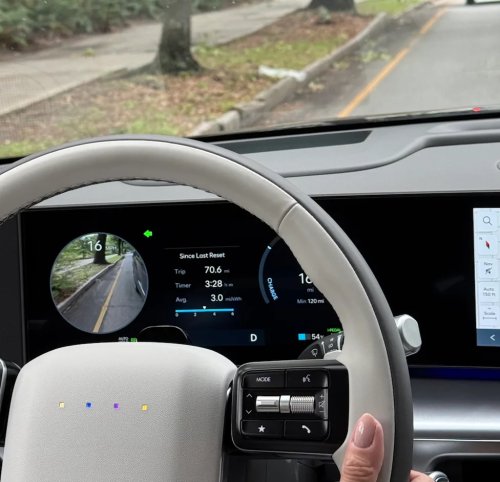
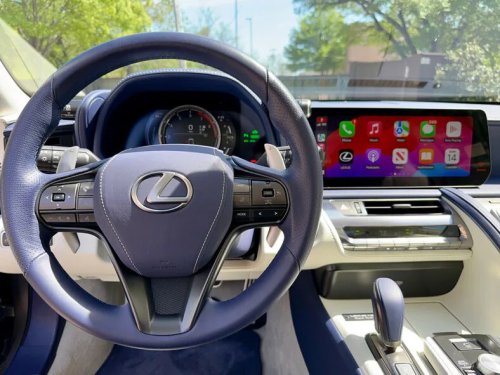
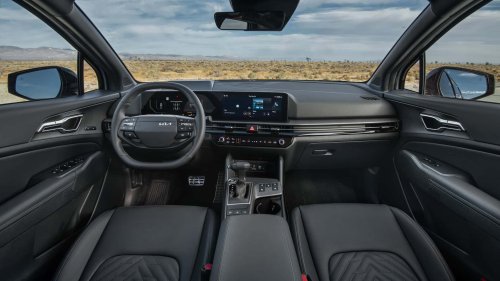
Europe Just Made Every New Car Watch Your Eyes. America Gets the Camera, Not the Rules.The Auto WireJohn LloydTue, September 22, 2026 at 12:08 AM UTCAdd us on Google1 / 2Europe Just Made Every New Car Watch Your Eyes. America Gets the Camera, Not the Rules.On 7 July, a threshold passed in Europe with no ribbon, no press conference and no new badge on the tailgate. From that date, every new passenger car and van registered in the European Union has to leave the dealership with a driver monitoring camera pointed at the person behind the wheel.The European Commission confirmed the deadline as the second wave of the bloc's General Safety Regulation took effect. The mandated feature is called Advanced Driver Distraction Warning, ADDW in the trade, and the practical shape of it is a small near-infrared camera in the steering column shroud or the top of the instrument binnacle, plus enough invisible light to make it work after dark.The camera is the boring half of this story.AdvertisementAdvertisementEurope did not simply mandate a sensor. It mandated a legal envelope around the sensor — what it may record, how long it may keep it, whether it is ever permitted to work out who you are — and it wrote that envelope into type approval, which means a carmaker cannot sell the vehicle without it. The hardware is now crossing the Atlantic, because nobody tools up two different dashboards for two different continents. The envelope is not crossing with it.What the rule actually asks the camera to doThe delegated regulation carves up your field of view. Areas 1 and 2 are the windscreen and the road ahead. Area 3 is essentially everything more than 30 degrees below your eye point: the centre screen, the phone in your lap, the cupholder, the footwell.At 50 km/h and above, gaze parked in Area 3 may "last for a maximum time of 3,5 seconds in the nominal situation." Between 20 and 50 km/h the allowance stretches to six seconds. Defined non-nominal situations can buy another 1.5 seconds. Past that, the car is required to speak up: a visual warning to inform you, plus an acoustic or haptic one to alert you, with explicit permission to "cascade and intensify" until you look back at the road.Here is the part that is in none of the supplier decks: the threshold is written in seconds, not in metres.AdvertisementAdvertisementThree and a half seconds at 31 mph is about 160 feet of road covered blind. The same three and a half seconds at 70 mph is roughly 360 feet — a full American football field, end zone to end zone. At an autobahn-legal 81 mph, with the non-nominal extension applied, you can be more than 590 feet down the road before the law obliges the car to say a word. A rule expressed in time behaves very differently at the two ends of the speedometer, and this one does not scale.Why it has to see in the darkMarketing departments sell night vision as a feature. It is not a feature. It is the floor.The regulation requires the system to operate effectively during both day and night, and the assessment includes running the test after sunset with nothing on the road but the car's own headlights. A camera that only works in daylight cannot be type-approved, and a car that cannot be type-approved cannot be sold.That is why these are infrared units rather than ordinary colour cameras. Component maker ams OSRAM, which supplies the emitters that light the cabin, offers in-cabin illuminators at 850 and 940 nanometres and points to 940 nm for its "robustness against sunlight and sunglass reflections inside the car." The company also markets "reduced red glow" as a selling point, because a visible strobe two feet from your face on a night drive would be intolerable.AdvertisementAdvertisementSit with that for a moment. The lighting rig in your new car is deliberately engineered to be invisible to the person it is lighting. There is nothing sinister in the engineering — the alternative is a flickering red eye in your peripheral vision every evening — but the result is a light source that runs whenever the vehicle is awake and that you will never once notice.The face the system was tested onThis is the detail that deserves to travel further than it has. The regulation specifies the drivers used in the compliance assessment, and the default attributes include "No glasses or head accessory, including hat or mask."Manufacturers are free to widen that pool — the text expressly allows a maker to "choose to allow one or more of the attributes" for its test drivers — but nothing compels them to. A car can therefore be certified as meeting Europe's distraction standard on a validation population of bare, unobstructed faces.That is not a scandal. It is how type approval has always worked: you define a population, you test against it, you publish the boundary. But it does mean the phrase "complies with ADDW" tells you considerably less about how the system will behave with your face — in reading glasses, in a knit cap, in a hijab, in heavy wraparound sunglasses — than the phrase implies. And recall why the industry settled on 940 nm in the first place. It picked that wavelength because it already knew sunglasses were the enemy.The rules America did not importEurope wrote the data rules into the same law that created the camera. The General Safety Regulation states that drowsiness and distraction systems "shall not continuously record nor retain any data other than what is necessary in relation to the purposes for which they were collected," and that the data "shall not be accessible or made available to third parties at any time and shall be immediately deleted after processing." The ADDW regulation goes further still: the system "shall function without relying on biometric personal data of any vehicle occupants." It may use the camera. It is forbidden from identifying the person. It must run, in the regulation's language, as a closed loop.AdvertisementAdvertisementHere is the American position on identical hardware: there isn't one.There is no Federal Motor Vehicle Safety Standard for driver monitoring. Congress instructed NHTSA in the 2021 infrastructure law to write a rule on advanced impaired driving prevention technology; the statutory deadline passed in November 2024, and the agency's most recent report to Congress explains the delay, noting that neither of its studies "found commercially available technology that detects driver alcohol impairment accurately and passively." The advance notice that opened that docket is now more than two years old and has produced no standard.So the law governing an infrared camera aimed at an American driver's face is whatever the manufacturer's privacy policy says, plus a patchwork of state biometric statutes, with Illinois's Biometric Information Privacy Act the one carrying genuine enforcement weight. The commercial fleet world has already discovered what happens when the camera becomes the defendant.Hardware crosses borders. Statutes don't.Why it ships here anywayBecause taking it out costs more than leaving it in. Once the column shroud is tooled with an aperture, the harness carries the connector, the domain controller has the compute budget and the software has been validated to a European standard, building a North American variant without the camera means a second bill of materials, a second validation programme and a second set of service parts. Nobody does that to save a few dollars on a part they have already paid to develop.AdvertisementAdvertisementThe volume is already showing up in the accounts. Seeing Machines, which licenses driver monitoring software to carmakers, reported in March that its cars on the road had reached 4.8 million, up 67% year on year, with 1.09 million units produced in the first half of its 2026 financial year, a 62% jump, and said it retains more than half of current production volumes. Chief executive Paul McGlone tied the trajectory straight to the mandate: "As regulatory adoption accelerates, particularly with GSR in Europe, we expect further growth in production and royalties."That is what a regulatory cliff edge looks like on a supplier's income statement. It is also why the feature will arrive on American window stickers dressed as a safety upgrade rather than as what it actually is: the residue of somebody else's legislature.The off switch that isn'tThere is a quiet contradiction sitting inside the mandate. You are allowed to turn it off. The regulation requires that the driver be able to "manually deactivate either the ADDW warning or the ADDW system," with the manufacturer choosing which of those options to offer.And then, "upon each activation of the vehicle master control switch," it comes back.AdvertisementAdvertisementWhich tells you what the binding engineering constraint really is, and it is not detection accuracy. It is tolerance. A system that scolds you wrongly on the school run gets switched off every single morning, and a system that is switched off delivers exactly zero safety benefit. Every false alert is a withdrawal from a very small account, and the driver holds the button.NHTSA has put the arithmetic more bluntly than any supplier ever will. Writing about impairment detection, the agency warned that even a "99.9 percent detection accuracy level could result in millions to tens of millions of instances each year where the technology would incorrectly prevent or limit drivers from operating their vehicles." Distraction warning is a nag rather than an interlock, so the cost of any single error is lower. The volume of errors is the same problem.Camera modules are also, already, a recall category in their own right. In March, Ford filed a Part 573 report covering 254,640 Lincoln and Ford SUVs whose image processing module could reset without warning, taking the rearview camera image and several driver-assistance functions with it. Hyundai spent the summer chasing its own camera gremlins. Bolting a second camera and a second processing chain into every new vehicle sold does not make that recall surface any smaller.What the camera is really forStrip the safety framing away for a second and watch where the thresholds are drifting.AdvertisementAdvertisementUN Regulation No. 171, the international rule for hands-on assisted driving that the EU folded into its own law in 2024, requires the vehicle to monitor whether the driver is motorically and visually disengaged, and to issue an eyes-on request "latest when the driver is deemed visually disengaged for 5 seconds," escalating within three seconds after that.Read the two numbers side by side. Driving yourself, Europe gives you 3.5 seconds before the car objects. With the car doing the steering, you get five seconds before it even asks you to look up. Different working groups wrote those rules for different purposes and the comparison is not quite like for like, but the direction of travel is unmistakable. Every step toward hands-off, and eventually eyes-off, driving requires a manufacturer to prove continuously, and to a regulator's satisfaction, what the human was doing at the moment it mattered.The camera is the instrument that manufactures that proof.Which is exactly why the data rules are not a footnote. A sensor that can establish where your eyes were in the two seconds before an impact is not only a safety device. It is a witness. Europe decided in advance, and in statute, that the witness forgets. The United States has decided nothing, which means the question gets settled the way these questions usually get settled here: by whoever sues first, in whichever state has a law worth suing under. The same vacuum is why Americans keep learning about their cars' capabilities from foreign regulators.What to rememberForget the wavelengths. Forget the gaze zones and the stopwatch. Remember this instead: the hard part of putting a camera in a car was never the camera.AdvertisementAdvertisementYour next new vehicle will know whether you were looking at the road. In Europe, the law already says what it is allowed to do with that knowledge. In America, the only thing standing between that answer and anyone who wants it is a document you scrolled past at the dealership.Would you want a camera watching your eyes while you drive, even if it made roads safer? Tell us in the comments.The post Europe Just Made Every New Car Watch Your Eyes. America Gets the Camera, Not the Rules. appeared first on The Auto Wire.