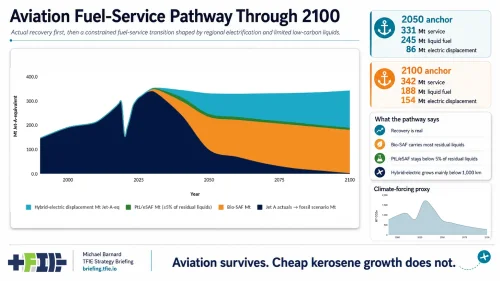
For most of the 20th century, a simple assumption worked well enough for energy forecasting: when economies grew, fuel demand grew with them. More people, more housing, more vehicles, more factories, more roads, more ports, more airports, more concrete, more steel, more coal, oil, and gas. The relationship was not perfect, but it was strong enough that a lot of models, policies, and investment stories absorbed it as background physics, which is precisely why it has become one of the easier ways to get the transition wrong. Economic growth is not disappearing. People will still need heat, mobility, freight, buildings, industry, food, electricity, and infrastructure. Many parts of the world still need much more of all of them. But the machinery that used to convert growth into fossil fuel demand is changing. A forecast that starts with GDP growth and quietly turns it into rising demand for coal, oil, gas, LNG, hydrogen, ammonia, methanol, or synthetic fuels is often preserving the 20th-century system after key parts of it have already been removed. Demographics are the first correction. Global population is still rising, but the era of repeated population doubling is over. Much of the explosive fuel growth of the last century was tied to a world adding people, cities, factories, power plants, roads, vehicles, and material throughput at the same time. Slower population growth does not eliminate development needs, especially in lower-income regions, but it changes the slope and makes straight-line fuel demand assumptions harder to defend. The second correction is China’s first-build pulse. China’s construction, materials, and infrastructure surge was historically enormous. It pulled coal, steel, cement, iron ore, shipping, diesel equipment, and industrial energy demand upward at a scale no other country is likely to repeat. But first-build infrastructure does not happen twice. Once housing, ports, rail, highways, factories, and power systems are substantially built, the demand profile shifts toward maintenance, replacement, retrofits, and selective expansion. That is a very different materials and fuel story than the one that drove the early-2000s commodity supercycle. The third correction is the physics of electrification. Combustion chains waste a great deal of primary energy before useful work appears. Electric motors, heat pumps, batteries, rail, grid-connected equipment, and direct electric industrial processes usually deliver the same service with far less energy input. A heat pump does not need a unit of gas-equivalent fuel for every unit of heat a furnace used to deliver. An electric drivetrain does not need a barrel-of-oil-equivalent input for every unit of motion an internal combustion engine used to provide. Electrified ports, rail, buses, vans, mining equipment, short-sea vessels, and industrial drives do not preserve the old fuel pool and paint it green. They shrink parts of it. That is why activity measures can mislead. More freight does not automatically mean more marine fuel. More mobility does not automatically mean more oil. More heat does not automatically mean more gas. More industrial output does not automatically mean more molecules. The service matters, the conversion chain matters, and the denominator matters, and fuel forecasts that skip those tests are increasingly fragile. This is where a lot of fuel narratives become suspect. LNG demand stories often assume industrial and power growth will keep pulling gas upward even as renewables, storage, transmission, heat pumps, and electrification erode the use cases. Hydrogen stories often assume today’s fossil fuel demand can be translated into future molecule demand, even where direct electricity is cheaper, simpler, and more efficient. Aviation and shipping fuel stories often extrapolate activity first, then attach alternative fuels later, without first asking how much of the fuel-burning work disappears through cargo shifts, route shifts, electrification, efficiency, and changed demand. None of this means fuel demand goes to zero. Aviation will still need liquid fuels for long-haul flights. Some shipping will still need liquid fuels for long-range operations. Some industrial processes will still need chemical feedstocks or high-temperature niches where molecules have real jobs. Remote operations, backup systems, military logistics, and parts of agriculture will not all become grid-tied overnight. Molecules remain, but the serious question is how large the remaining pool is after electricity, efficiency, demographics, and first-build completion have done their work. That smaller and more specific question is much less friendly to weak infrastructure arguments. A fossil fuel project cannot be justified merely because a model shows GDP rising. A hydrogen project cannot claim a market simply because an industrial sector uses fuel today. An LNG terminal cannot assume that emerging-market development automatically means decades of gas demand. A synthetic fuel proposal cannot start with today’s liquid fuel use and treat it as the addressable market. The right test starts with the service: heat, motion, freight, materials, electricity, resilience, or chemical feedstock. Then it asks what can be electrified, what can be avoided, what is first-build versus replacement, and what truly remains for molecules. The investment implication is just as direct. Many climate-tech and fossil-infrastructure pitches still hide inside aggregate growth assumptions. They start with population, GDP, trade, or industrial expansion, then imply that a specific fuel must grow with it. That shortcut deserves much more skepticism now. Growth may support grids, transmission, storage, electrified transport, heat pumps, industrial retrofits, digital controls, and better infrastructure. It does not automatically support more fuel. The world is not entering a no-growth energy future. It is entering a future where useful work is increasingly decoupled from the fossil fuel quantities that used to deliver it. That is a very different market map, and a lot of long-range fuel forecasts have not caught up. A longer maintained version of this analysis is available at TFIE Strategy Briefing: Growth No Longer Guarantees Fuel Growth It is part of Michael Barnard’s broader WorldView work on the assumptions underneath serious 2100 transition scenarios.



















 +71 others