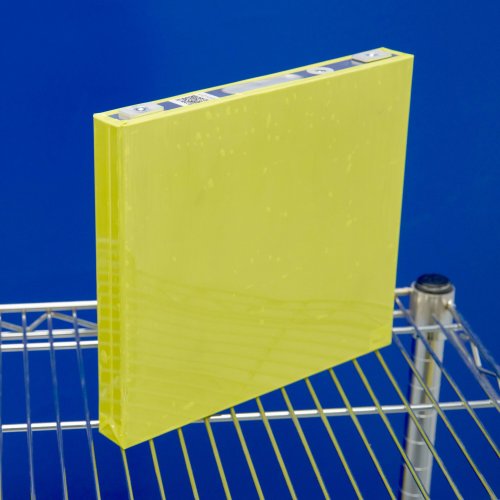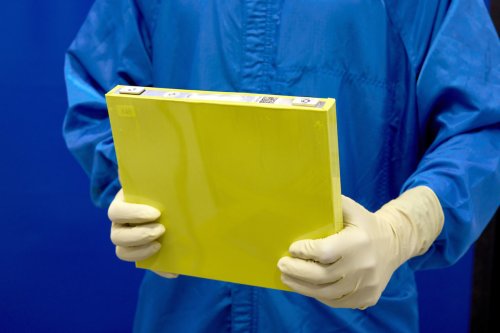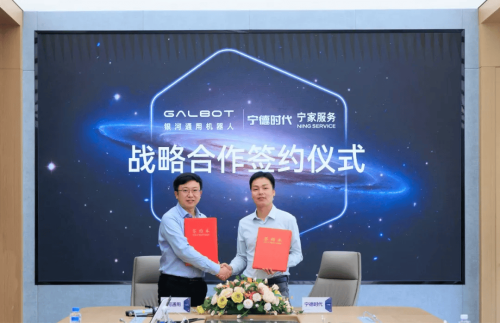
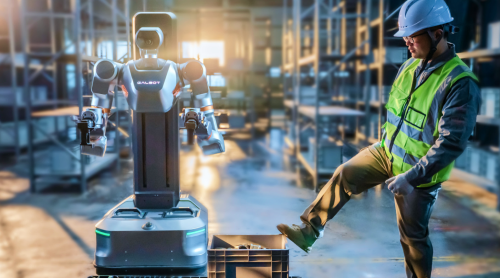
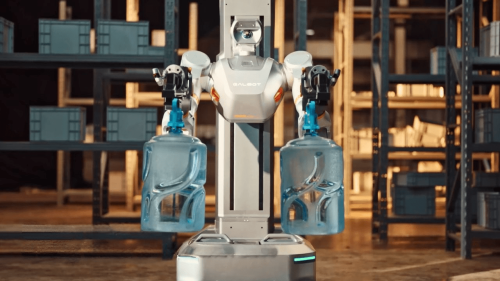
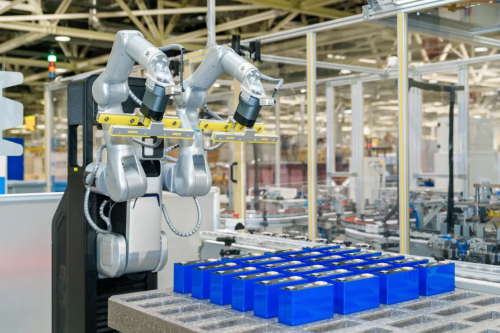



















On June 24, CATL announced that it has officially signed a global strategic cooperation agreement with Galaxy General Robotics (Galbot). The two companies will collaborate on smart production line upgrades, the global deployment of embodied AI robots, and large-scale commercial applications. Cooperation signing ceremony between CATL and Galbot They also plan to jointly establish the world’s first aftermarket service standard for embodied intelligent robots. The centerpiece of the partnership is Galbot S1, a heavy-duty humanoid robot developed by Galaxy General Robotics. The model is also the world’s first embodied AI robot designed for regular commercial operations to be equipped with CATL batteries. According to information released by the companies, Galbot S1 features a dual-arm system with a payload capacity of approximately 50 kg. It is equipped with vision-only centimeter-level positioning capabilities and 360-degree omnidirectional obstacle avoidance. Galbot S1 CATL said the battery system supplied for the robot incorporates particle-level cathode formulation technology, low-lithium-loss anodes, and biomimetic self-healing electrolyte technology. The battery cells reportedly achieve a failure rate at the PPB (parts-per-billion) level, enabling approximately eight hours of continuous operation while meeting industrial requirements for safety and durability. Galbot S1 has already been deployed at CATL’s smart factories, where it performs long-distance autonomous transportation, picking, and material-handling tasks in battery module and battery pack production processes. Over the past several years, China’s new-energy vehicle industry has established a relatively mature ecosystem covering inspection, maintenance, recycling, and operational services. Galbot’s S1 industrial humanoid robot Following this cooperation, CATL’s existing “Ningjia Service” platform will expand beyond power batteries and energy storage systems into the embodied AI robotics sector. The two companies plan to establish service standards covering inspection, maintenance, operational support, and related functions, laying the groundwork for future large-scale robot deployment. From an industry perspective, the convergence between humanoid robotics and the electric vehicle supply chain is accelerating. Capabilities accumulated by automakers and battery manufacturers in batteries, electric drivetrains, electronic control systems, perception technologies, and supply chain management have significant overlap with the needs of the robotics industry. In recent years, automakers including XPeng, SAIC, and Chery have entered the robotics sector, with some products already undergoing pilot operations in factories, warehouses, and service environments. SAIC’s humanoid robot “Nengzai No.1” Meanwhile, market expectations for humanoid robots continue to rise. Morgan Stanley this week raised its forecast for China’s humanoid robot shipments in 2026 to 50,000 units, up from a previous estimate of 28,000 units. It had already doubled its initial January forecast of 14,000 units, marking the firm’s second upward revision of the forecast in 2026. The bank projects China’s humanoid robot market could reach $2 billion in 2026 and expand to $15 billion by 2030, with annual shipments rising to approximately 446,000 units.