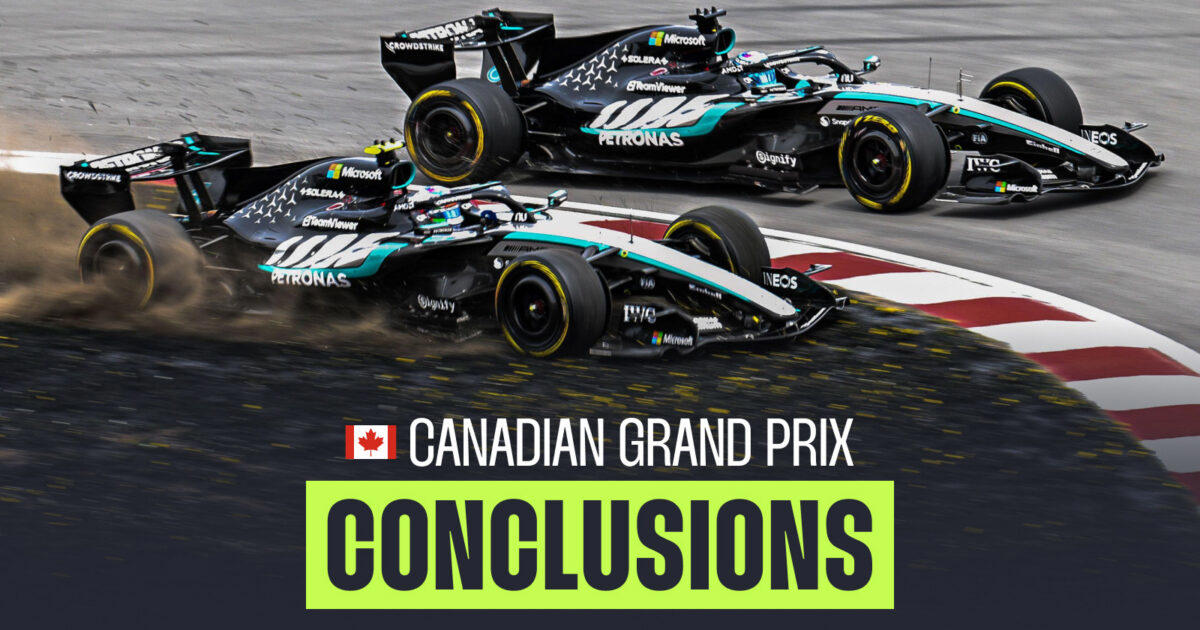
Canadian Grand Prix, conclusionsIf the Canadian Grand Prix did nothing else, it hinted at the potential for civil war at Mercedes and offered a strong argument for further reduction in grip in Formula 1. While from the drivers’ seat it may be the extreme speed and g-forces that appeal, to the watching world it is on track battles like we saw between Kimi Antonelli and George Russell that excite. Canadian Grand Prix sows Mercedes seeds of discontent Mercedes and its drivers will move swiftly to plaster over any cracks, but the evidence is there, especially from Russell, that this year’s title battle has the potential to get especially pointed. Russell announced as much with an elbows-out drive in the Sprint, taking no prisoners in battle with Antonelli. If he wants to be world champion, it’s exactly the right approach. Every world champion in history has been ruthless, a character flaw in some regards that makes them exceptional racing drivers. Max Verstappen, Lewis Hamilton, Michael Schumacher, Ayrton Senna, they were (or are) uncompromising. Canada was an important race for Russell. After three defeats at the hands of Antonelli he needed to bounce back and assert his authority. He did so in Sprint Quali by putting his car on pole and converting it on Saturday morning was an important psychological moment. It has also planted the seeds of discontent at Brackley. While there was a whiff of potential for a true championship battle prior to Canada, Russell’s drive aggression highlighted that there is a real prospect – if left unchecked – of things spiralling into civil war. In the Sprint, Antonelli was aggressively rebuffed as he attacked his teammate for the race lead, and found himself off track in a moment that triggered a flurry of complaints over the radio. A mistake followed as the teenager bounced through the grass at Turn 8 and lost second to Lando Norris as the teenager appeared to briefly lose his composure. After that clash with Russell at Turn 1, his youth and inexperience showed through as his race unravelled. Come Sunday, there were no such issues. Antonelli was more measured, and carved a more rounded, composed and threatening figure on track. It could prove to be an important moment, far bigger than the Canadian GP weekend, and a turning point for the young world championship leader. The 19-year-old is not the finished product; he will only get better and yet already Russell is having to employ every trick he knows to fend him off. That he’s barely a season into life at the pinnacle of the sport and is capable of challenging Russell on what has been a ‘Russell’ track is a hell of a statement. After Miami, I wrote how Max Verstappen looked desperate with a performance uncharacteristic of a four-time world champion – scrappy, overly zealous, and riddled with uncharacteristic mistakes. Much the same can be argued of Russell in Canada. Though his mistakes can perhaps be explained away by the conditions – he wasn’t alone in making them – it was an especially aggressive performance, especially against his teammate. And one has to question: had the Sprint battle been with Verstappen, or Norris, or Lewis Hamilton, would it have ended the same way, or would it have been referred to the stewards? In the race and under pressure again, Russell was found wanting more than once. A more experienced driver might have used that information differently than the young Italian did. Not that it ultimately mattered given he won the race, his fourth in as many grands prix as Russell’s Mercedes suffered a battery failure, ending a weekend in which the rivalry with Antonelli was turned up a notch. Credit should be paid to Toto Wolff and Mercedes management; letting its drivers race is good for the sport, but potentially disastrous for the team. A year ago, we endured a wet sponge of a title fight between Norris and Oscar Piastri as McLaren attempted to stage manage proceedings on track. It robbed us of the intrigue and the drama. Things look different this year, and one can’t help but feel that, right now, Antonelli holds the upper hand both in the championship standings, and psychologically. Vindication for F1 2026 rule changes… to a point Part of the credit for the drama and intrigue we saw in Canada has to go to the F1 2026 regulations, which have done much to improve the racing product. Put the power unit regulations to the side (and preferably in the bin) and focus purely on the chassis side of the equation, and it has produced good racing. Cars can follow one another; they can attack and battle. What was once a distant dream, the holy grail for every F1 fan, is now a reality. And for that we should be thankful. But what played a significant element in the racing in Canada was the number of driver errors. More than one driver threw it off the road over the course of the weekend as they struggled for grip, particularly in the cooler conditions in Sunday’s race. Russell skated long at the hairpin on three occasions on Sunday as he battled his teammate, mistakes that led to intense wheel-to-wheel action. Charles Leclerc had a half spin out of the final chicane, Oscar Piastri nerfed Alex Albon into retirement too – there were countless mistakes up and down the field. And it is that which made the race interesting. There was never a degree of certainty, there was always an edge, even after Russell threw his headrest away in disgust after his battery conked out. Throughout its 68 laps there was never certainty. Cooler conditions, tyres that were outside their operating window, and drivers struggling for purchase all conspired to create an engaging race. The result: an encounter that was dominated by the drivers, not the power unit regulations and the yo-yo effects they’ve had on racing. The race was far more straightforward, which is a point in support of the pre-Miami rule changes. After Miami, we weren’t sure whether the less chaotic racing was a result of the revised rules, the track, or car convergence. In Canada, we gained crucial data to support the thesis that things have improved. The power unit regulations are far from ideal, and the FIA’s proposal for F1 2027 needs urgent attention as it does (on paper) look a step improvement, but at least things seem better than they were – not that they could have been much worse. But Canada was engrossing, intriguing, and exciting at a time when F1 desperately needed it, because not only did we get an excellent race, but we have a new rivalry to enjoy as Russell and Antonelli make the transition from teammates to title rivals. British bias However, the enormity and deservedness of Antonelli’s fourth consecutive win felt overshadowed by a parochial Sky telecast that seemed to take every opportunity to build up and defend Russell. The story of the Canadian GP weekend was unquestionably the developing rivalry between Russell and Antonelli, not Russell’s credentials (an apparent right) to become world champion, which is where Sky’s narrative fell all weekend. During the Sprint, Martin Brundle defended Russell’s aggression against Antonelli at Turn 1 before clear evidence of what had transpired was available. When the evidence was available, he ceded that Antonelli was briefly ahead (as the rules required in such instances for racing space) but immediately dismissed it as it being only momentary. One might argue that it’s a view supported by the lack of investigation by the stewards but that there was no argument from Antonelli’s perspective left it feeling rather one-sided. In the race, David Croft insisted that Russell had been steadfast against the pressure applied by Antonelli as their pair scrapped in the opening laps, a comment that was at odds with the Brit running wide at the hairpin more than once. There were moments of balance, but they were outweighed by examples where parochialism appeared to take over. Later, as Hamilton battled Verstappen, the Ferrari driver put a fine move on the Dutchman to claim second place into Turn 1, but it hardly warranted the exuberance Croft gave it. A pass around the outside against a driver known for his no-quarter nature is a strong move, but Hamilton had been catching at some rate for several laps and an overtake seemed inevitable. That doesn’t diminish the pass, but important context was absent from Croft’s comments. Having commentated myself, I understand the challenge, but to a global audience the Canadian GP weekend reinforced perceptions of British bias. While I accept Sky is ostensibly the British broadcaster, its package is carried internationally and therefore has an obligation to be more balanced in its coverage. An aside, but somewhat related, is that the television broadcast was better than in Miami but still wanting. On Lap 12, we missed a pass for the lead as we watched a battle further back. Though I can concede there was far more track action to keep tabs on, at that point it was clear there was something developing out front that was far greater than simply the battle for the lead. The all-Mercedes scrap wasn’t about the lead, or even the win, it was an internal battle for supremacy in the context of the world championship fight. In terms of the active storylines through the race, that warranted far closer attention than it received at that moment. Canadian Grand Prix showcases F1 path to success Beyond that, the coverage was fair and managed to tell the story of the race well; the growing tension between the Mercedes pair, the scramble for the lower places, and the capitulation of McLaren. That’s a story best told in our Winners & Losers column, which will follow later today, but suffice to say McLaren’s Canadian performance was a snowball, as Martin Brundle so appropriately described it on the telecast. A poor decision pre-race compromised both Norris and Piastri, leaving them mired in the midfield pack as they attempted to recover from the early mistake. But it harks back to my original point; less grip and less certainty creates better racing. Formula 1 has become over engineered with too much data available to teams and drivers. If everything is optimised it leaves little room for human error, but it’s that which introduces the natural variation that produces great races. The Canadian Grand Prix proved that once again. In cool conditions, where the cars didn’t work, we were treated to an extraordinary race against a backdrop of a developing rivalry between Mercedes’ two world championship contenders. How F1 puts the genie back in the bottle to routinely capture that is unclear; the sport has evolved such that engineering, data, and extreme analysis has become baked into competition. Perhaps it’s a case of banning radio, and car-to-pit telemetry. If F1 is serious about increasing the spectacle, the key is not equalising the cars but highlighting their differences and allowing the drivers to showcase their skill. That is what we saw in Canada. That is what every fan wants to see, not overtakes resulting from power unit regulations that should have never seen the light of day. Want to be the first to know exclusive information from the F1 paddock? Join our broadcast channel on WhatsApp to get the scoop on the latest developments from our team of accredited journalists. You can also subscribe to the PlanetF1 YouTube channel for exclusive features, hear from our paddock journalists with stories from the heart of Formula 1 and much more!



















 +72 others