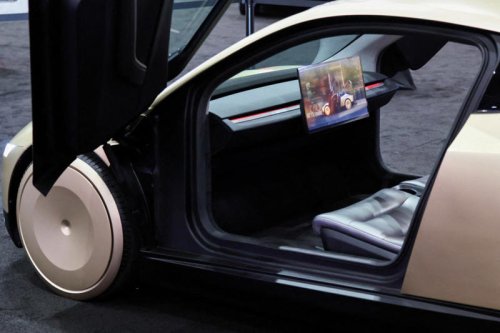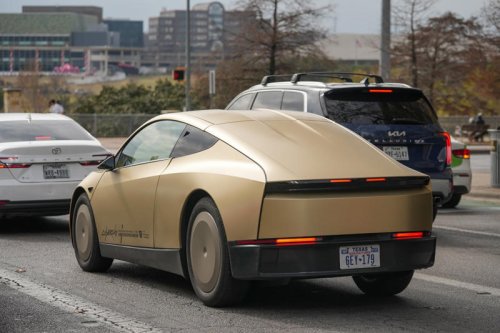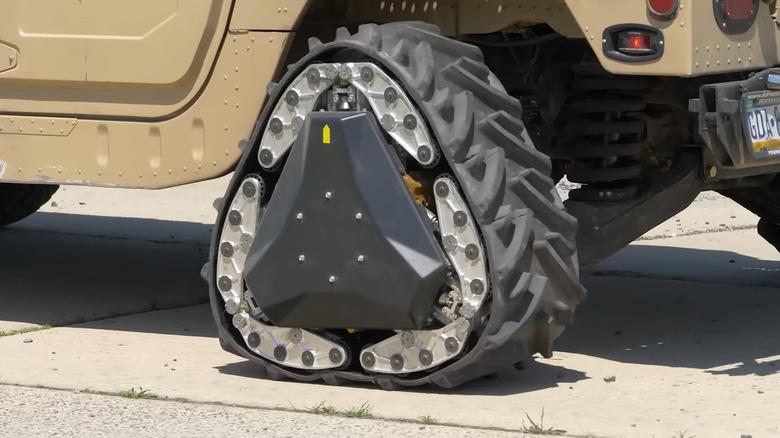




















Transforming Wheel TrackWheels excel on solid roads, but sometimes they have trouble gripping the surface — assuming there's even a "surface" and not just sand or mud. Caterpillar treads tend to shine in the latter scenario, but their paved road performance lags behind wheels. It's a shame you can't use a vehicle that shifts between wheels and treads depending on the road conditions. Or can you?In 2018, the Defense Advanced Research Projects Agency (DARPA) revealed the fruits of the Ground X-Vehicle Technologies (GXV-T) program, which consisted of projects meant to improve military vehicle survivability without weighing them down with armor. The Carnegie Mellon University's National Robotics Engineer Center's contribution was the reconfigurable wheel track (RWT). The RWT could shift from a rolling round wheel to a tumbling triangular tread in under two seconds — even while attached vehicles were on the move. The device was meant to optimize vehicle mobility over rapidly shifting terrain and ensure its attached car or truck sped along as quickly as possible.DARPA and Carnegie Mellon weren't the only think tanks to come up with rapidly-transforming tires. Seoul National University's Biorobotics Lab and Harvard's School of Engineering and Applied Sciences also collaborated to develop their own transforming wheels, but instead of creating pliable tank treads, their project result was essentially metal origami. This particular model couldn't turn into rubberized caterpillar treads, but it could shift from long, drum-like rollers with smooth rims to tall, ridged wheels intended for rough terrain.While you probably won't find transforming wheels on your average consumer Honda or Toyota, they might become a common sight on military vehicles, armored or otherwise.Light-Up WheelsThe Mercedes-Benz Vision AVTR and Lincoln Model L100 are both concept cars that embody what their respective designers think cars will look like in around 100 years. While their forms look nothing alike, they still share many design tropes — automatic, handleless doors; electricity-powered engines; and for the purposes of this entry, light-up wheels. At first glance, the Vision AVTR's and Model L100's wheels are just cosmetic. The AVTR tires look like rolling rubber armadillos with luminescent bands, whereas the L100 doesn't even show its tires — the "wheels" are part of the car's body, and the lights mimic their shape. However, neither car's wheel lights are mere fashion statements. Since the AVTR and L100 are electric vehicles, their wheels also function as charge indicators and show whether the batteries are full or still need a bit of juice. Moreover, AVTR's wheel lights act as turn signals — people driving beside you get a helpful shine of yellow lights when you want to merge into their lane.Cars probably won't look like the Vision AVTR or Model L100 in the next 100 years, but their light-up wheels hold promise. Many devices with rechargeable batteries feature lights that let owners know if they're fully charged. Who wouldn't want that on an electric vehicle, especially if it doubles as a turning signal? You can never have too many road safety features.