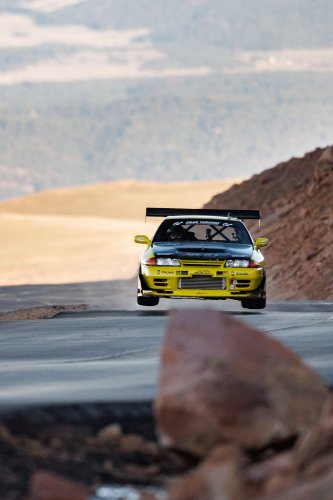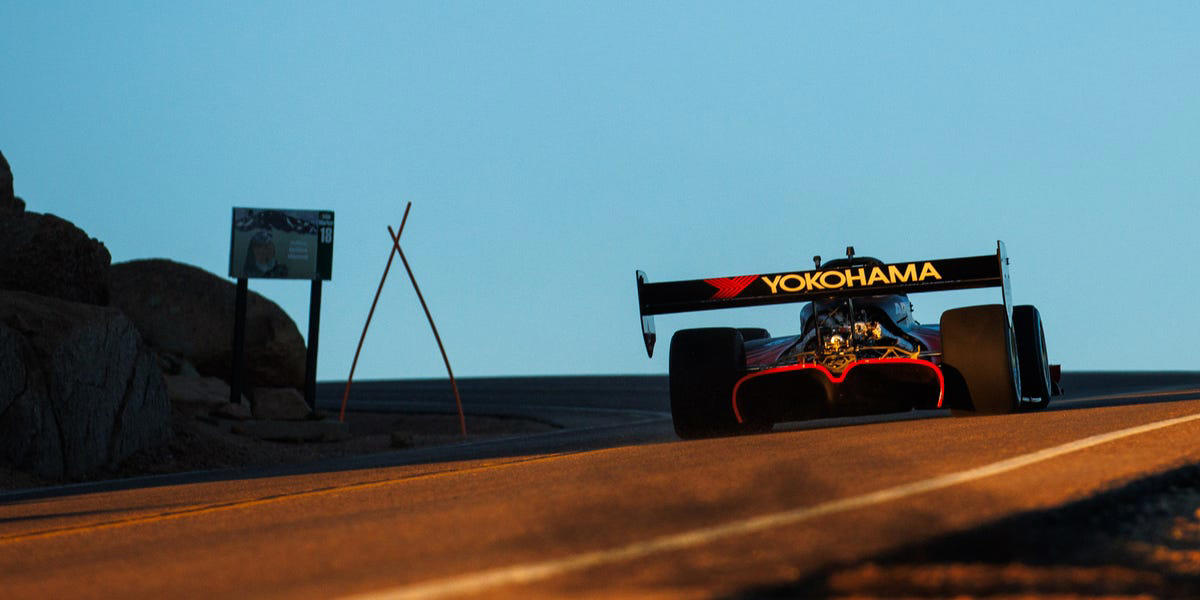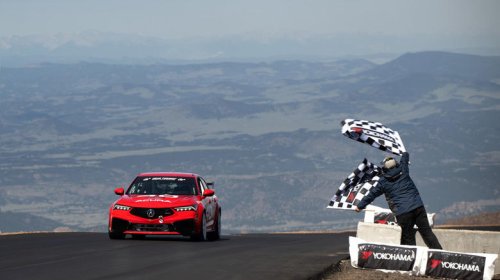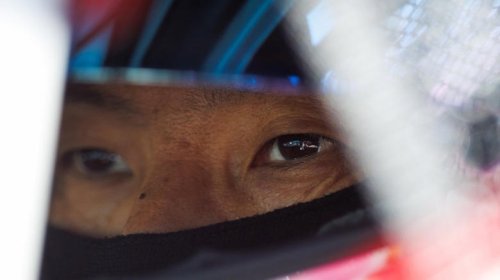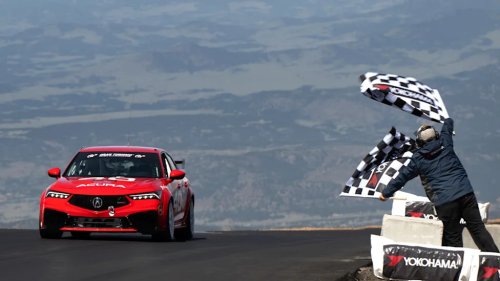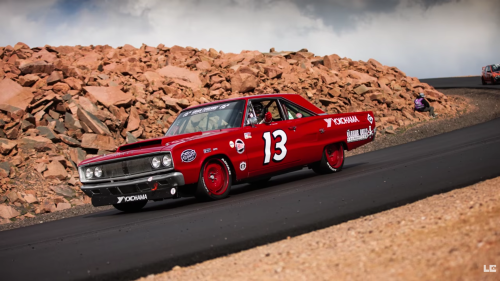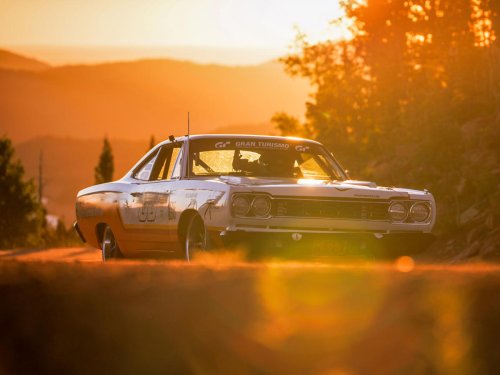
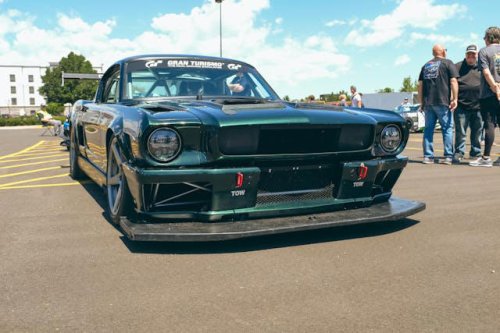
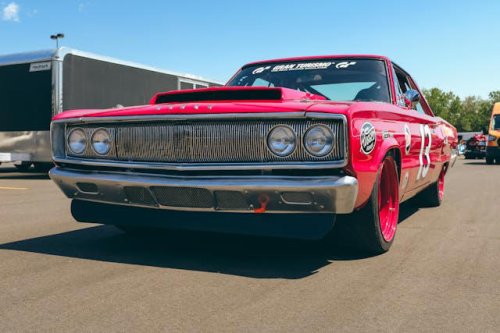
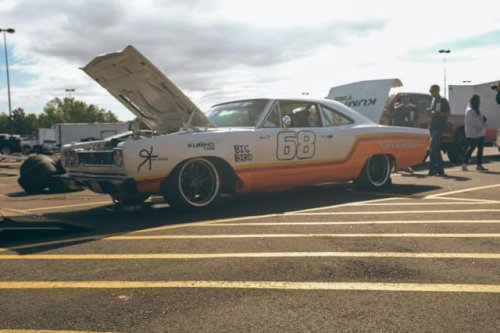
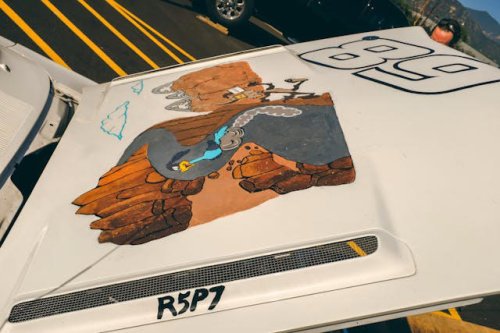
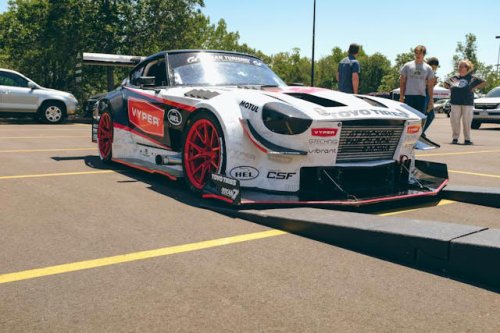
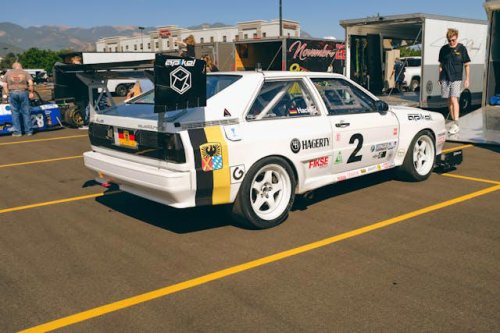
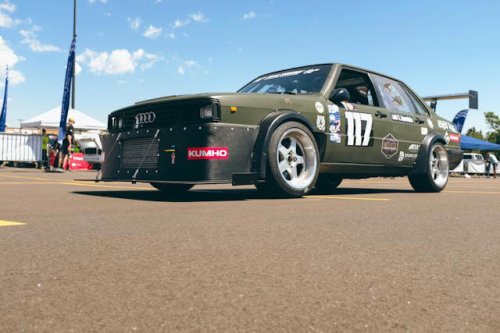
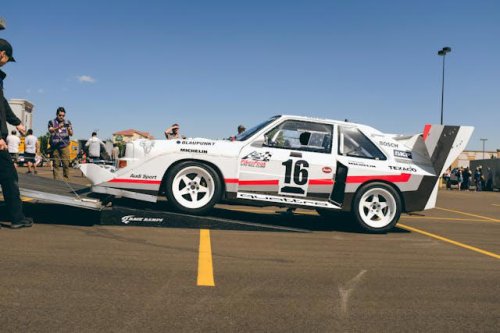
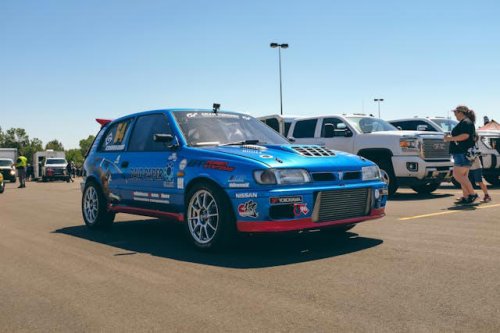
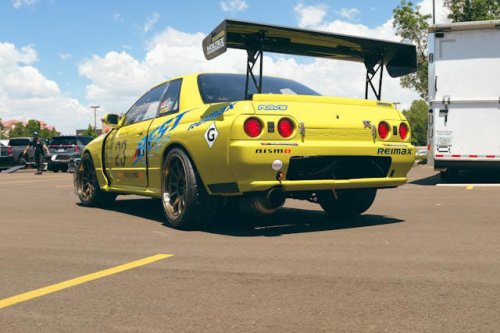
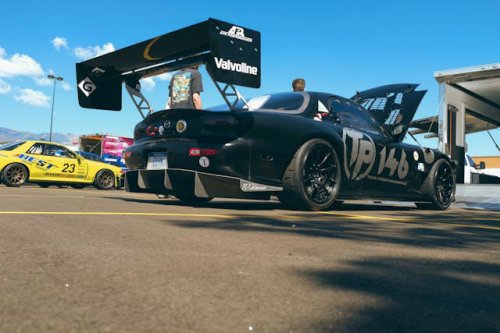













10 Vintage Rides Racing up Pikes Peak This Weekend Ask any driver attempting to run the Pikes Peak International Hill Climb what their goal is, and they will undoubtedly answer, “Make it to the top.” It seems simple enough, seeing as that is the whole point of the race, but it isn’t as straightforward as it sounds; last year, 80-mph winds at the summit forced race organizers to dramatically shorten the course by more than 60%. First staged in 1916 on the mountain outside of Colorado Springs, Colorado, the “Race to the Clouds” is the second-oldest automotive racing event in America, with participants driving flat out over 12.4 miles and through 156 turns, gaining 4725 feet of elevation as they fight to reach the finish line at 14,115 feet above sea level. The road was dirt for several decades, though paving took place from 2002 to 2011, which significantly impacted speeds and race times. As such, the current record time is 7:57, set in 2018 by Romain Dumas and Volkswagen in an all-electric I.D. R Pikes Peak.The climb is as physically exhausting as it is emotionally taxing, and it can be even more fatiguing when you’re rolling in vintage metal. Earlier this week, during technical inspection, we spoke with 10 drivers of highly modified classics to better understand what brings them to the 104th run up America’s Mountain on Sunday, June 21. 1965 Ford Mustang Kurt Dieker, from Maize, Kansas, is a rookie running his #98 first-year fastback in the Unlimited Production-Based class. Dieker is no stranger to Pikes Peak, though, and spent several years supporting teams and competitors before receiving the invitation to compete in his own car. About 18 months ago, Dieker finished building his tube-chassis Mustang and has been shaking it down at time-attack events across the country. He has a soft spot for classic Mustangs—his first car was a ’67 coupe with an inline-six, and this race car is his seventh Mustang. Under the hood is a twin-turbocharged 427 LSX engine that can put out 1500 horsepower, but it is running a milder tune this weekend, pushing around 900 hp. The Mustang and its rookie driver stand a good chance at making a strong first impression, as long as they don’t snap another carbon-fiber driveshaft as they did in testing. “The car is capable of running under 10 minutes, but I’m not,” Dieker admits. “We’ll be safe, be consistent, and put on a good show.” 1967 Dodge Coronet R/T JT Taylor, of Fountain, Colorado, was the first-ever rock racer invited to compete in the Exhibition class at Pikes Peak, back in 2010, where he won the class and recorded a 14:07 run. He came back in 2011 and took second place in the class. This year, he returns to the mountain for a third time with a very different machine, built in partnership with Warrior Built, a nonprofit focused on rehabilitating combat veterans and wounded service members through vocational and recreational therapy. Taylor picked the Dodge Coronet R/T because, as a kid, he admired Richard Petty’s blue Plymouth Belvedere race car and wanted to build a Mopar that would make “The King” proud. The #13, tube-chassis coupe competing in the Pikes Peak Open class doesn’t have a 440 Magnum or a 426 Hemi, but rather, a 6.2-liter, supercharged Hellcat Red Eye crate V-8. Originally, that motor made 807 horsepower, but thanks to some tuning, it’s now putting out over 1000. “The car sticks like glue to the road, and I am super happy with the performance,” Taylor says. “I’m racing against big-dollar teams, so I don’t stand a snowball’s chance in hell of winning the class, but I want to beat the mountain.” 1968 Plymouth Road Runner Ben Ryan, of Arvada, Colorado, first raced at Pikes Peak in 2023 in a Mini Cooper S that ran poorly due to a last-minute engine swap, and then he returned the next year with an Audi TT RS that crippled itself with electrical issues. This year, he is back with something far less German—or fickle: the #68 “Big Bird” Plymouth Road Runner. Competing in the Pikes Peak Open class, “Big Bird” rides on a modified NASCAR truck chassis and has a legendary NASCAR engine: the high-revving, 358-cubic-inch Dodge RP57 that sends 800 horsepower to the wheels. The builder, Richard Tomlin, asked his daughter to hand-paint the illustration on the hood. The Plymouth originally belonged to Tomlin’s father, who was tragically killed in the Oklahoma City Bombing when Richard was a teenager. Ryan also raced a Road Runner with his late father, who passed away just two days before his son’s first run up Pikes Peak, so Ryan and Tomlin built “Big Bird” with a clear mission: Take the car that started it all, and run it to the clouds. Ryan tells us, “With the race being on Father’s Day this year, we’re going through a lot of emotions this week, but we’re excited to be here, to do this, and to get this car up the hill for our dads.” 1972 Datsun 240Z This is the fifth time that Shawn Bassett, from Mount Dora, Florida, is running up Pikes Peak in his #269 Datsun 240Z, competing in the Unlimited Production-Based class. Bassett bought the junked Japanese sports cars off Craigslist for $1100 with no intent of building a full-carbon hill climber, but here he is. During his first climb in 2020, Bassett recorded his best time of 13:08, but in subsequent years, inclement weather and oiling issues kept him from pushing faster. “As soon as you come down from the mountain, all you can think about is next year,” Bassett says. “How you’re going to change the car, how you can run differently—and it eats at you for a whole ’nother 365 days.”This year, Bassett refrained from entering the Datsun in local time attack races as he had done in the past and instead focused on saving the car for Pikes Peak and dialing in heat management, aerodynamics, and power delivery from the 850-hp, turbocharged, 5.3-liter V-8. When asked how long it will take him and the Datsun to make it to the top of the mountain, Bassett confidently says, “Sub 10 minutes.” 1983 Audi Quattro A 13-year veteran of the Race to the Clouds, David Hackl, of Grand Lake, Colorado, returns to the mountain to compete in the Pikes Peak Open class in his #2 Quattro. With a turbocharged 2.5-liter inline-five stroker capable of producing more than 800 horsepower, Hackl’s car represents one of the most historically significant lineages in Pikes Peak history, as the Quattro has been driven up the mountain by racing legends like Michèle Mouton, Bobby Unser, and Walter Röhrl. For years, Hackl has chased Röhrl’s time of 10:47—his best time to date is 11:02—and this could be his team’s year, seeing how their car is more advanced than ever. “This is the first Ur Quattro to have a JRZ remote suspension,” Hackl says. “It’s taking in data, it’s learning the mountain. We’re testing different corner speeds, entry speeds, exit speeds. Every single corner, every single angle … it’s really a game-changer for us.” Also different this year is Hackl himself, who says there’s a little more “chutzpah” behind him to make him go faster. “We’d watch videos of past runs and see that I still have six inches before the edge of the mountain, so I have to push six inches further. That’s the terrifying part … but we’re picking up seconds in each sector, and hopefully we have an uneventful week.” 1984 Audi 4000 Quattro If you race against your dad on Father’s Day, do you let him beat you? Not if you’re Trevor Aweida, of Boulder, Colorado, who is piloting his #117 Audi sedan in the Pikes Peak Open class against his father, Dan, who is racing a factory-built Ford Boss 302S. In 2021, father and son lost not only their home but also their original Pikes Peak race cars in Colorado’s devastating Marshall Fire. The next year, both returned to the mountain with new builds. This is Trevor’s fifth effort in the square-stance Audi, which was a rear-wheel-drive, VR6-powered oddity when he bought it off of his racing partner, Troy Casteel, of Apikol Performance Automotive. Together, Aweida and Casteel welded in a roll cage, bolted a dual-ball-bearing turbocharger to the engine, and restored the all-wheel-drive system. “The last five years have been a lot of testing and development to try to get the car to run right, and now we’re at a point where it’s pretty happy mechanically, so now we’re making incremental changes,” Aweida says. “This year we have a new splitter and a new wing, and finally things are working appropriately, so now we can focus on trying to go a little bit quicker.” 1987 Audi S1 Pikes Peak Tribute Last year, Alex Kim realized a lifelong dream and made his rookie run up the mountain. The Holladay, Utah, resident returns this year to compete in his impossibly beautiful #16 Audi S1 tribute in the Pikes Peak Open class. Kim spent his younger years drag racing, autocrossing, and road racing, but since he was a teenager and saw John Buffman racing Audis up Pikes Peak, he knew he had to make the climb himself. On the shortened course last year, he completed a run in a different S1 in 5:35. Commissioned from Poland-based Group B Garage, this street-legal replica has carbon-Kevlar bodywork and a blueprinted turbocharged inline-five engine. “It either makes no power or all the power,” Kim says with a laugh. “The car is kind of a handful. There are no antilock brakes, there’s no traction control … everything’s fully manual.” Last year’s run taught Kim a lot about the S1, so he made sure to improve the cooling system, which suffered at high altitude, and installed a paddle-shift transmission, because he wanted two hands on the steering wheel instead of rowing through gears “400 times on the way up the mountain.” 1991 Nissan Pulsar GTI-R Last year, Chikara Kamiko returned to Pikes Peak for the first time in three decades. In the ’80s, the Tokyo native competed in Japanese national automotive racing championships as a driver for Suzuki Sport and earned his first opportunity to race Pikes Peak in 1991, when part of the course was still dirt. He and his Pulsar GTI-R finished fifth in the Pikes Peak Open class 35 years ago with a time of 13:22, and the next year, he rolled the car in practice but still managed to shave 11 seconds off his time. Now 64 years old, Kamiko competes in the Pikes Peak Open class in his #64 “Baby Godzilla.” Built for Group A rally homologation, the all-wheel-drive Nissan Pulsar GTI-R has a turbocharged SR20DET inline-four engine. That motor made 227 horsepower from the factory, but Kamiko’s car puts out 330 hp. After running last year, Kamiko trimmed 220 pounds from the car’s curb weight by swapping out the hood and the hatch for composite versions. He jokes that there is one “big weak point” with weight reduction—that he cannot lose more weight himself. “When I was a young man, I didn’t use the brakes. Only full throttle, so I crashed the car a lot,” Kamiko says. “But now I am getting older and a little bit smarter. I love an aggressive style of driving, but now I am more steady, more balanced.” 1992 Nissan Skyline GT-R It has been 28 years since Akira Kameyama, of Sano, Japan, last drove up Pikes Peak. Winner of the Pikes Peak Open class in 1993, ’96, and ’98, Kameyama is known as one of the most stylish drivers on the mountain, and on his last run into the clouds in his R33 Nissan Skyline GT-R Nismo 400R, he used every ragged inch of the dirt road leading to the summit. This will be his sixth time running at Pikes Peak, and he will be driving his #23 R32 Skyline GT-R in the Pikes Peak Open class. Kameyama typically drives this Skyline in time attack, but he modified it for the mountain climb. There is a brand-new 2.6-liter, twin-turbocharged RB26DETT inline-six engine under the hood; on a dyno run last week in Colorado Springs, it put out 792 horsepower. “This year I have to adjust my driving, because there is no more gravel, just tarmac,” Kameyama says. “That’s what I can focus on this time, and my goal is to enjoy and to finish.” 1993 Mazda RX-7 Rob Dahm, of Monroe, Michigan, has 1.3 million subscribers on his YouTube channel, and a video of his hand-built, turbocharged four-rotor RX-7 “SCREAM[ING] on the Dyno” has more than 24 million views. This is Dahm’s third year on the mountain, competing again in his #146 three-rotor FD RX-7 in the Pikes Peak Open class. Dahm first came to Pikes Peak because it is “raw, undistilled American classic racing.” On his first climb, he set a record time of 11:04 as the fastest Wankel-powered RX-7 to ever conquer the 12.42-mile course. “This car has always been a three-rotor, but it was a street car long before it was a Pikes Peak car,” Dahm says. “The same soul, the same engine has been in this since the beginning, but all the supporting systems have definitely been upgraded, mostly the heat dispersion, cooling, and aero.” Dahm says he has his formula dialed in for this year’s race, but he is going to change it up next year and hopefully return to Pikes Peak in 2027 in his all-wheel-drive, four-rotor RX-7.