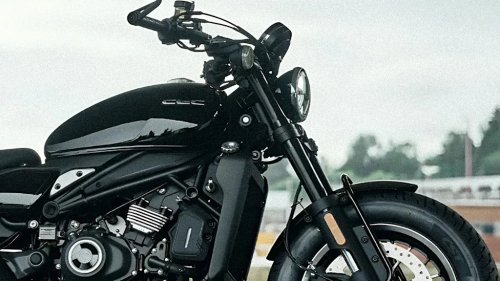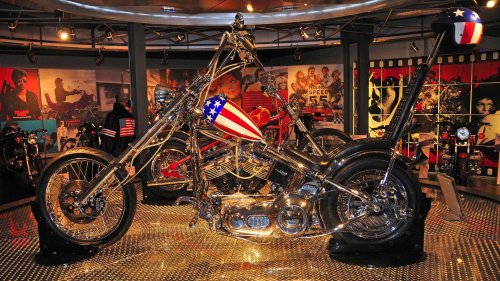
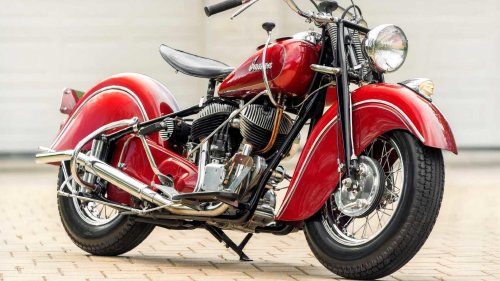
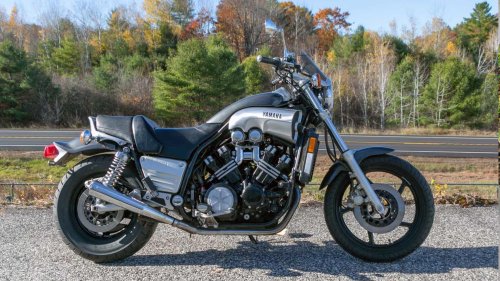
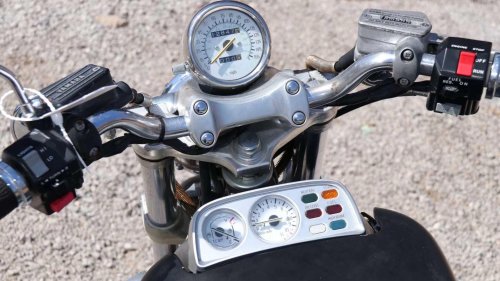
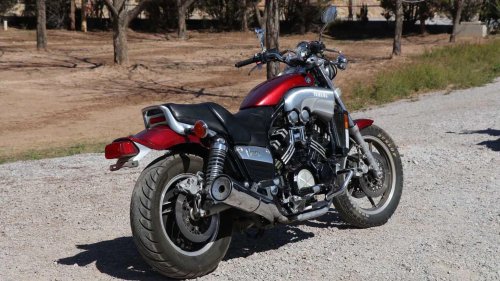
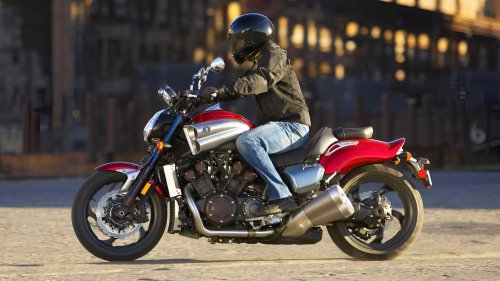


















Picture the scene: it’s the mid-1980s, and you’re a motorcycle rider. You want something that has power, and lots of it, but you’re not hugely concerned about corners so a sports bike is off the cards. Likewise, the desire for speed means that your typical cruisers are also not an option. If you were a car fan, you could buy a muscle car like the Chevrolet Monte Carlo SS or the Camaro IROC-Z, but as yet no such equivalent exists for motorcycles. At least, that’s what you thought.In 1985, Yamaha released a new bike that would shake up the industry, creating a new segment for so-called “muscle bikes”. The bike would receive instant acclaim, becoming “Bike of the Year” on release and remaining almost unchanged for over 20 years. Cruisers And Harleys Were Almost Synonymous MecumThe American market had a long history of adoring cruisers. It started at the turn of the 20th century, when both Indian (founded in 1901) and Harley-Davidson (founded in 1903) started to create large bikes with comfortable riding positions for daily use.The post-war world saw the rise of the “bobber” style, as riders modified military surplus bikes to make them lighter and quicker. Choppers rose to prominence in the 1960s, defined by longer front forks and high handlebars, and were helped in popularity by films like 1969’s Easy Rider, which featured the famous “Captain America Chopper."The cruiser was a truly American piece of machinery, signifying individuality and rebellion, helped both by pop culture and by motorcycle gangs like the Hells Angels, which typically rode Harley-Davidson cruisers. But while the bike was a popular and distinctly American option for riders, that’s not to say that everything was going well behind the scenes. Indian went into liquidation and closed its doors in 1953, while Harley-Davidson spent the 1970s in financial turmoil.Bring A TrailerWhile 1969 saw Easy Rider ignite a spark of consumer interest in choppers, it also saw Harley-Davidson taken over by American Machine and Foundry (AMF), whose changes led to a labor strike and lower-quality bikes, tarnishing the brand’s reputation. At the same time, Honda released the CB750. The bike, which is considered to be the first super bike, revolutionized the motorcycle industry, showing what was possible on two wheels and making Harleys look antiquated by comparison.Harley-Davidson would see a revival in the early 1980s as the brand was sold and underwent new ownership. In subsequent years they’d release bikes like the FXST Softail, which had the appearance of a hardtail but with a shock hidden in the bike to aid comfort, the high-performance XR-1000, and the pioneering FLT Tour Guide, reestablishing themselves as a purveyor of quality cruisers. But competitors didn’t stand still either.Japanese brands, which had typically focused on sports bikes, were starting to sniff around the cruiser market. Yamaha released the Virago in 1981, while Honda released the Shadow in 1983, Kawasaki released the Vulcan in 1984, and Suzuki released the Intruder in 1985.MecumHarley-Davidson, and the US at large, was worried by the influx of these popular foreign bikes. These cruisers had all the hallmarks of one, like V-twin engines, long wheelbases, and similar styling to Harley-Davidson, but with the technological and reliability improvements associated with Japanese bikes. They were so concerned, in fact, that President Ronald Reagan implemented a five-year tariff starting at 45% on imported bikes over 700 cc specifically to help Harley-Davidson, the amount coming down to 10% by 1987.This was enough to make some manufacturers produce lower-displacement bikes that came in at 699 cc, but in 1985, Yamaha threw tariff complaints out the window and released a 1,200 cc bike that would turn the cruiser world on its head. Yamaha’s VMAX Was A Step Outside Their Norm MecumTaking no notice of the tariffs that had limited some manufacturers (and which were still 20% in 1985), Yamaha unveiled its powerful new bike, the Yamaha VMAX. It had a cruiser layout and a 1,198 cc engine pushing over 140 bhp, which was massive for the time.It was designed by Akira Araki, who wanted to create a bike that could go fast in a straight line. He’d been inspired by “bridge races” in Mississippi, where two riders would line up on one side of a bridge and race to the other side, with the winner being the first to cross, and wanted to create something. With that goal in mind, he set about designing a bike to achieve it.The engine choice wasn’t an easy one, as Yamaha needed something meaty to get the speed they desired. A V-4 they’d originally used in the Venture Royale tourer was identified, but with only 90 hp, it wasn’t enough stock. To extract more power from it, Yamaha developed something completely new in the shape of V-boost, which, under high revs (around 6,000 rpm), allowed each cylinder to be fed by two carburetors instead of one through butterfly valves. By 8,000 rpm, the valves were completely open, and it unlocked more than 50 extra horsepower. For riders, it felt like a sudden surge of power.MecumWhile this made it an immensely powerful cruiser, it wasn’t actually developed to directly compete with the Harley-Davidsons of the time. Harley was about aesthetics, sound, and comfort on long rides in the 1980s, whereas the VMAX was singularly focused on power, to the point where even the name referenced top speed.From the moment it broke cover, the bike was a success. Its incredible acceleration, aided by the ground-breaking V-boost, boggled minds, while the design and attitude also won people over. Cornering response wasn’t praised quite as heavily, but the bike wasn’t made for corners. It was made to go fast in a straight line. And that’s exactly what it did.So fast was the VMAX that it didn’t belong to any current sub-genres of bikes, instead becoming known as the first “muscle bike” for its muscle car-style power and aggression. So, to put it to the test, a race was arranged between the VMAX and a Shelby Cobra 427 to see who was the king of acceleration.MecumThe 7.0-liter, 425-hp Cobra comfortably trumped the 1.2-liter, 145-hp Yamaha in terms of figures, so you’d be forgiven for thinking that it would decimate the bike in a straight line. You’d also be wrong, as the bike ran a faster quarter mile (11.34s vs 12.85s), was faster at the end of it (123-mph vs 115-mph), and went from 0-100-0 faster as well (12.35s vs 13.77s).The motorcycle had taken on Harley-Davidson, one of the most iconic muscle cars ever, and motorcycles in general, and beat them all. It would understandably go on to be named 1985’s Bike of the Year by Cycle World, setting the benchmark for others to catch up to. Why The VMAX Faded, But Still Holds Value YamahaThe VMAX was very much a product of its time. Yamaha had great ambitions for the VMAX, and it met them, but a lack of development in the bike while competitors moved forwards meant that it started to feel dated. It was also released three years before the inaugural Superbike World Championship, which brought with it a renewed interest in sports bikes. The VMAX had sports bike performance in a straight line, but was designed with a straight line in mind, meaning cornering was secondary.Yamaha discontinued the bike in 2005, some 20 years after it was first released, though it did create a second-generation VMAX with a 1.7-liter, 197 hp engine between 2009 and 2020.Today, the VMAX still has a cult following among devoted top speed enthusiasts. First-generation bikes go for slightly cheaper, owing to their age and smaller displacement, and you can pick one up for around $5,000. Second-generation bikes are more expensive, with good examples going for $13,000 upwards and a 443-mile example selling for $16,000 in 2025. This puts it over $1,000 more expensive than the 98 hp 2026 Harley-Davidson Street Bob; the cheapest new bike in their catalog.But remember, the VMAX was never about beating Harley. It was about speed above all else, and wanting to get across that bridge faster than the other guy. And, in 1985, that’s exactly what the VMAX did.Sources: Hagerty, Cycle World, Bring a Trailer