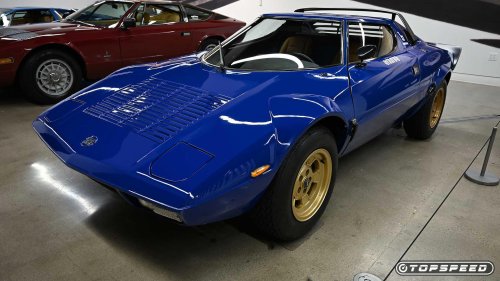
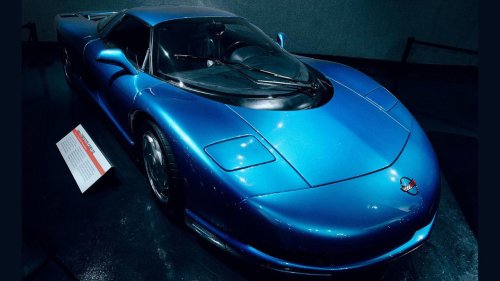
The 1960s heralded a new era for car design. Gone were the remnants of the age of the Industrial Revolution. Designers started thinking in a different way. Suddenly, fast in. Cars that looked fast, even while standing still, quickly caught the eye of the public. The idea was simple: create cars with a distinctive "wedge design" so that they looked as though they were literally cutting through the air. We all know, the higher the speed, the more of a problem air becomes. At speed, air pressure can cause all sorts of problems for fast automobiles, so designers wanted to give faster cars an "edge" to better slice their way down the road.Giorgetto Giugiaro and Marcello Gandini were the two most influential designers of the time. They were responsible for the wedge craze. It was their idea of a leap into the future of the automobile, one that challenged the norm by setting a new status quo. If you wanted to be a part of the future, the wedge was the way to go. It was the promise of a tech-driven era where cars could be more than just basic modes of transportation styled after their contents. Adorned not by ornaments, but rather a signature shape, one that transcended exterior and interior.With wedge cars, seating positions changed, interior controls, and the way people interacted with the machine itself changed. This was the point where we went from operating motor vehicles to piloting spaceships on the road. The following examples of wedge-era cars can all be found at the "Wedge Revolution: Cars on the Cutting Edge" exhibit at the Petersen Automotive Museum in Los Angeles, California.In order to give you the most up-to-date and accurate information possible, the data used to compile this article was sourced from various manufacturers and other authoritative sources, including a tour of The Petersen Automotive Museum exhibit on the wedge era. All images were captured using the Z6III mirrorless camera provided by Nikon. Lamborghini Countach Blue Lamborghini countach frontStarting off strong, we have the Lamborghini Countach, designed by Marcello Gandini himself. The Countach was one of the first wedge cars, and the one that put the shape on the map. It's the car that made the world excited about a bold new automotive era. It's, perhaps, the most iconic of the wedge-shaped era, and certainly the one that gave the era some real traction. Being one of a few wedge cars that actually made it to production and as a cultural success gave the futuristic shape a promising future. It also gave Lamborghini credibility, and it's a shape that influences their cars today. Limited Production Specs Lancia Stratos HF Zero Concept Orange Lancia Concept 1970 Lancia Stratos HF “Zero” front 3/4Designed by Bertone, the Lancia Stratos Zero concept broke cover in 1970 at the Turin Auto Show. The design, like many others of the time, was spearheaded by famed designer Marcello Gandini. It utilized the chassis of a Lancia rally car and was created to explore the future of aerodynamic design. There are no doors on the Stratos Zero concept, but rather a front hatch and retractable steering wheel, allowing occupants to enter from the front of the car. The car is powered by a 1.6-liter Lancia V-4 engine that makes 113 horsepower. The production Lancia Stratos wouldn't appear for another three years. Limited Production Specs Gold DeLorean DMC-12 By American Express American Express Gold DeLorean DMC-12 front 3/4Where we're going, we don't need roads. Well, time machines aside, the DeLorean DMC12 has never been bolder. Created by American Express as a marketing tactic, specially built DMC12s were gold-plated on top of the already controversial stainless-steel-bodied DeLorean. The original plan was to sell up to 100 examples, but only two ever made it to customers. The car was part of a special promotion by American Express targeting its most affluent customers. Pricing was set in the 1980s at $85,000, which in today's economy would be roughly $330,000. Oh, how wonderful it would be to jump back to the 1980s and make different decisions. Limited Production Specs Honda Civic "Lady" Front 3/4 view of green Honda Civic Designed by Sergio Coggiola, the Honda Civic "Lady" was actually a commissioned vehicle from 1976. Based on a normal 1975 Honda Civic, the Lady was meant to lean into the wedge era. The one-off Civic was meant to be delivered to Swiss importer Claude Sage. It never went into production, but debuted at the iconic Geneva Motor Show. The wedged Civic used a standard Civic powertrain and transmission, a 1.2-liter inline-four-cylinder, and a four-speed manual transmission. Limited Production Specs Chevrolet Aerovette 1968 Chevrolet Aerovette sideSo, you thought the C8 was the first-ever mid-engined Chevrolet Corvette? Not the case. Not even close. Chevrolet has been teasing Corvettes with the mid-engine layout for decades. It was, after all, the original vision behind Corvette's best advocate, Zora Arkus-Duntov. The Aerovette was originally built with a rotary engine, but last-minute changes gave the production-intent version an all-American 6.6-liter V-8.The production variant would have used a 5.7-liter V-8. The car was shown in 1970 as a concept, but wasn't approved for production until 1979. By that time, new management within GM decided a more traditional front-engine, rear-wheel-drive layout was the economical move, and ultimately, the Aerovette program was scrapped. Limited Production Specs Aston Martin Bulldog Front 3/4 of Aston Martin BulldogBuilt as a one-off concept in 1979, Aston Martin had a bit of a late entry to the wedge era. It was designed by William Towns and was intended for a limited production run. Bulldog was powered by a twin-turbocharged V-8. The target was 200 miles per hour and up to 700 horsepower. In testing, the team reached an honorable 192 miles per hour, no small feat for a single concept car. Ultimately, the project was deemed too expensive to achieve a full production run of such an ambitious vehicle. Limited Production Specs Maserati Khamsin TopSpeed | Garret Donahue Debuting in late 1972, the Maserati Khamsin was yet another example of wedge design from the Bertone design firm. Headed by Marcello Gandini, the Khamsin was the first project on which Bertone collaborated with Maserati. The brand already had a GT car, but wanted to provide something with a wedge design. The Khamsin was sold alongside the Kyalami, but offered a much sleeker and distinctive wedge front fascia. Created for those who demanded a front-engine, rear-wheel-drive layout, the Khamsin was an all-encompassing car for Maserati, putting the brand on the map during the wedge era, but continuing to build on their core clientele. Limited Production Specs AMC Amitron TopSpeed | Garret DonahueAMC's Amitron was the product of the mid-1960s, after several bills were passed to push EVs and the development of the technology required to make them viable transportation solutions. The Amitron was created during a time of conservation, but also with the influence of Italian wedge flair. To create the Amitron, AMC partnered with Gulton Industries to develop the battery tech and corresponding electronic components. Two versions of the car's lithium-nickel-flouride battery were developed, and it even featured a version of regenerative braking. It was to have a range of 150 miles and travel at up to 50 miles per hour, respectable numbers for the time. Limited Production Specs Chevrolet Cannara 1966 Chevrolet Cannara It's hard to believe, but the Cannara is based on a 1958 Chevrolet Impala station wagon. Designed and built by Ray Cannara, the car was an example of the influence the wedge revolution had, even all the way in California. Cannara, who attended ArtCenter College of Design, created his own wedge car using the components of existing Chevrolet products, including the 283 cubic-inch Impala engine of the time. Ray Cannara was influenced by designs coming out of the Italian design powerhouses in the 1960s and decided to put his newly acquired skills to the test. The Chevrolet Cannara concept highlights the ambitious nature of the wedge era on a global scale. Limited Production Specs Lancia Stratos Lancia Stratos front 3/4It's only one of the most coveted rally cars to ever exist, the legendary Lancia Stratos, lives on as a major highlight in the wedge era. Designed by Bertone and powered by a Ferrari Dino V-6 engine, the Stratos was the first ever purpose-built vehicle specifically for the World Rally Championship. It went on to win three years in a row, thanks to its racing-focused design. Stratos was able to secure multiple championships in other racing series, further proving its winning recipe. Lancia turned to Bertone, specifically Gandini, to design the Stratos, after a significant history of designing vehicles with Pininfarina. Limited Production Specs