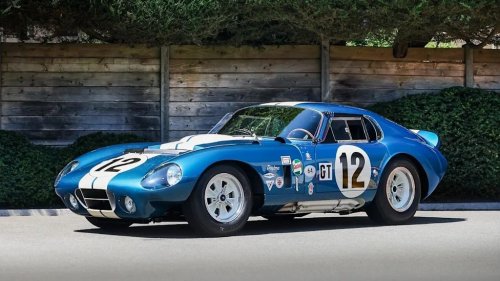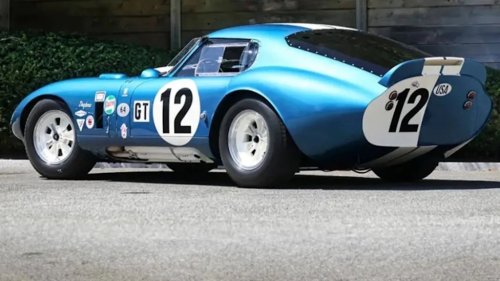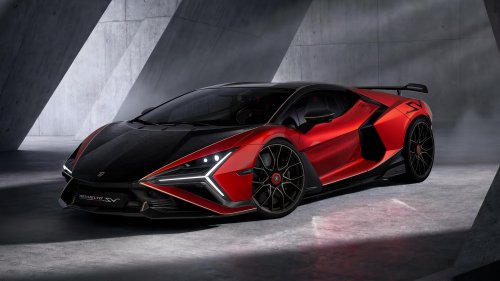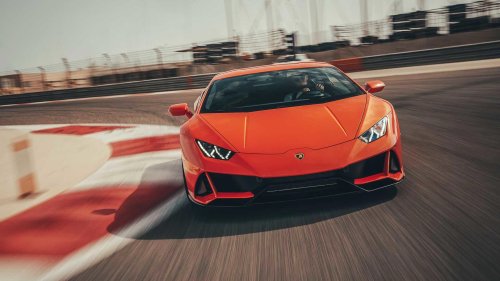
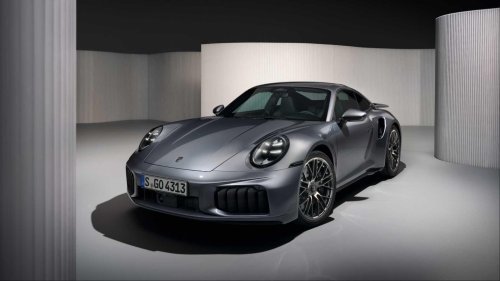
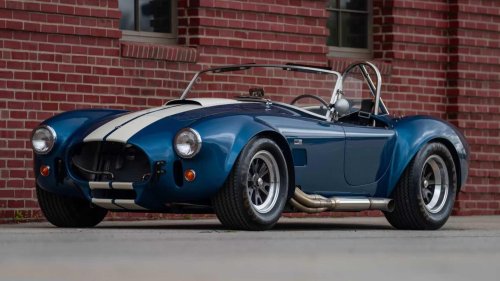
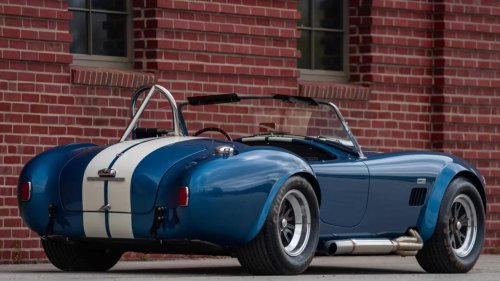
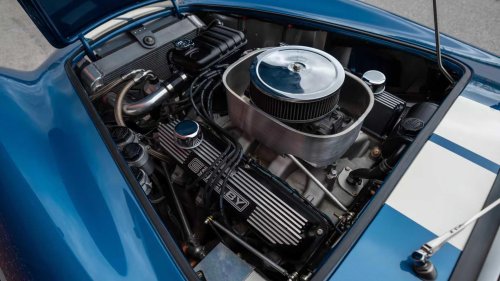
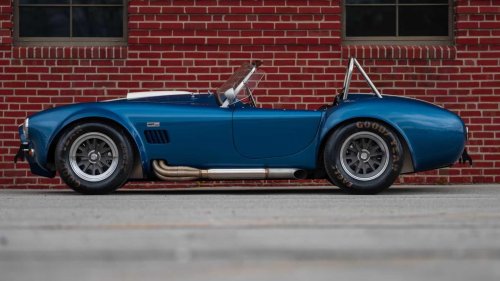
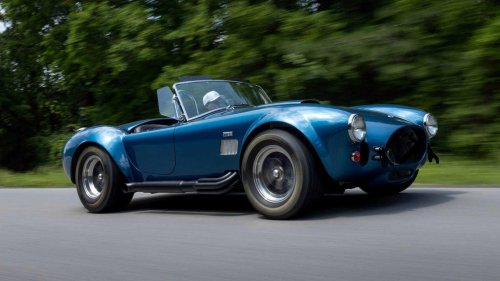


















Thirteen point eight seconds, that's how long it took one American car to reach from zero to 100 mph, and then to a dead stop. Not a 0-60 run, but zero to 100 and back to zero, in less time than an average TV commercial. That feat is sixty years old, and it still holds up today.In 2026, with electric motors, active aerodynamics, and more computing power than NASA had in the Apollo era, most of the world's most expensive performance cars only manage to match this American sports car from the 60s. Some are still chasing it.This isn't a story about a collector car selling at auction for nearly two million dollars. The real story is why a machine built in a California workshop in 1965 is still winning arguments today. The 13.8-Second Benchmark That Still Haunts Modern Supercar Engineers Mecum The man who set the record was Ken Miles, a British racing driver who served as Carroll Shelby's most trusted test pilot. Miles wasn't chasing a record in a closed environment with a full crew behind him. He did it to prove a point, and he proved it so well that the number has followed the automotive industry ever since.LamborghiniIf we hold that 13.8-second figure up against today's best and the math gets awkward fast. A Lamborghini Huracán EVO, with 631 horsepower and active aerodynamics, needs around 14 seconds for the same run. A Porsche 911 Turbo S is one of the most complete performance cars ever made, competing in the same neighborhood. Even modern Ferraris are only marginally quicker.PorscheThe reason the 0-100-0 test matters more than a simple 0-60 time is that it measures the whole car. It's not just about how hard the engine pushes. It's about how well the brakes, tires, and chassis hold together when everything is working at its limit, all at the same time. In 1965, one American car passed that test better than almost anything built since. Meet the Shelby 427 Cobra: The Car Carroll Shelby Built Too Fast for Its Own Era Mecum The car Ken Miles drove was a Shelby 427 Cobra in 1964-65 from 0-100-0 mph in just 13.8 seconds, and the idea behind it was almost laughably straightforward. Carroll Shelby took a small, lightweight British roadster, the AC Ace, hand-built in England out of aluminum, and stuffed the biggest American V8 he could find into it, the massive 427 (7.0-liter) Ford FE V8.The AC Ace was nimble and delicate. The Ford 427 V8 was a brutal, high-revving racing engine built to survive Le Mans. Shelby put them together and the result was, by any reasonable measure, a barely street-legal race car.Mecum Only 260 street-spec 427 Cobras were ever built. The 427 engine was never meant for road cars, Ford built it for racing, and supply was tight. Shelby's team in Los Angeles was assembling these things largely by hand. The whole operation was, by modern standards, chaotic.What came out the other end, though, was a car that weighed under 2,500 pounds and made somewhere between 410 and 485 hp depending on the setup. As a result, the 427 Cobra was the first car to achieve a sub-4 second time to 60 mph the world had ever seen, and a top speed of 160 mph. The Side-Oiler: Why The Ford 427 Engine Was Nearly Indestructible Mecum The 427 that Shelby used wasn't just any V8. It was a specific version that Ford engineers had developed for NASCAR and endurance racing to beat Ferrari at LeMans with the Ford GT40 MK.II. The V8 had one feature that set it apart from almost every other engine on the market at the time.In the standard Ford 427, oil is pushed to the top of the engine first, feeding the valvetrain before it works its way down to the crankshaft bearings. That's fine at normal speeds. But at sustained high RPM, the crank bearings don't always get enough oil fast enough, and that's where engines fail.Ford solved this by moving the main oil gallery to the side of the block, so pressurized oil reached the crank bearings first. Valvetrain second. The bottom end, where the stress is greatest at high speed, was always protected. That's why it became known as the side-oiler, and the reason why it could survive conditions that would destroy other engines. Shelby Secretly Used The 428, Then Ford Forced Him To Fix It MecumThe side-oiler 427 was in high demand. Ford was supplying it to multiple racing programs at the same time, and Shelby's workshop couldn't always get enough of them. According to Hagerty, around 100 of the 260 street Cobras left the factory with a Ford 428 Police Interceptor engine under the hood instead. Shelby's team tuned them as best they could, fitting a custom camshaft, carburetor, and intake. But the 428 was great for low-end torque, making it ideal for road use. But it wasn't the high-revving race unit buyers were paying for.Ford found out, and was furious. Shelby was forced to go back and sort it out. Many of those 428-powered cars were eventually retrofitted with the correct 427 engines. A Power-to-Weight Ratio That Makes Modern Performance Cars Look Soft Mecum The simplest way to understand what makes the 427 Cobra so fast is to look at what it weighed. At around 2,400 pounds, the Cobra was lighter than a modern Mazda Miata or a Honda Civic. Yet sitting in the middle of that tiny aluminum body was a massive big-block 427 cubic inch V8 making up to 485 hp in full competition trim. That works out to a power-to-weight ratio that most modern performance cars still can't match without adding forced induction, electric motors, or both.For comparison, a Dodge Viper, which many consider the Cobra's spiritual American successor, weighs around 3,400 pounds. A base Porsche 911 Carrera tips the scales at over 3,300 pounds. These are fast, capable cars. But they're hauling around a lot more mass.Mecum The AC Ace chassis was never designed for an engine like this. It was a lightweight British sports car built for small six-cylinder engines. Shelby essentially forced a racing powertrain into a body that had no business containing one. The result was a car that couldn't really be made today, because modern safety and emissions standards would never allow it. Why Collectors Are Still Paying Nearly Two Million Dollars For A 60-Year-Old Roadster Bring a Trailer In April 2026, a 1966 Shelby 427 Cobra with the chassis number CSX3355 sold for $1,842,500 at the Mecum Glendale auction. It was the top sale of the entire event.That number sounds extraordinary until you look at the wider market. According to tracking data from Classic.com, the average sale price for a street-spec 427 Cobra sits at around $1.4 million. CSX3355 landed well above that, which tells you something about where demand is heading.Only 260 street-spec cars were built. Sixty years of accidents, fires, neglect, and the occasional engine-out-the-back incident have reduced the number of surviving, unmodified examples. The supply shrinks every year. The number of people with the money and desire to own one does not.Mecum But there's something beyond simple scarcity driving these prices. The 427 Cobra sits at a rare intersection of motorsport history, genuine engineering significance, and a performance record that still holds up in 2026. Collectors are buying proof that Carroll Shelby built something special in 1965 that the rest of the automotive world spent the next six decades trying to answer. Most would argue it still hasn't been answered.In an era of four-figure horsepower numbers and software-managed everything, it says something that car enthusiasts keep coming back to is a hand-built aluminum roadster from 1965 with no traction control, no driver aids, and barely enough space in the cockpit to fit an adult comfortably.Carroll Shelby set out to build the fastest car he could with the parts available to him. The fact that the market keeps revaluing that achievement upward, six decades later, suggests the rest of the industry still hasn't fully closed the gap. At nearly two million dollars a unit, the 427 Cobra remains the most expensive argument in American automotive history.Source: Car and Driver, Classic, Mecum