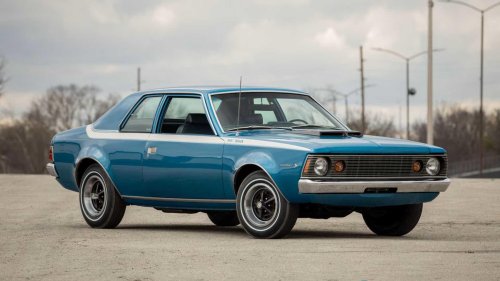
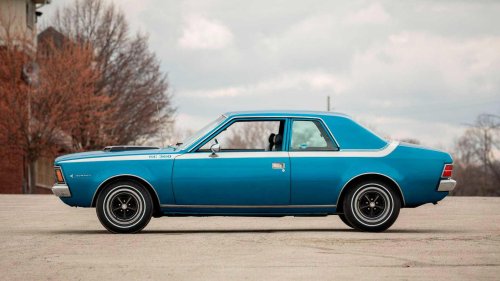
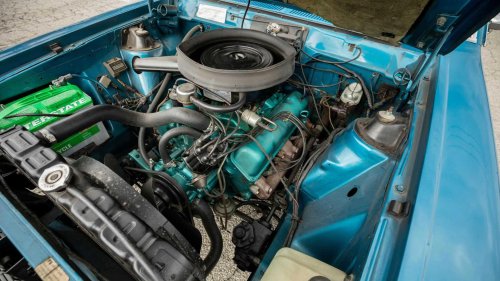
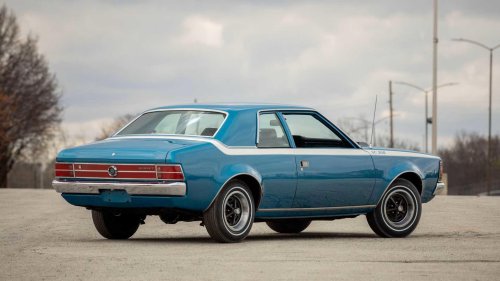
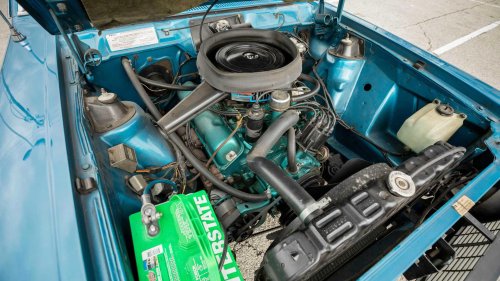
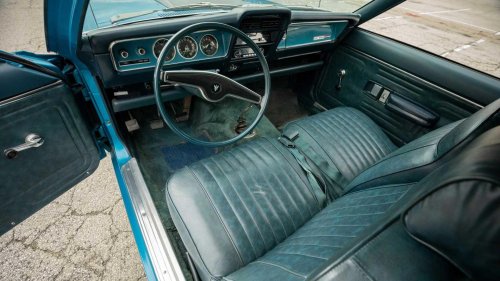


















In December 1970, American Motors took out a full-page ad in Motor Trend with a headline that read like a provocation: "Introducing a sensible alternative to the money-squeezing, insurance-strangling muscle cars of America." The car it was selling, the 1971 Hornet SC/360, looked like a well-optioned compact sedan. Under the hood sat a 360-cubic-inch V8. For an extra $199, you could add ram-air induction and 285 horsepower, all inside a body just 179.6 inches long and 70.6 inches wide.AMC planned to sell 4,000 of them, with optimistic projections pointing at 10,000. What actually rolled off the line was 784 cars before the model was dropped and never offered again. That makes the SC/360 one of the rarest one-year-only muscle experiments Detroit ever attempted, rarer than the Hurst SC/Rambler's 1,512 units and rarer still than AMC's own Rebel Machine at roughly 2,326 copies. Fifty-plus years on, gearheads who know their AMC history still argue it was one of the sharpest muscle car ideas anyone built and then promptly killed.The SC/360 lived at the intersection of everything collapsing in 1971: rising insurance costs, tightening emissions pressure, and an industry-wide retreat from the high-compression era. AMC saw the wall coming and built a car designed to go around it. The fact that it didn't work commercially is worth understanding. The car that came out of that attempt is worth owning. The Insurance Lobby Was Killing Muscle Cars In 1971 Mecum By 1971, the insurance industry had muscle cars in its crosshairs. Premiums on high-performance machines were climbing fast enough to push younger buyers out of the segment, and the major automakers were responding by quietly defanging their flagship performance cars. Lower compression ratios, tamer cam specs, and softer marketing were the order of the day at Chrysler, GM, and Ford. AMC, with a smaller budget and fewer product lines to absorb the hit, tried something different.The SC/360's standard specification was engineered with deliberate precision to hit a 12.5:1 weight-to-horsepower ratio, the specific threshold that kept insurance rates manageable under period actuarial tables. The Hornet's compact dimensions made that math work.AMC spec'd the base two-barrel 360 carefully enough to land just under the line, positioning the car as an insurable commuter with sporting intent. A buyer who wanted the real thing could then spend $199 on the Go Package and get an entirely different animal. The pitch was direct: buy the insurable version, upgrade discreetly, and drive something that looks like a grocery-getter but runs like a muscle car. It was one of the sharper plays anyone made in that era, and the market largely ignored it. A Compact Hornet Body As The Perfect Disguise Mecum The Hornet had replaced the Rambler American for 1970, giving AMC a clean compact platform with a 108-inch wheelbase. Compact was the operative word. At 179.6 inches overall length and just 70.6 inches wide, it was sized more like a sensible daily driver than anything you'd stage next to a Chevelle SS at the strip.That anonymity was the product. The base SC/360 wore 14x6 mag-style wheels, D70x14 Polyglas tires, and subtle rally stripes. Standard equipment included individually reclining front seats, a heavy-duty clutch, and a Space Saver spare. Nothing about it screamed muscle car from across a parking lot, which is exactly what the insurance-crisis pitch required. The sleeper formula only works if it actually looks like something else, and the Hornet body delivered on that completely.For drivers who knew what they were looking at, the details told the story without advertising it. The SC/360 badge was there.The flat-black hood scoop on Go Package cars stood out if you were looking for it. But casual observers weren't going to flag this as competition. That was deliberate design thinking, not a byproduct of AMC's limited styling budget. The $199 Go Package: Where The Real Story Lives Mecum The base SC/360 came with AMC's 360 cubic-inch V8 in two-barrel form, rated at 245 hp gross. The sticker sat at $2,663, roughly $40 less than a 1971 Plymouth Duster 340. The base car was already a reasonable package. The $199 Go Package was where it turned into something worth driving hard.For that money, the 360 gained an AM 4300 Model 1RA4 four-barrel carburetor, functional ram-air induction through the flat-black hood scoop, and dual exhaust.Output climbed to 285 hp and 390 lb-ft of torque. The Go Package also bundled a handling suspension upgrade, raised white-letter tires, and a large-faced tachometer on the dash. Transmission choices ran from a standard three-speed manual to an available automatic, but the one worth having was the Hurst-shifted Borg-Warner Super T10 four-speed (available exclusively on the SC/360 in the Hornet range). Of the 784 cars built, 304 came with the four-barrel and four-speed together. Those are the ones to hunt.Will it have a Hemi? No. What it had was 285 horses in a compact, light body at a price point that made the big-block alternatives look like financial decisions dressed up as enthusiast ones. The package made sense on paper and made more sense when you actually drove it. 784 Cars: Context For How Rare That Actually Is Mecum AMC had been building low-volume performance cars before the SC/360, and the SC/360 still came out rarer than all of them. The 1969 Hurst SC/Rambler ran to 1,512 units. The 1970 Rebel Machine reached approximately 2,326 cars. The SC/360 undercut both at 784 total, representing a fraction of the roughly 75,000 Hornets AMC built for the full 1971 model year.Production projections had ranged from a realistic 4,000 to an optimistic 10,000 units. Neither happened. The insurance headwind cut into demand even for a car explicitly engineered to sidestep the insurance trap. High premiums across the performance category kept mainstream buyers away regardless of how cleverly the spec was structured, and AMC didn't have the dealer network or marketing budget to close the gap. The commercial failure that resulted is what created the rarity collectors are chasing today.Conceptually, cars like the 1969 Dodge Dart GTS with its big-block option tried similar compact-muscle territory, but the Dart GTS moved far larger numbers than 784 total units across all configurations. The SC/360 had one model year and 784 examples, period. Finding one in any usable condition is a genuine event, not a routine classified search. Performance Numbers That Backed Up The Marketing Mecum Go Package, four-speed, 360 breathing through the ram-air scoop: the SC/360 ran 0-60 mph in the mid-six-second range and turned the quarter-mile in 14 seconds at 95 mph. With basic tuning work, enthusiasts pushed it into the 13s. Those numbers don't embarrass the car in any era.The price context makes them sharper. Big-block Challengers, 'Cudas, and Chevelles of the same year delivered comparable or better trap speeds, but they cost roughly twice as much as a Go Package SC/360. For a buyer who wanted genuine muscle car performance without the muscle car insurance bill, the math was almost unarguable. The SC/360 made its case on every run it got. The problem was never the car. The problem was finding buyers willing to make the calculation at all in a market that was actively walking away from the performance segment. What SC/360s Are Worth In The Current Market Mecum Hagerty's price guide puts a good-condition 1971 SC/360 with the four-speed manual in the $34,700 to $64,200 range. A documented RM Open Roads auction result — a Mustard Yellow Go Package car with the four-speed, hood scoop, dual exhaust, power front disc brakes, and Magnum 500-style wheels — hammered at $30,800, giving a real-world reference point for solid but not concours-grade examples.For a muscle car with 784 total units produced and a single model year to its name, those numbers reflect genuine market undervaluation. If the SC/360 carried a Mustang or Camaro badge, the conversation would be starting several multiples higher. AMC's underdog reputation is keeping these cars accessible, and it's unlikely to hold that way indefinitely. Celebrity collection exposure is already moving the needle: a former John Cena collection SC/360 surfaced recently, described as one of the finest surviving examples, the kind of high-profile attention that typically accelerates price discovery on overlooked models.The window for finding a driver-quality four-speed Go Package car at a sensible number is real. It is not permanent.AMC built the SC/360 as a precise answer to a structural problem, and the market said no anyway. The formula was right. The timing, the industry's retreat from performance, and a buyer base spooked by insurance costs all worked against it. That's the collector's advantage now: 784 cars, one model year, a documented auction floor, and a performance-per-dollar argument that still holds up on paper and on the strip. Hunt the four-speed Go Package cars. All 304 of them are worth the effort.Sources: Hagerty, Car And Classic, Clasic.com, How Stuff Works