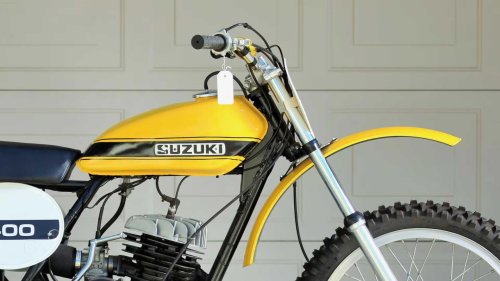
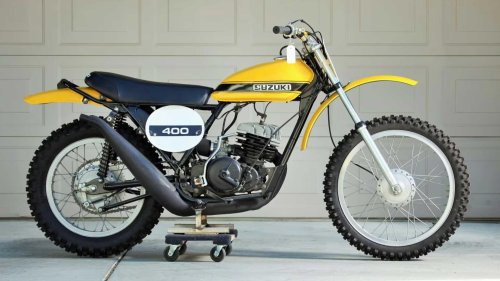
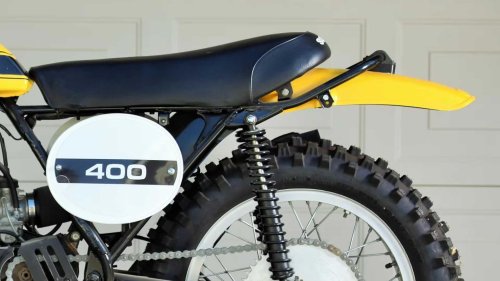
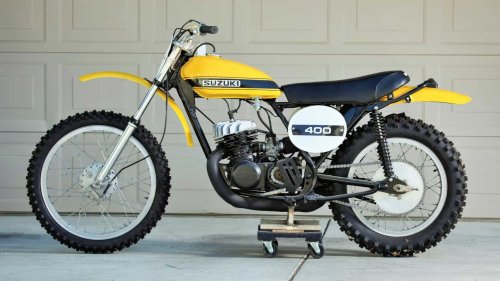
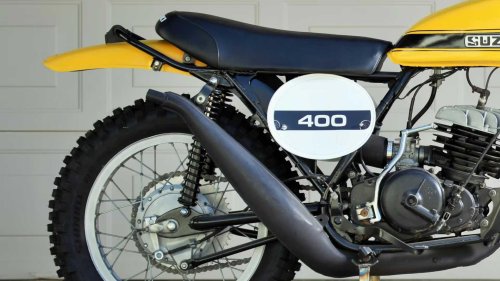

















In the early 1970s, motocross was where motorcycle manufacturers went to prove themselves. The Europeans had owned the Open class for years. Maico, Husqvarna, and CZ were the machines serious riders ran, and the Japanese were considered second-tier at best in the dirt.Suzuki decided to change that in the most aggressive way possible - by building a machine that matched the works race bikes on paper, priced it low enough to undercut everyone, and launched it in front of the cameras with one of the most famous faces in American television. What followed was not the triumph they had planned. The bike sold well, but not because it won races. Riders bought it because it was cheap and looked ferocious. Then they got on it, and some of them never quite forgave the decision. When Japan Went To War With Europe Mecum By 1971, Japan's presence in Open-class motocross amounted to very little. What Honda, Yamaha, and Kawasaki offered in the dirt were largely converted trail machines—fine for weekend fun but nowhere near the dedicated racing hardware coming out of Germany and Sweden. Suzuki had a different plan. Their works riders, Roger DeCoster and Joël Robert, had just swept both the 250 and 500 World Motocross Championships in 1971. The factory bikes they raced were exceptional. Built from magnesium and titanium, light and ferociously fast, they were rolling proof that Suzuki knew how to build a serious motocross machine. The question was whether any of that could translate into something a customer could buy and actually race.The answer they came up with was ambitious enough to worry anyone paying close attention. A full-size Open-class motocrosser, purpose-built from the ground up with a large-bore two-stroke engine, works-style plastic bodywork, electronic ignition, and a price low enough to make the European competition look expensive. Suzuki's press materials called it a machine for experts only. That turned out to be the most honest thing ever written about it. The bike earned a reputation so vivid, so consistent across riders and publications, that the story of finding one for sale at a suspiciously low price—owned by a seller with his arm in a cast—became a piece of motocross folklore repeated for decades. Meet The Suzuki TM400 Cyclone And What It Costs Today MecumThe machine at the center of the story is the Suzuki TM400 Cyclone, produced from 1971 through 1975. When it launched, the sticker price sat at $999, roughly $200 to $300 less than comparable European machines. That number looks different today. Based on comparable TM400 sales, the 1971 model now trades in a range from around $4,400 in good condition up to $6,592 for a clean original example. A 1974 example in highly original condition sold for $6,000 at Mecum in September 2023, showing that later years in exceptional condition can push above the range when the right buyer is in the room.The 1971 model commands the most collector interest and consistently brings the highest relative prices. The reason is straightforward: 1971 was the only year the TM400 wore its distinctive orange finish, making it immediately identifiable and visually unlike anything else from the era. Later years switched to a yellow and black scheme that, while still period-correct, lacks the same visual impact. If originality and provenance matter to you, the 1971 is the one to find. If your budget is tighter and you want a rideable survivor rather than a show piece, a mid-run 1973 or 1974 example in good condition represents the most value per dollar in the current market. What 40 HP Felt Like Without The Chassis To Match MecumOn paper, the TM400 sat right in the middle of the Open class field. The Husqvarna 400 Cross matched it at 40 hp, and the Maico 400 edged ahead at 42 hp from its own 400cc two-stroke. These were the machines the Cyclone was designed to beat. The numbers look similar. The behavior on a track was not. The Husqvarna was considered a serious, capable racer with predictable power delivery. The Maico was fast and tractable, rewarding skilled riders with a broad usable powerband. The TM400 had neither of those qualities. The engine produced its power in a sudden, violent surge that arrived without warning, not because the motor made more power than its rivals, but because it delivered that power in a way that made it almost impossible to manage.The dry weight of 242 lbs placed the Cyclone on the heavier end of the field, which would have been acceptable if the suspension and frame had been built to manage it. They were not. The forks went rigid on sharp impacts rather than absorbing them, and the rear shocks faded under sustained hard riding. The result was a machine that could genuinely pitch a rider over the bars or sideways into the dirt mid-corner when the power hit landed. It was not slow. Riders who could control it had a real chance of getting to the first turn first. Staying on it for a full race was the harder problem. The PEI Problem And Why Riders Couldn't Tame The TM400 Mecum The root cause of the TM400's behavior was the Pointless Electronic Ignition system, known as the PEI. The concept was genuinely forward-thinking - an electronic advance curve that eliminated the need to adjust ignition timing by hand. In practice, the calibration Suzuki shipped from the factory was badly off. Because the Cyclone was difficult to start cold, the PEI was set to run at full retard for starting, then advance the spark once the engine was running. The problem was that this transition was not gradual. Somewhere around 4,000 rpm, the ignition snapped from full retard to full advance in a single step, which is what caused the sudden, explosive power hit that threw so many riders off.The situation was made worse by the inconsistency of the system. The exact rpm at which the advance kicked in varied with temperature and other conditions, which meant the power hit could arrive at slightly different points in the rev range on any given lap. Riders described it as something close to Russian roulette. You would roll on the throttle exiting a turn, and either the bike would pull cleanly, or the back end would step out 3 feet without notice.A fix did exist and was relatively simple: swapping the PEI for the conventional points ignition from the TS400 enduro model, which gave a smooth, progressive advance curve. However, Suzuki never made this change at the factory level across the production run, leaving it to owners and a cottage industry of aftermarket suppliers who also offered frame stiffening kits, Koni replacement shocks, and replacement swingarms in an attempt to address what the stock machine would not. From Widowmaker To Collectible Mecum The TM400 ran in production from 1971 through 1975, with each model year bringing incremental changes that gradually addressed some of the machine's worst habits. The 1971 model, with its orange paintwork and original specification, is the one that carries the most historical significance. From 1972 onward, Suzuki switched to a yellow and black color scheme matching the factory race team, and the later years saw modest suspension and chassis revisions.None of those revisions fully solved the underlying problems, but by the 1975 model year, the bike was at least more predictable than its predecessor. The TM400 was discontinued after 1975 and replaced in 1976 by the RM370, which was everything the Cyclone should have been - a competent, reliable, genuinely raceable Open class machine that went on to earn a strong reputation.Today, the TM400 occupies a specific kind of collector status, the kind that belongs to bikes remembered more for their infamy than their success. There are not many left in original or restored condition. The ones that survive tend to have been raced hard, modified heavily, or both. Finding a matching-numbers example with its original PEI intact is the exception rather than the rule. Concours-condition 1971 examples, the orange ones, are the most sought after, and the market reflects that.For collectors, the TM400 represents something genuinely unusual: a machine that failed conspicuously at its stated purpose, yet holds a place in motorcycle history as the first serious purpose-built Open class motocrosser to come out of Japan. It is also the bike that made Suzuki understand exactly what it would take to get it right. The RM series that followed would prove they had learned the lesson.Sources: Suzuki, Classic.com, Bonhams, CycleChaos, PulpMX, Mecum, TopSpeed