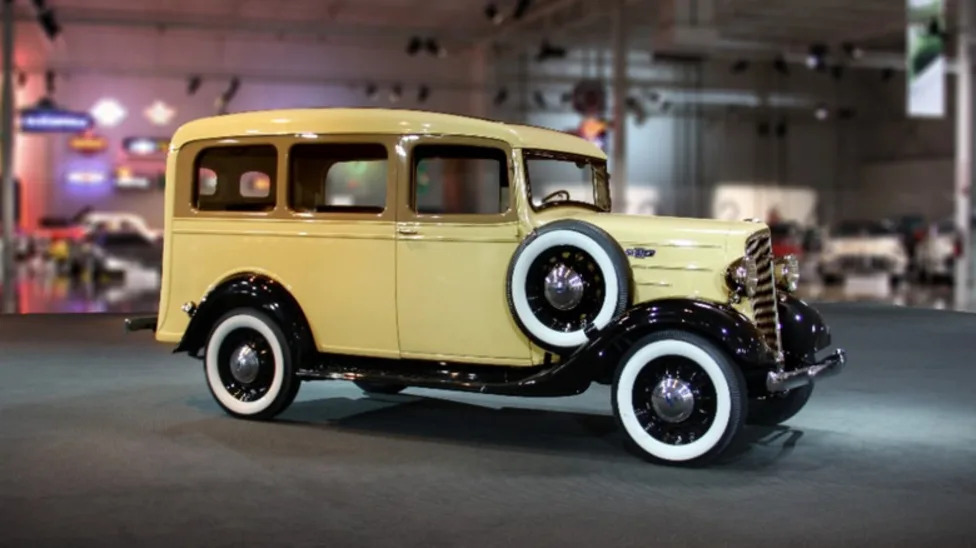
The Original Chevy Suburban Cost $675, Here's What It's Worth TodayJalopnikCharles KromeSat, September 12, 2026 at 2:05 PM UTCAdd us on GoogleGM ArchivesThe Chevrolet Suburban has a lot of honors on its resume: It's the only car with a star on the Hollywood Walk of Fame, for example, and it's also considered both the industry's first all-steel truck-based station wagon and its longest-running nameplate. In fact, the Suburban has been in production since the end of 1935, even during World War II when military versions were made.Of course, the Suburban has gone through its share of changes over the years, and that's something reflected in its cost. Chevy originally set a starting price of $675 to $685 for the machine. This was on par with the 1935 wood-bodied Ford 48 station wagon that came in at $670, which represents the equivalent of roughly $16,450 to $16,700 in 2026 dollars. So it's the opposite side of the coin compared to the Toyota Camry, which now costs thousands less than when it was introduced (when accounting for inflation).Meanwhile, the current Suburban — which was updated in 2025 along with the Tahoe — now opens at $63,700 before $2,795 in destination charges. At the top of the current Suburban range, you can easily take a High Country model above $105,000. Yet at least one vintage Suburban joined the 2026 models in the six-figure club: In 2021, a "refurbished" 1936 example went for $102,500 on Bring a Trailer. This may be a bit of an outlier, though, as another early Suburban went for about half that, $51,700, at a more recent Mecum sale in 2024.AdvertisementAdvertisementRead more: 12 Non-Corvettes That Are Powered By Corvette EnginesWhat did you get in 1936 for your $675?GM ArchivesThe 1936 Chevrolet Suburban Carryall was built using the same chassis as the brand's ½-ton commercial truck, which makes sense since these vehicles were essentially old-school airport shuttle buses. Instead of picking people up and dropping them off for flights, the vehicles mostly carried train and ship passengers to and from terminals. The Suburban's body was then based on a Chevrolet panel truck, now outfitted with rear windows and a dual-opening tailgate with flip-up and drop-down cargo doors. If more room was needed for cargo, some of the seats in the standard eight-passenger cabin layout — in a 3-2-3 configuration — were designed to be unscrewed and removed.Helping to haul all that around was a 207-cubic-inch Chevy "Stovebolt" inline-6 cylinder engine that famously got its name because some of its bolts looked like those from an old-fashioned wood stove. The mill made 60 horsepower to start, but that was soon bumped to 79 horses, and it was paired up with a 3-speed manual transmission to send those ponies to the vehicle's rear wheels. It would take about two decades, until 1957, before the Suburban was offered with four-wheel-drive. In the beginning, the option list was limited to items like a heater and a rear bumper.But what really helped the Suburban stand out was the all-steel body we mentioned above. Before that debuted, station wagons tended to feature canvas tops that could let the weather in, while their wood bodies weren't robust enough for commercial work. The Suburban's steel body fully enclosed the interior for a much more comfortable passenger experience — an early step toward today's SUVs.AdvertisementAdvertisementWant more like this? Join the Jalopnik newsletter to get the latest auto news sent straight to your inbox, and follow us or add us as a preferred search source on Google.Read the original article on Jalopnik.



















 +52 others