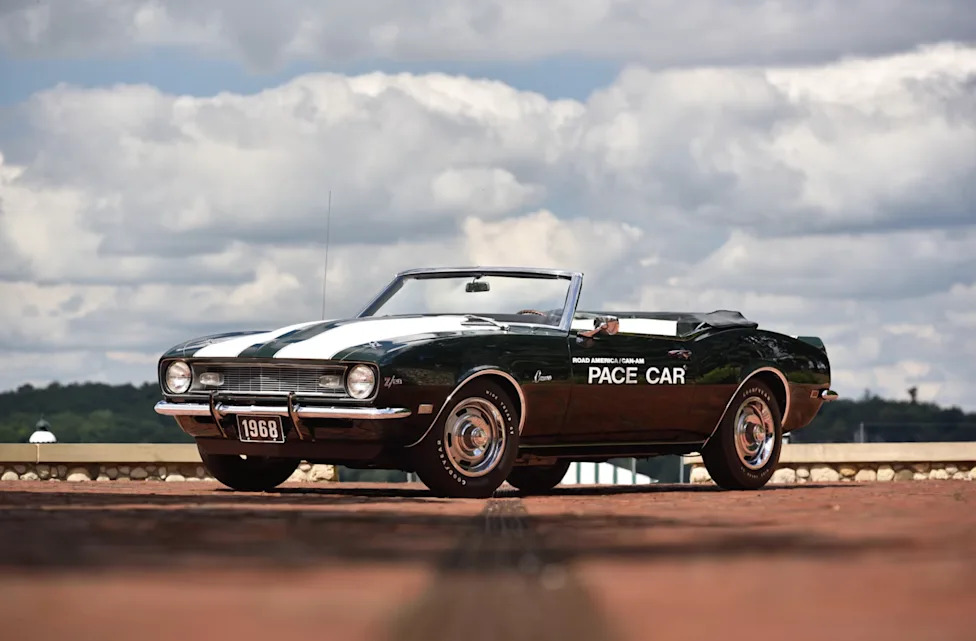
The Only Camaro Z28 Convertible Chevy Ever Built Was a Company Car for Its Own General ManagerBackfire NewsJohn LloydThu, September 10, 2026 at 1:09 PM UTCAdd us on GoogleThe Only Camaro Z28 Convertible Chevy Ever Built Was a Company Car for Its Own General ManagerCorporate executives don't usually get to raid their own factory for a one-off toy. Pete Estes did, and Chevrolet shut down an entire assembly line to make it happen.The result is sitting in Mecum's Kissimmee catalog as Lot R636: a 1968 Camaro Z28 convertible, VIN 124678N470441, finished in Fathom Green with a black top and a white interior GM's own paperwork calls "Parchment." It is the only first-generation Z28 convertible Chevrolet ever built, and unlike a styling-department show car or a hand-built prototype, it rolled down the regular Norwood, Ohio assembly line like any other Camaro. Chevrolet wouldn't sell the public a Z28 convertible until 1987, nearly two decades and 3.6 million Camaros later.A Convertible Wasn't Supposed to HappenThe Z28 itself was a workaround before this car ever existed. Vince Piggins, Chevrolet's product promotions manager (his actual job title, though everyone understood it to mean racing director), wanted a Camaro that could run in SCCA's new Trans-Am series, which capped engine displacement at 305 cubic inches. Chevy's small block didn't have anything that fit neatly under that number, so engineers spliced a 283's shorter-stroke crankshaft into a 327's four-bolt-main block and landed on 302 cubic inches, a displacement that never existed anywhere else in Chevrolet's lineup before or since. Piggins got that combination approved by ambushing General Manager Pete Estes with a prototype at the GM Proving Ground.AdvertisementAdvertisementThat relationship paid off again when Piggins wanted to keep expanding the Z28 program. Knowing Estes preferred open-top cars, Piggins special-ordered a heavily optioned Z28 convertible through Chevrolet's Fleet Special Order Department, the same internal channel used for executive company cars, under dealer code 00-500, Chevrolet's own Central Office.One Line, One Day, One CarOn July 15, 1968, Chevrolet stopped the Norwood assembly line specifically to build this Camaro. It was ordered, built and put on a truck to Detroit the same day, then routed to the Chevrolet Motor Division Central Office before making a stop most Camaros never see: the GM Technical Center in Warren, Michigan.There, engineers used Estes' new company car as a rolling test bed for Trans-Am hardware that hadn't been cleared for public sale yet: a cross-ram intake feeding two four-barrel carburetors, a hand-laid fiberglass cowl hood that would later be productionized as the ZL2 Special Ducted Hood, tube headers, Koni shocks and a 4.88:1 rear axle. If the general manager liked driving it, the parts had a much easier path to becoming regular production options, which is roughly what happened before the unhomologated pieces were pulled off the car later in 1968 for liability reasons.A Company Car With a Racing HabitEstes put more than 2,000 miles on the convertible before summer 1968 ended, and on September 1, 1968, it worked as the pace car for the Road America Can-Am race with Sir Stirling Moss driving, the kind of star-powered logbook entry that, much like Paul Newman's Daytona-winning Mustang, tends to follow a car through every subsequent ownership and sale. Pace car duty likely traces back to GM design vice president Bill Mitchell's well-documented habit of bringing prototypes and styling cars to that track.Traded for a Brand-New CorvetteEstes kept the car until a General Motors holiday banquet in December 1968, where a lottery seat next to him became the opening for Cadillac suspension engineer Tom Standen to make his pitch by letter. Chevrolet's Central Office sold him the convertible through Bill Markley Chevrolet, and Standen put roughly 20,000 miles on it over two years, including a road trip from Michigan to Key West. He sold it in spring 1970 to Vern Nye, a GM employee at the Lordstown plant, who drove it only 10,000 miles across the next two decades, and the car effectively disappeared from public view.AdvertisementAdvertisementIt resurfaced because a mechanic on Mecum Racing's IMSA Camaro team happened to work alongside Nye at Lordstown. Dana Mecum tracked the car down in 1990, and Nye's asking price was simple: a brand-new Corvette ZR1, which in 1990 was close to impossible to buy at a dealership for sticker price. Mecum paid a premium for a black ZR1 on the secondary market and traded it straight across for the Z28 convertible, later calling it the best car deal he'd ever done.A $100,000 Muscle Car, Then Gone AgainMecum had the car restored in 1990, a decision he has since called a mistake, since the convertible was still a largely original 40,000-mile survivor with nothing wrong beyond a dented fender. It's a useful reminder for anyone who stumbles onto a genuinely unmolested muscle car today: the collector market has swung hard from the 1990s instinct to strip and repaint toward paying a premium for honest, original survivors, and a repaint can't be undone once it's done.The convertible went unsold as the debut Main Attraction at Mecum's 1991 Spring Classic in Rockford, Illinois, but sold privately weeks later to collector Milt Robson for $100,000 plus a Pontiac GTO, the first muscle car ever documented selling above six figures. It made Popular Mechanics in 1992 and Car Collector in 1994 before changing hands twice more, ending up with Michigan owner Al Maynard, who commissioned restorer Scott Tiemann to refresh it and reinstall the unhomologated racing parts along with JL8-style four-wheel disc brakes. Muscle Car Review put it on the cover in 2002, calling it the rarest Camaro on the planet.A Stolen Purse and a Million-Dollar No-SaleIn 2004, Maynard consigned the convertible to Dean Kruse's Labor Day auction in Auburn, Indiana, promoted as one of the first million-dollar muscle cars. During the event, the purse containing the car's original factory paperwork was stolen out of Maynard's vehicle. Bidding topped $1 million but fell short of a $1.5 million reserve, and the car went home unsold, a fate that shows up more often than collectors like to admit when a one-of-one car meets a market with no real precedent to price it against, the same problem currently facing a Cold War-era land speed racer that can't even get an auction estimate.The Paperwork Comes HomeDana Mecum kept checking in with Maynard, and in 2007 the two agreed on a seven-figure price, making the convertible the first GM muscle car to sell above $1 million. Shortly after, Tom Standen, the car's first private owner back in 1968, read a book about the sale and called Mecum to say he still had the original paperwork from when he bought the car out of Chevrolet's fleet: the factory invoice, a Michigan sales tax receipt, a company-car validation letter, a warranty extension letter with a reissued Protect-O-Plate, and a copy of his own state registration, still in Chevrolet's original mailing envelope.AdvertisementAdvertisementA Protect-O-Plate was General Motors' embossed metal warranty card, stamped with a car's build data and swiped by dealers to validate service work; surviving examples get treated by collectors the way a birth certificate gets treated by a genealogist. Mecum had actually photographed that same paperwork for the 1991 auction catalog before it went missing for over a decade, so the returned documents effectively verified themselves against their own decades-old photocopies.Why the Paper Trail Is Worth More Than the PaintThat kind of documentation does more than satisfy curiosity. In six- and seven-figure muscle car sales, an invoice, build sheet or Protect-O-Plate tying a specific VIN to specific factory options is frequently what separates a genuine sale from a stalled one, because option codes stamped on a data plate can be replicated far more easily than a matching paper trail from the year the car was built. Anyone shopping in this segment should ask a seller for build documentation before asking about paint and chrome, a fresh restoration can always be redone later; a lost data trail generally can't be recovered at any price, just ask the family behind the 1970 Chevelle LS6 that hid its own build sheet under a front seat for 55 years.The Math That Makes It a UnicornChevrolet built 699,138 first-generation Camaros between 1967 and 1969, including roughly 63,000 convertibles (about 9% of production) and roughly 27,800 Z28 coupes (about 4%). None of those Z28s were convertibles. Chevrolet didn't offer a factory Z28 convertible to retail buyers until 1987, by which point the company had built 3.6 million Camaros total, meaning this fleet-ordered, assembly-line-built convertible remained the only one of its kind for the entire first twenty years of the model's existence.Kissimmee, January 15The convertible crosses the block as Lot R636 on Friday, January 15, at Mecum's Kissimmee auction, carrying more original documentation than most museum pieces and a resume that includes a Chevrolet general manager, an SCCA-adjacent parts test program and Sir Stirling Moss. Mecum's listing doesn't publish a pre-auction estimate, which for a car with no comparable sales on record is less an oversight than an admission that nobody actually knows what buying the only one of something is worth until somebody pays for it.AdvertisementAdvertisementWhoever wins the bidding will own a car that was never supposed to be for sale in the first place. Chevrolet built it as a perk, not a product, and it's taken more than half a century of dumb luck, a mechanic's tip and a stranger's saved mail to keep the story intact.



















 +47 others