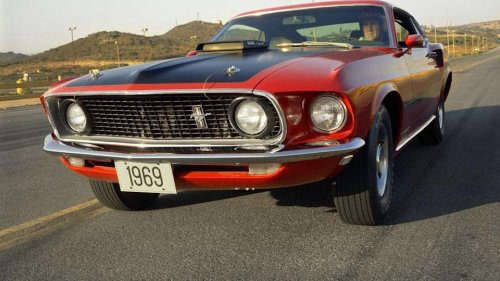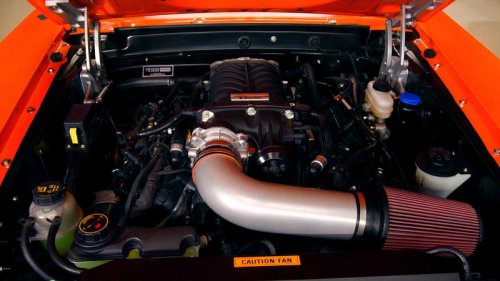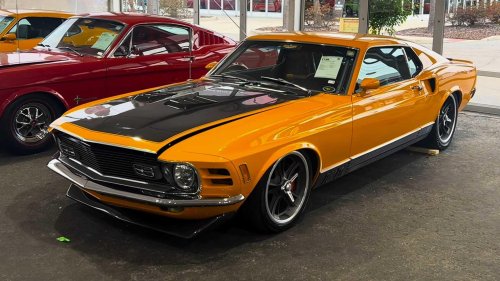
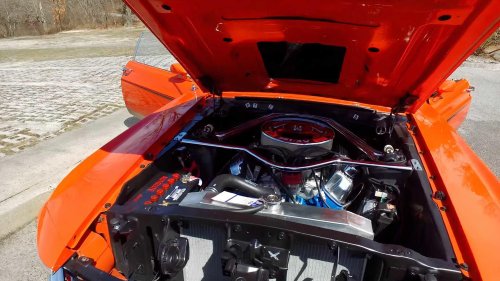
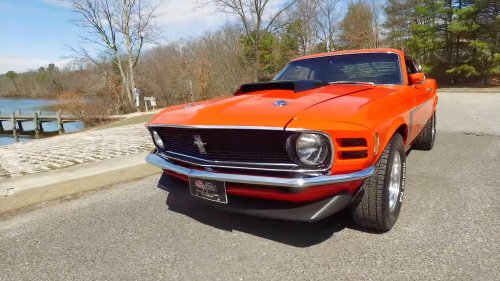
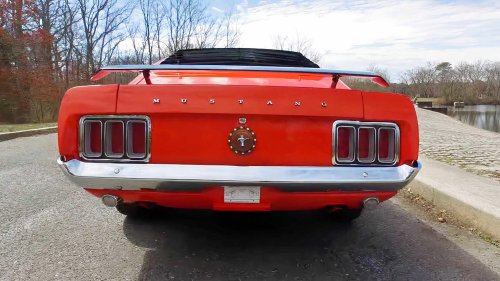
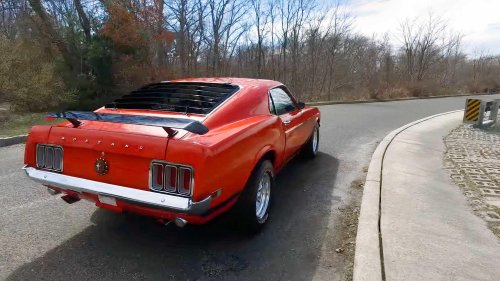



















The pecking order of Ford Mustangs by 1970 was established. If you were to compete in road races, a Boss 302 was the car to have, while the more exclusive Boss 429 was built for Ford's competition in NASCAR racing. Meanwhile, the right mix of street presence and V8 punch came from the Mach 1. There was a Mustang for everyone, which is why that 1970s era is remembered so fondly among enthusiasts.However, somewhere between the homologation heroes and the volume-selling Mach 1 sat a Mustang that looked every bit as rebellious as its siblings. It featured bold colors, aggressive graphics, and the kind of visual attitude that demanded attention at a stoplight. And yet decades later, it rarely gets mentioned in the same breath as the heavy hitters. Filling The Gap: When Looks Did The Talking via Jalopy Jeff (YT)TheFord Mustang in 1970, wasn’t just one fast car, but a series of fast cars that, depending on what you wanted to spend, could be configured in different ways. Base SportsRoofs left assembly lines with a 250 cubic-inch inline-six and a three-speed manual, but tick a few boxes on the order sheet, and that same car could have a higher-compression small-block, or a race-ready Boss package.The Mach 1, meanwhile, which made Ford kill off the GT for a decade, delivered strong performance and dramatic looks to match, with a black hood, bold stripes, and a rear spoiler that set it apart from the other fastbacks. It sold in huge numbers, but it still wasn’t the entry point for head-turning looks and attention.There was still a gap in the Mustang market, which Ford saw as an opportunity to fill. Instead of engineering another high-output variant (there were enough of them), Ford introduced a variant for the SportsRoof that emphasized color, graphics, and stance.It didn’t house a large engine, or require the hardware for racing. Instead, it transformed a standard Mustang into something that looked like it belonged in the same conversation as its more powerful siblings, without the high price tag.This version of the Mustang would define one of the most visually striking, yet least-discussed, Mustangs of 1970. The 1970 Mustang Grabber The Mustang Grabber was not a new car, but merely an appearance option built atop the SportsRoof. This wasn’t just a Ford muscle car with stripes, the Grabber option gave a regular fastback high-contrast paint, a matte-finish hood, side graphics, and a rear deck spoiler. Visually echoing the competition hardware seen on higher trims, the Grabber also paired the blacked-out hood with twist-style hood pins, despite the engine underneath being far more modest. The choice of colors, meanwhile, wasn't subtle and included Grabber Blue, Grabber Green, and Grabber Orange. Engine & Drivetrain Options Unlike the Mach 1, which came standard with a V8, the Grabber could be ordered with a few Ford engine options, such as Ford’s 250-cubic-inch inline-six to small-block V8s. The base option for entry-level buyers was a 250ci inline-six, rated at 155 horsepower and paired with a single-barrel carburetor. The most potent option was limited to a 351ci Cleveland (4V). This engine made 300 horsepower and featured large-port heads and a four-barrel carburetor.Transmission options, meanwhile, included a three-speed manual, four-speed Toploader manual, or Ford’s C4 automatic. Rear axle ratios varied depending on engine choice, with more aggressive gearing available on higher-output combinations.In effect, the Grabber six-cylinder car performed in the same manner as a six-cylinder Mustang. However, if a 351 Cleveland-powered Grabber was specified, it could potentially achieve good straight-line speed — 0-60 mph in the mid-6-second range and quarter-miles in the mid-14s, depending on gearing and traction.Futureclassicsllc (YouTube) In essence, the Grabber's potential was limited not by any particular area, but by the particular model that the buyer specified.What’s important here is what the Grabber didn’t include. Unlike higher-end versions of the Mustang, there were no unique cams, no upgraded suspension calibrations, and no special engine codes tied exclusively to the Grabber package. For example, the Ford Mustang Boss 302, which featured solid lifters, four-bolt mains, and competition tuning developed for Trans-Am racing as standard, the Grabber relied on whatever drivetrain the buyer selected. Chassis & Hardware The Grabber did not inherit the competition suspension that was given to the Boss cars either, nor did it inherit the standard V8 baseline that the Mach 1 used. Instead, it used the conventional 1970 Mustang coil spring front suspension and leaf spring rear suspension, with optional power disc brakes on the front axle, depending on the particular model used. Production & Market Position The estimated production of the Grabber version of the 1970 Mustang is around 5,000 units. This is a small number in comparison to the more than 40,000 Mach 1 units produced that year. As such, the Grabber is significantly rarer than the more popular Mach 1, despite not carrying the standard V8 powerplant. The Grabber, being more of an appearance package, allowed buyers to obtain the visual aggressiveness of the Mach 1 at a lower cost, and as insurance companies began to scrutinize high-horsepower engines more closely, it became an appealing proposition. Why The 1970 Mustang Grabber Was Overlooked 1970-mustang-fastback-grabber-edition-1 In 1970, Mustang enthusiasts measured a car’s worth in cubic inches and racing pedigree. The Boss 302 existed for SCCA Trans-Am competition, and the Boss 429 was built to satisfy NASCAR homologation. The Grabber, however, had no dedicated engine program, no competition hardware, and no exclusive VIN or engine codes. And in terms of performance depended entirely on the buyer’s chosen drivetrain.Mechanically, it was indistinguishable from a standard SportsRoof. Instead, the emphasis on appearance over mechanical exclusivity meant it never earned the halo-car status of its siblings. As a result, purists overlooked it, and early collectors dismissed it as just another standard trim.Yet perhaps the whole point of the Grabber was misunderstood. As a marketing exercise, it showed that style alone could work as effectively as horsepower, offering a strong visual presence without the costs and insurance implications of a high-output V8.In hindsight, it was a precursor to the variety of Mustang appearance packages which would shape the marketing of the brand for decades to come. Legacy & Collector Appeal Futureclassicsllc (YouTube)Though it was overlooked in its own era, the 1970 Mustang Grabber has since quietly earned a reputation among collectors. With only around 5,000 built, it’s rarer than many standard ’70 fastbacks, but its collector value is still held back by no dedicated engine program or racing pedigree - historically keeping its prices lower than halo models like the Boss 302 or Mach 1. This shouldn’t be a deal breaker for everyone however. It’s significantly rarer than the Mach 1, yet far more attainable than a Boss 302 or 429, making it a smart entry point for enthusiasts seeking a distinctive vintage Mustang.As with everything, authenticity drives value, meaning original Grabber colors, correct hood graphics, and verified build sheets are essential, as reproductions are common.Real-world sales show growing collector interest. A 1970 Grabber in original Grabber Orange was documented by Barn Finds, which sold for $35,000 as a “survivor” example, while a Grabber Blue SportsRoof went up for sale for $48,500 in 2025. While these numbers hardly put a Grabber in six-figure territory, examples can occupy a sweet spot for enthusiasts seeking rarity, originality, and visual flair. Style Over Speed, Legacy Over Hype Futureclassicsllc (YouTube) Although the 1970 Mustang Grabber may not have had the prestige of being a halo car like the Boss 302 or 429, it stood out as a visually aggressive, limited-production fastback that emphasized appearance to create an appealing yet attainable Mustang, just as insurance companies began to scrutinize high-horsepower engines more closely. As a result, it went without the performance to match its looks, but it remains rare, and represented Ford’s design emphasis on appearance — a philosophy that still shapes the Mustangs of today.Sources: Hemmings, Hemmings Muscle Machines, Car and Driver, MotorTrend, Mustang Monthly, CJ Pony Parts, Ford Factory 1970 Mustang Sales Brochures, Marti Auto Works