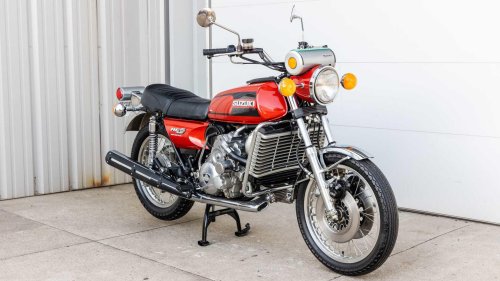
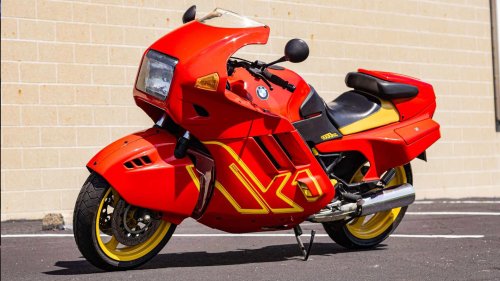
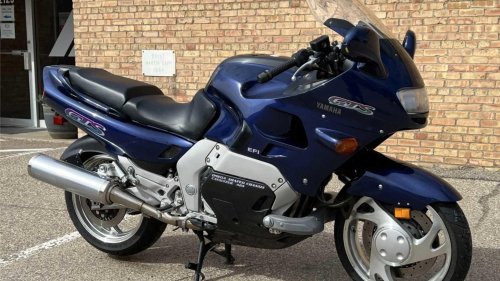
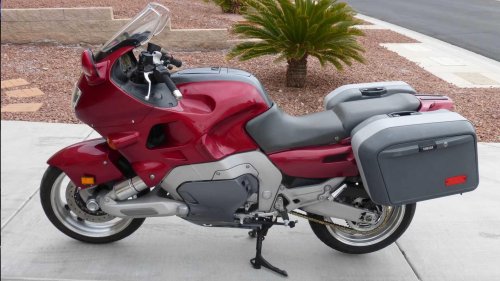
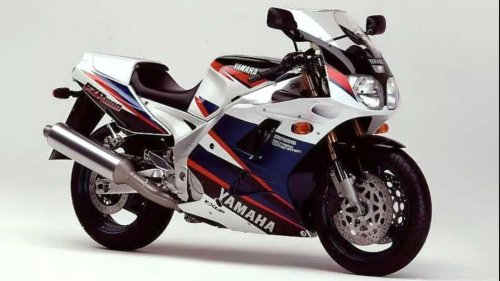
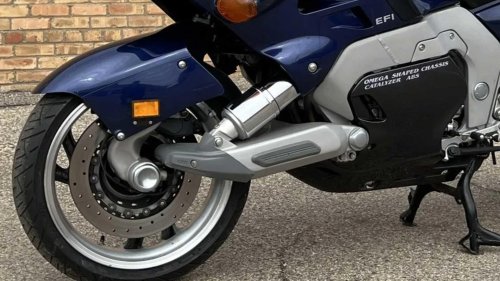



















The motorcycle world would be nothing without innovation. Motorcycles like the Honda CB750, the Suzuki GSX-R750, and the Suzuki Hayabusa irrevocably shook up the industry, marking clear before-and-after periods for both manufacturers and consumers. They, and other bikes like them, pushed motorcycles beyond where they were and to what they are today, helping to keep the motorcycle industry alive and thriving.But while manufacturers looking at new and interesting ways to make two wheels work has led to some of the most exciting, genre-defining motorcycles of their generations, others have simply fallen flat. Some were simply too advanced for their time, or their changes too radical, or their construction too costly to make sense for a normal rider. And when it comes to motorcycles that promised on paper but failed at dealerships, one is arguably the champion. Technological Advancement Doesn’t Always Lead To Sales MecumThere’s a fine line between advanced and avant-garde. Consumers want an improvement on the current, but not so much so that the price of the bike is pushed beyond similar offerings as that will kill demand. It’s a difficult balance to find, and one which manufacturers have occasionally got wrong in the past.Take the Suzuki RE5. Released in 1974, it was the only rotary Wankel-engined bike made by a major Japanese brand. The engine had proven itself in the car world and offered benefits like less vibration and freer revs, but coupled that with poor fuel economy and higher oil usage. It was also more expensive than similar motorcycles like the CB750, and two years later, Suzuki scrapped it.Of course, brands also need to be wary that the market they design the bike in won’t be the market they release the bike in. In steps the BMW K1. BMW wanted to change how riders viewed the brand, so they made the K1 futuristic, colorful, and exciting. They also gave the bike an all-over fairing, thinking that they could improve speed without overstepping the voluntary 100-horsepower limit on motorcycles in Germany by making it more aerodynamic. That fairing would also come in a range of garish colors to show that the K1 wasn't like other motorcycles.MecumThe problem was that while the fairing gave the bike an incredibly daring look, it also retained enough heat to occasionally burn riders and added weight to the bike. It was slower than Japanese competitors on release and, as a result, lasted from 1988 to 1993 and sold fewer than 7,000 units.Manufacturers need to create something that allows consumers to connect the dots between the problems with what exists now, and how their new product fixes them. Honda saw poor reliability, kick-starts, and dated designs, so it fixed them with the 1969 CB750 and its Japanese manufacturing. Suzuki saw that sportbikes were heavy and inefficient, so it solved that by making their new 1985 GSX-R750 much lighter.Yamaha saw that brake dive and stability were a problem so, in 1993, it released a bike with forkless suspension. The problem: It solved an issue that people didn’t have. The Yamaha GTS1000 Answered A Question Nobody Asked Bring a TrailerFirst released in 1993, the Yamaha GTS1000 was to be the brand’s “halo” bike. It was the most technologically advanced of the time and had a number of innovations, chief of which was the forkless front suspension.Turning to former motorcycle racer James Parker's RADD, Inc. (RADD standing for Rationally Advanced Design Development), Yamaha used his company's front swing arm suspension system. The idea here was that a swing arm would eliminate brake dive, reduce weight, and improve steering as forces from the road weren’t being transferred directly up into the handlebars.It wasn't the first bike to do it, as it had appeared both on race bikes (Honda and Elf had experimented with it in the 1980s, with British rider Ron Haslam taking the 1986 Macau Grand Prix atop the Elf-3) and road bikes like the Bimota Tesi 1D in 1990 and the Britten V1000 in 1991. The GTS1000 was similar again to the Britten by incorporating a more frameless approach.MecumWith the front end not attached in the standard way, it opened up the frame to be altered too. Both the Britten and the GTS1000 used the engine as a stressed member, giving the bikes more rigidity and lowering the center of gravity. But while the Britten was frameless, the GTS1000 had a cast aluminum "Omega" chassis, named after its horseshoe appearance. The similarity to the Britten should sound promising, given the Britten was so highly-regarded for its radical approach, but the GTS1000 was supposed to be a consumer-friendly, mass-market offering and not a $100,000 bespoke racing machine.The innovations on the GTS1000 didn’t stop at the swing arm suspension though, as prominent as that might be. Another trick the bike brought to the party was ABS. Still highly uncommon for motorcycles at the time, the motorcycle's Anti-Lock Braking System was brought over from the preceding FJ1200 and added another element to the GTS1000.Another feature from a previous bike was the engine, this time taken from Yamaha’s incredibly popular FZR1000. Detuned to around 100 horsepower, the engine improved on the integration on the FZR by using fuel injection rather than carburetors, which offered better fuel efficiency, reliability, and better emissions.YamahaBut for all its considerable technological investments, the motorcycle just wasn't popular with riders. It lasted only one year before being pulled from the market in the United States and continued until 1999 elsewhere (giving it just a six-year lifespan). The motorcycle's cost was undoubtedly part of this, as retailing for $12,999 in 1993 meant it was more expensive than some cars at the time and far more than other Japanese competitors.Then there was the weight. At over 600 pounds wet, it wasn't exactly lightweight. The preceding FJ1200 weighed 586 pounds wet despite having an extra 20% displacement, while the competing Honda CBR1000F came in at 564 pounds wet.The looks and styling were always going to be divisive, but the real issue was that people weren't dissatisfied enough with traditional forks to overlook the weight and price. Sure, it might have provided a slightly smoother ride, but not enough to make people switch. And if people don’t see the value, it’s never going to sell. The GTS1000 Stands The Test Of Time Bring a TrailerWhile its sales record may leave something to be desired, the motorcycle wasn't a complete failure. Despite being hailed as genius, the RADD suspension didn't make a reappearance, nor did the Omega chassis. But ABS and fuel injection were carried across to other motorcycles and are commonplace today.Whether the motorcycle can be called "ahead of its time" is a question nobody really has the answer to, given that "its time" arguably never came, but it's still appreciated today, and that initial skepticism makes for a rarer motorcycle today.Ultimately, the GTS1000 is a reminder that not every innovation is a winner and not every alternative is better. Innovation itself doesn’t exist in a vacuum and, while technological progress might be possible, innovation without demand won’t lead to success. But this doesn't mean Yamaha was wrong to do it—far from it. Thomas Edison said, “I have not failed, I’ve just found 10,000 ways that won’t work.” While the GTS1000 didn’t work this time, it very well could have done. And Yamaha were the ones bold enough to try.