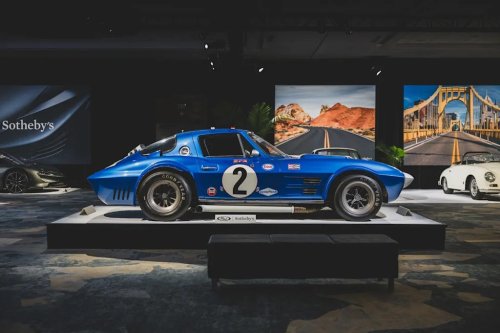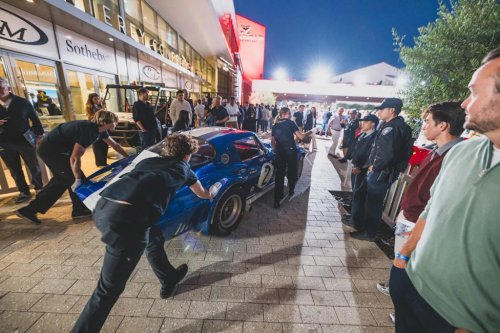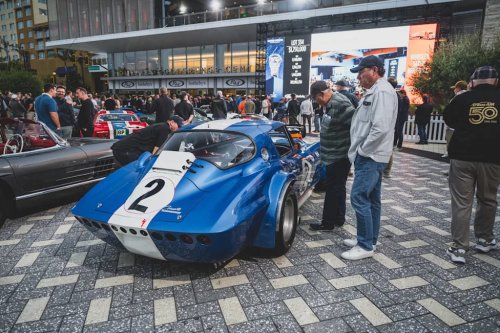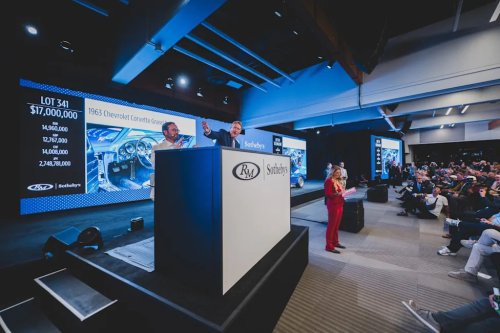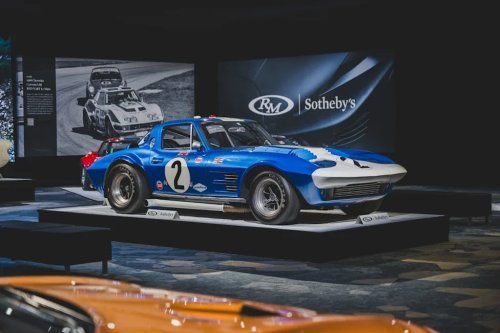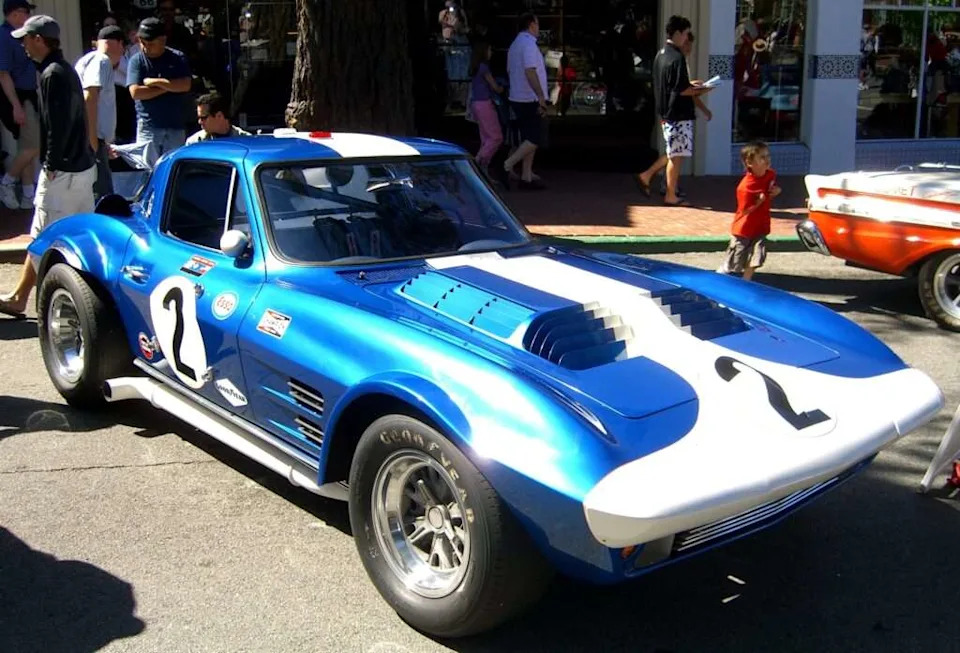
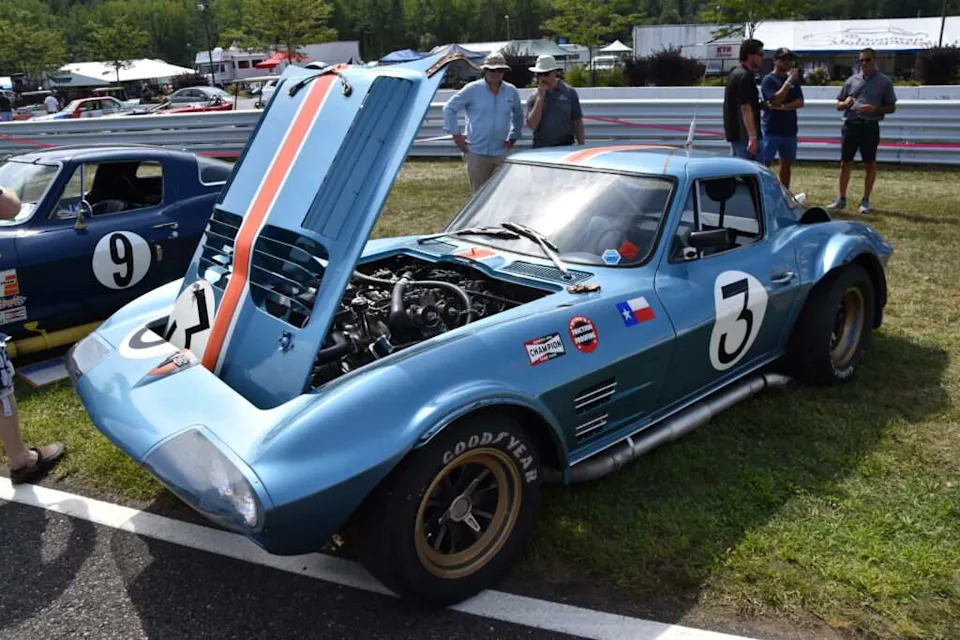


















The Grand Sport’s Owner Spent 23 Years Driving a Car He Could Have Locked Away. That Is Why It Brought $18.7 Million.Modern Car CollectorShawn HenryMon, September 14, 2026 at 6:37 PM UTCAdd us on GoogleIn 2003, California collector Larry Bowman bought one of the five 1963 Chevrolet Corvette Grand Sports that General Motors built before its executive suite shut the program down. He then did the thing that almost nobody who acquires a car of that stature does anymore. He took it apart, spent more than four years and something approaching a million dollars putting it back together, and then he drove it — at Goodwood, at Laguna Seca, at Sonoma, in front of judges and spectators and cameras, for the better part of two decades.On the Saturday night of Monterey Car Week, Corvette Grand Sport chassis 003 brought $18,705,000 at RM Sotheby's against a pre-sale estimate of $11 million to $13 million, making it the most expensive Corvette ever sold at auction and the third-most-expensive American car, behind only the $42.9 million Shelby Cobra Daytona Coupe sold the same week and the 1935 Duesenberg SSJ. We covered why the car itself matters when the hammer fell. Now that the result has finished circulating through the mainstream press, a narrower question is the more useful one: why this Grand Sport, and not one of the other four?The answer has remarkably little to do with rarity. All five survive. All five share the same origin story, the same engineer, the same clandestine birth. What separates chassis 003 is that it spent the last twenty-three years accumulating evidence of what it is, during precisely the period in which the collector market reorganized itself around that kind of evidence. Bowman did not protect this car's value by putting it away. He built it by using it.A Million-Dollar Restoration Was Buying Something Other Than PaintThe 2003 restoration was carried out by Terry Scarborough Racing in Sonoma, and RM's catalog puts it at well in excess of 4,000 labor hours and an investment approaching $1 million. Those figures are impressive in isolation and nearly meaningless without the decision behind them. TSR did not return chassis 003 to a static concours standard. It returned the car to its 1964 Sebring configuration — the specification it wore when A.J. Foyt and John Cannon ran it for John Mecom Jr. — and it kept the car capable of actually running.AdvertisementAdvertisementThat is a choice with valuation consequences, and it is one collectors of competition cars face constantly. Restoring a racer to a specific date in its campaign history means committing to one chapter of the car's life and, by implication, setting the others aside. Choose the wrong chapter and you have spent a fortune documenting the least interesting year of the car's existence. Bowman chose the entry that put the Grand Sport on the grid at Sebring with the reigning Indianapolis 500 winner in the seat.The mechanical inventory reflects that decision rather than a preservationist one. The engine bay carries an all-aluminum 377-cubic-inch V8 with four Weber 58 DCOE carburetors on a cross-ram manifold, built by Ted Yamashiro at Techcraft and good for more than 600 horsepower and over 600 pound-feet of torque in a car that weighs roughly 1,900 pounds against a production Corvette's 3,200. An earlier rebuilt small-block from the Tom Armstrong era accompanied the car to the block. The tubular frame, the hand-laid single-piece body, the dashboard and the seats are original.The Case Against This Car, and Why It Did Not MatterRead that inventory the way you would read a 1963 split-window road car and chassis 003 looks compromised. It is not on its original engine. It was worked over by a fiberglass specialist in 1975 and repainted into Mecom blue. It has been apart at least twice and was rebuilt at enormous cost less than twenty years ago. In the vocabulary the market uses for restoration versus preservation, this is a heavily restored automobile with a modern engine build in it.It sold for $18.7 million anyway. The reason is that the scoring system developed for production cars does not transfer to purpose-built racers, and anyone applying it here will consistently misprice this segment. A matching-numbers Corvette is valuable because the drivetrain is evidence that the car left St. Louis as advertised. A Grand Sport had no such assembly line to leave. Five chassis were hand-built, campaigned hard, re-engined repeatedly by independent teams, rebodied, converted between coupe and roadster configurations, and passed among racers who were interested in lap times rather than in posterity. Originality of components was never going to be the test.The File Is the AssetWhat authenticates a competition car is the chassis and the paperwork. Chassis 30837X100003 has an ownership chain that has never gone dark: Mecom Racing from 1963, then Alan Sevadjian, who bought it at nineteen and whose father Ed drove it, then Mike Golas, then Alan Foster in Palo Alto, then Robert Paterson in Woodside, then Tom Armstrong from 1989, then Bowman from 2003. Seven custodians across sixty-three years, every transition documented and supported by period photographs, racing records, restoration files and an archive of spare components.AdvertisementAdvertisementThe competition record is equally legible. Dick Doane campaigned the car through the 1963 SCCA season and led the Road America 500 outright for 93 laps before retiring. It ran Nassau Speed Weeks with Jim Hall, Augie Pabst and John Cannon aboard. It took second in class at the 1964 Sebring 12 Hours with Foyt and Cannon, returned to Nassau that December, and finished third in class at Sebring again in 1965 with Delmo Johnson, Dave Morgan and Ed Sevadjian sharing the drive. That is a genuine campaign, not a single entry followed by six decades in a barn — a distinction that separates serious competition provenance from the merely decorative, as we noted with the ex-James Garner AIR Corvette.Provenance Compounds When You Use the CarGrand Sport chassis 003 during Monterey Car Week in August 2007, the same month it took Best of Show at Carmel's Concours on the Avenue. Photo: Writegeist via Wikimedia Commons, CC BY-SA 4.0.Here is the part experienced buyers should internalize. In the road-car market, originality and use sit in tension: every mile is a small withdrawal from the account. In the competition market they do not. A race car's identity is corroborated every time a credible third party accepts it — an organizer issuing an entry, a concours admitting it to the lawn, a museum borrowing it for an exhibition, a registry certifying it. Each of those is an outside institution putting its own reputation behind the claim that the car is what its owner says it is. Twenty-three years of that cannot be assembled retroactively.The ledger under Bowman is long, and its length is the point. Best of Show at Carmel's Concours on the Avenue in August 2007. The Palo Alto Concours d'Elegance. The Quail, A Motorsports Gathering. The Petersen Automotive Museum's Corvette racing exhibition. The Goodwood Festival of Speed in 2010. The Sonoma Motorsports Festival. Multiple Rolex Monterey Motorsports Reunions. The Corvette 70th anniversary celebration at Laguna Seca in 2023, followed in 2024 by an award naming it the best Corvette ever to race at that circuit, and a short film shot at Thunderhill by Johannes van Overbeek.Earlier custodians contributed to the same file. Bloomington Gold issued a Special Collection certificate in 1994 and inducted the car into its Hall of Fame in 1997, among the first 33 Corvettes so honored. The National Corvette Restorers Society presented a Special Interest Award at its 2002 national convention. Each entry is a dated, attributable, third-party statement about the car's identity, and collectively they constitute an authentication record that no amount of money can buy after the fact.AdvertisementAdvertisementEvery one of those appearances carried real downside. Grand Sports are quick, Goodwood's hill has claimed better-documented machinery, and a serious accident would have converted an eight-figure asset into a restoration argument. Conventional logic says a car at this level belongs in a climate-controlled room with the tire pressures checked quarterly. Bowman took the other side of that trade for two decades, and the market paid him roughly 44 percent above the high estimate for it.The Supply Picture Behind the NumberGrand Sport chassis 004 is part of the Revs Institute collection in Naples, Florida. Institutional ownership keeps most of the five permanently out of the market. Photo: Charles/usf1fan2 via Wikimedia Commons, CC BY 2.0.Chassis 002 resides at the Simeone Foundation Automotive Museum in Philadelphia and last came to auction in 2009, where it failed to sell against a high bid just under $5 million. Chassis 004 belongs to the Revs Institute in Naples, Florida. Institutions do not sell; their entire purpose is not selling. That leaves a global buyer pool chasing a float of perhaps one or two cars, and chassis 003 has now disappeared into another private collection.Compare that with the previous Corvette benchmark. The 1957 Corvette SS, Duntov's earlier factory racer, brought $7.7 million at RM Sotheby's in Miami in 2025. Chassis 003 sold for roughly 2.4 times that figure eighteen months later. The same weekend, a 1967 L88 — a car whose value rests on factory documentation rather than campaign history — failed to find a buyer across town at Mecum. The two results are not a contradiction. They are the same rule applied twice.What Serious Buyers Should Take From ThisFirst, for a purpose-built competition car, the campaign file has become the dominant pricing variable, and it is the only component that genuinely cannot be restored, fabricated or improved after the fact. A shop can build you a better engine than the one the car raced with. Nobody can build you an entry list.AdvertisementAdvertisementSecond, provenance is not a fixed quantity that a car either has or lacks. It compounds when the car is shown, entered, judged and certified, and it decays quietly when a car goes dark for twenty years and its former owners die without leaving records behind. The gap between those two trajectories is now wide enough to see in hammer prices.Third, the exposure calculus has inverted. For a significant competition car, the risk of campaigning it is now demonstrably smaller than the risk of letting its documentation go stale. That is a meaningful shift in collector behavior, and it sits alongside the broader repricing of American racing machinery that defined this year's Monterey week and produced the $42.9 million Shelby Daytona Coupe.A car locked in a vault stops adding to its own file. A car that is shown, entered, judged and accepted keeps writing it. What changed hands at Monterey for $18,705,000 was not really 1,900 pounds of fiberglass, aluminum and tubular steel. It was sixty-three years of uninterrupted testimony about what that fiberglass is — and twenty-three of those years were volunteered by a man who could simply have put the car away.Full catalog details and the complete ownership and competition record for chassis 30837X100003 are available from RM Sotheby's.Join our Newsletter, follow our Instagram page, and follow us on Facebook.