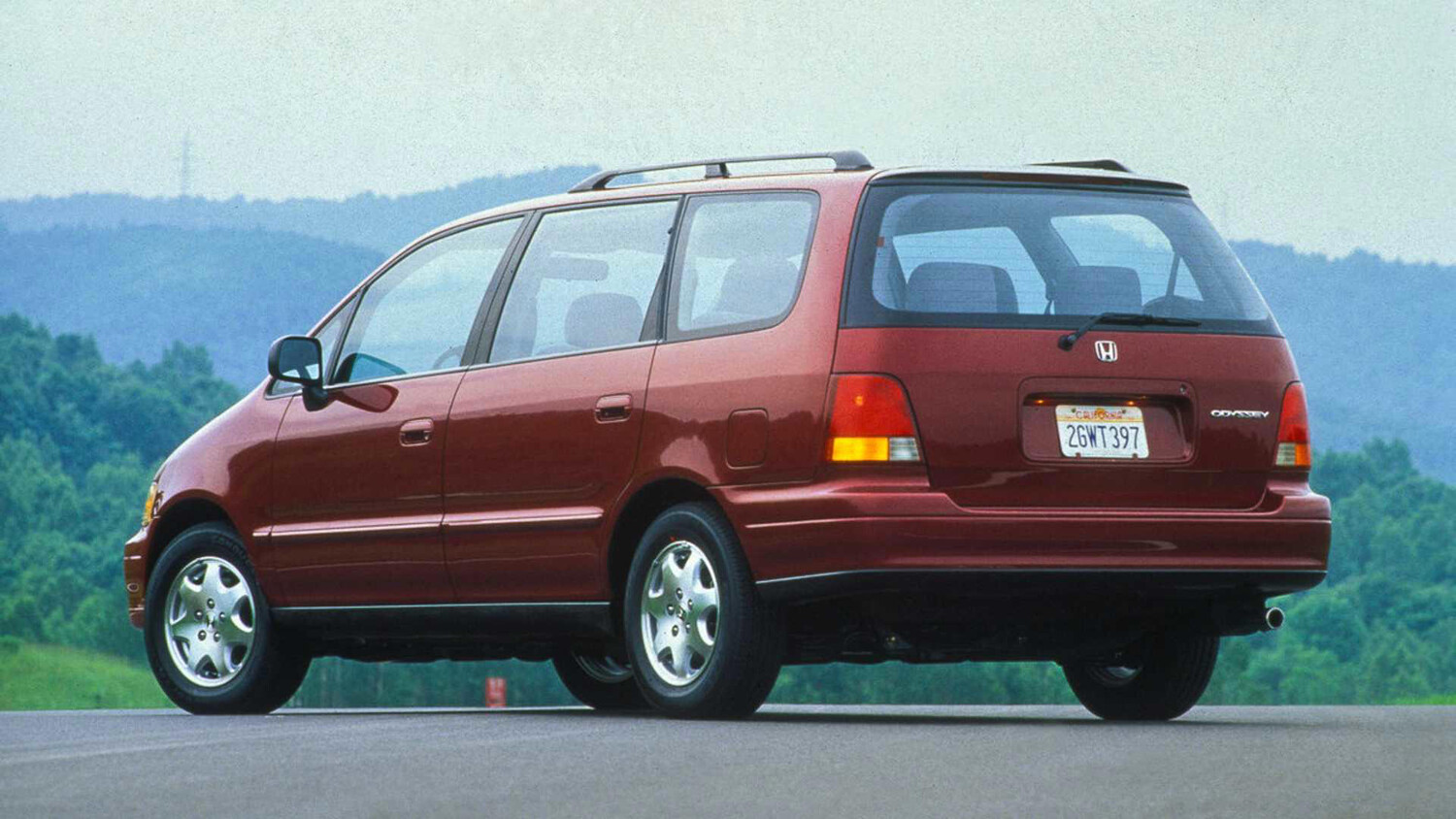
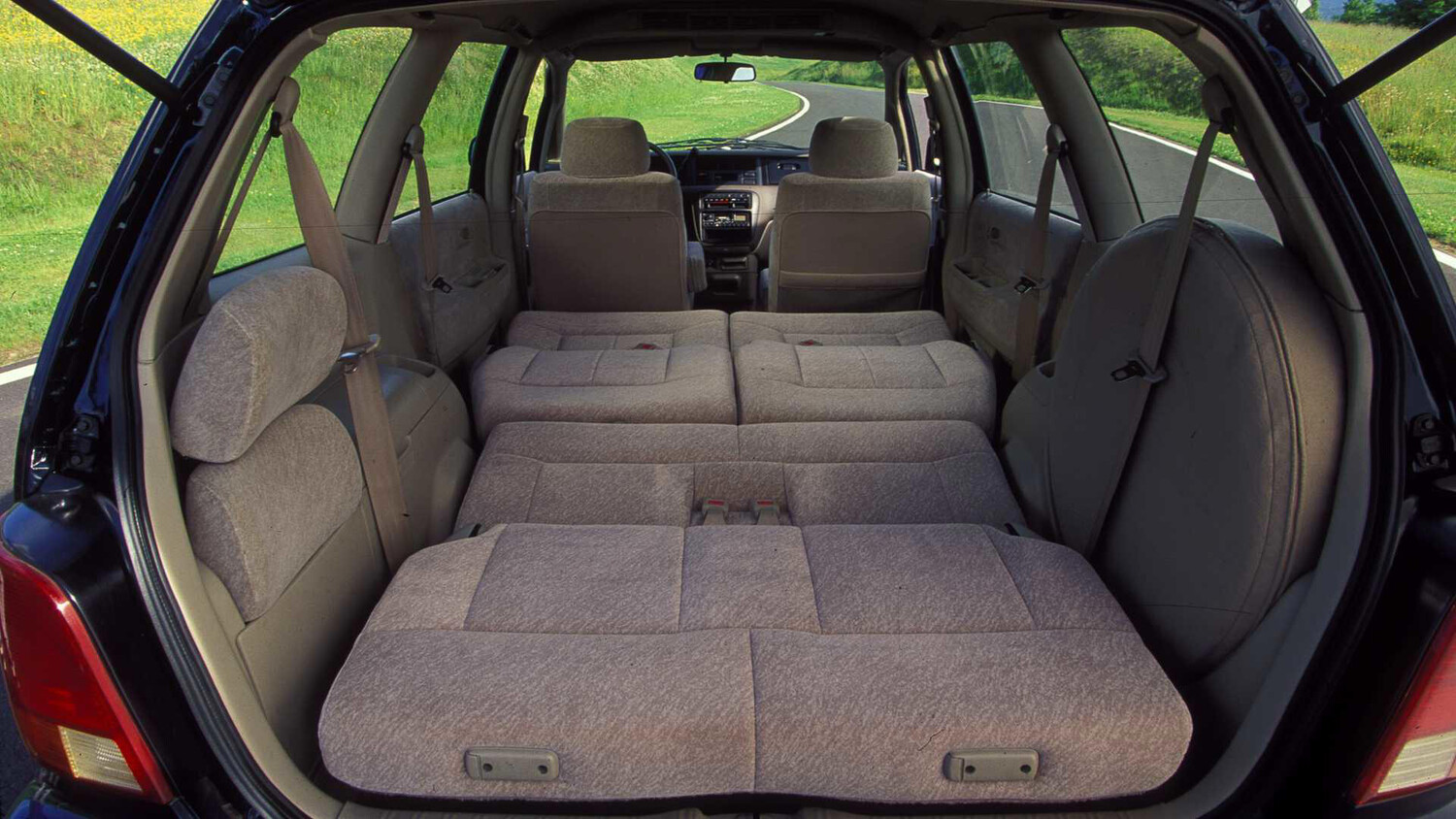
Of the minivans currently on sale, the Honda Odyssey not only has the most distinctive name but also, thanks to superior ride quality, impressive agility, and thatDeadpool & Wolverine cameo, is still among the most popular modelsin the segment. Granted, the now eight-year-old Odyssey was outsold last year by both the Chrysler Pacifica and the Toyota Sienna, but still notched up 88,462 sales worldwide in its best year since 2019.Which makes it even stranger that Honda’s first stab at a three-row "Premium Family Mover" in the early 1990s barely had room for six passengers, was deliberately more expensive, and didn't resemble the no-nonsense North American rivals at the time. Plus, the automaker sent into the showroom – gasp! – without a sliding door. Honda Wanted A Roomy New Car For The US, Then Canceled It HondaIn the summer of 1990, ironically just a few months after the historic launch of its Ferrari-baiting NSX, Honda decided it needed to compete in the American minivan market. With the sedan market way down in Japan and roomy vehicles selling well in the United States, Honda needed a model of its own. So committed was the Japanese marque to this idea that it even planned a brand-new facility in the US to build the vehicle.However, there were problems immediately. For starters, both of Chrysler’s benchmark minivans – the Chrysler Town & Country, the Dodge Caravan, and the Plymouth Voyager – had been on sale in the US since 1984. This already put Honda almost a decade behind its direct competitors in a sector in which the company had no previous experience. Establishing a brand-new facility, meanwhile, meant the new minivan would likely be priced from around $30,000 USD to offset those additional costs. By contrast, you could buy a second-generation, top-tier Dodge Caravan SE for less than $19,000 in 1991.The cherry on top of this already tenuous sundae was that Honda, believing its new minivan would go gangbusters at home in Japan as well. The company initially designed it to cater to two markets, and the vehicle was noticeably smaller than the US rivals. Unsurprisingly, just a few months into development, Honda’s bean counters were already getting cold feet. And in early 1991, the nascent Odyssey project was canceled.HondaBut for a dedicated team at Honda’s R&D Center, who had already spent months studying the growing US market, had spoken to hundreds of potential US customers, and had realized the lucrative potential of a functional, high-quality minivan, that might well have been the Odyssey. With tacit permission from the R&D Center’s president, who also believed in the project’s potential, secret development continued into 1991. Several of the 20-strong team who had been pulled onto other projects continued working after hours. It Was Built On Top Of An Accord Sedan HondaWith the Odyssey canned once already, cost-savings and lots of it were now the priority. The original plan, for example, had been for the new minivan to be powered by a torque-heavy V6. The 2.7-liter, naturally-aspirated six-cylinder that powered Acura’s upscale Legend, and which produced a hearty 160-horsepower and 162-pound, initially fit the bill nicely. The costs and complications involved, however, made this too expensive. Eventually, the dependable, albeit less powerful, 2.2-liter four-cylinder from Honda’s midsized Accord sedan was penciled in instead.Once the re-tuned engine was in, it wouldn’t be touched either. Indeed, when the curtain finally opened on the inaugural Odyssey on October 20, 1994, there were two trim levels: the bare-bones $23,790 LX and the full-bells-and-whistles $25,390 EX. Both had 140 hp and 145 lb-ft of torque, driving only the front wheels.HondaMoreover, with plans for a brand-new US plant now scrapped, the floorpan was lowered considerablyso the Odyssey could be built on the same production line as Honda’s fifth-generation Accord sedan, with only minor tweaks. In the end, this new personal family mover borrowed not only the engine from its sibling model, but also the four-speed automatic gearbox, the chassis, the independent suspension, the steering rack, and even most of the dashboard switchgear. Instead of the usual rear sliding doors on a minivan, the designers opted for conventionally hinged doors.It's no real wonder then that, when it arrived for 1995, the first-ever Odyssey, despite an epic name, was comfortably shorter, narrower, and lighter than every other minivan available in the US. This being Honda, of course, those diminutive dimensions hid a genuinely revolutionary design. The Design Was Different, But Innovative The Secret Cubby That Changed Minivan Design HondaHonda referred to the concept as the "Bullet Train" during development, and the internal PJ code name stood for "Personal Jet," which speaks volumes as to the company's mindset for the Odyssey. Where Chrysler, for example, had prioritized occupant space, almost to the detriment of the exterior looks, Honda’s design reflected how family cars could look in the future. Meaning, function, aesthetics, and innovation each got equal billing.The third row, for example, was mounted in the 39-inch gap between the rear wheel wells. While seven adults could – just – squeeze in, third row passengers had limited leg, shoulder, and headroom, and almost no thigh support at all (in fairness, Honda didn’t initially market the Odyssey as a seven-seater). Moreover, with all three rows filled, there was just 10 cubic feet of rear cargo space left. An almost sarcastically insignificant amount compared with the cavernous Caravan and Voyager.HondaHonda had not, however, taken complete leave of its senses. The Japanese brand had, in fact, been very clever. A flat fuel tank mounted in the middle of the chassis left room for an 8.0-inch well in the rear floor, into which the third row of seats could be folded conveniently and quickly. Conventional by today’s standards, but ingenious at the time. Open the trunk hatch, and the third-row seats can also be tipped backward for tailgating. Another novelty that, admittedly, never caught on. Honda’s Personal Jet HondaThere was equally innovative thinking across the second row, too. In the top-spec Odyssey EX, for instance, two captain's chairs were mounted rather than a bench seat. This left an aisle in the center that, Honda theorized, allowed passengers to switch seats, and thus enjoy the topography on both sides whilst the vehicle was in motion (there’s that ‘Private Jet’ rationale, if you were wondering). To give passengers room to roam freely, the headliner was at least 1.2 meters high at its lowest point. The designers then sculpted the exterior of their future family car around that. Complete, oddly, with sleek headlamps inspired by Honda’s motorbike division.With the push of a button, both captain’s chairs could also be removed from the vehicle altogether. Fold away the third bench, and this opened up significantly more cargo space. Put simply, if you needed to haul several dozen sheets of 4x8 drywall around, and you had a penchant for minivans, the smaller, narrower Honda was a good option. The Odyssey Is Almost Killed Off Again Honda USA / IsuzuDespite all of this, Honda’s board, particularly its US sales team, still wasn’t convinced. Indeed, the latter, concerned that development had been too focused on a future Japanese market, argued that R&D had lost sight of what a minivan in the US should be. Indeed, the US sales team was adamant that, as most “one-box” manufacturers had done, a diesel alternative to the Odyssey’s inline-four should also be offered. R&D, aware of the environmental concerns, refused.Eventually, with the project in danger of being canceled once again, R&D made one final push to save its first minivan. More detailed technical drawings were submitted. A quarter-scale clay model was built. And a full-sized mock-up of the cabin was sculpted from Styrofoam, allowing board members to experience it first-hand. A request to build a full-scale working prototype was also finally approved on April 16, 1991. But with the project still hanging in the balance, the R&D team moved quickly.Honda USATest drives were held in the US in January 1992 aboard a right-hand drive prototype, which didn’t help matters. Even the project’s staunchest critics were impressed with the innovative packaging, the sleek design, and the way the more planted Odyssey handled like a large sedan rather than a tall, unwieldy SUV. Finally, more than 18 months after it was greenlit and after being rescued from the gallows twice, the minivan was approved across the board. American Honda even proposed selling 5,000 units per month. On October 3, 1994, the first production model rolled off the line, and two weeks later, the brand's first three-row family hauler was finally launched. Honda’s 36-Year Odyssey HondaThe rest, as they say, is history. By September 1997, more than 300,000 Odysseys had been sold, with almost a third going to US customers. When the larger, V6-powered, second-generation arrived for 1999, it now had sliding doors. More than 335,000 Odysseys were sold in the US alone over the first three years. Isuzu even sold a rebadged version called the Oasis from 1996 onward.More than three decades later, both the Dodge Caravan and Plymouth Voyager are long gone. By contrast, the Odyssey, now without its Accord underpinnings and with more than 2.3 million US sales already under its belt, is well into its fifth generation, with a sixth expected in 2029. It’s a legacy that, had one of two cancellations stuck, had its design been considered too unorthodox, and/or had Honda’s US sales division not been won over, could easily have ended in 1990—a true sliding doors moment.Source: Honda