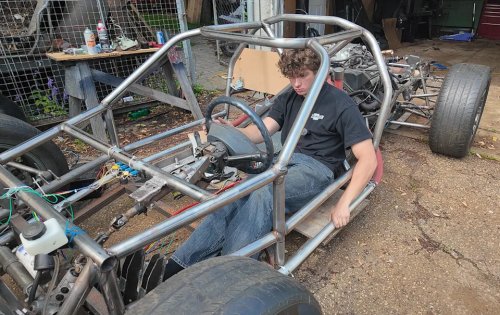
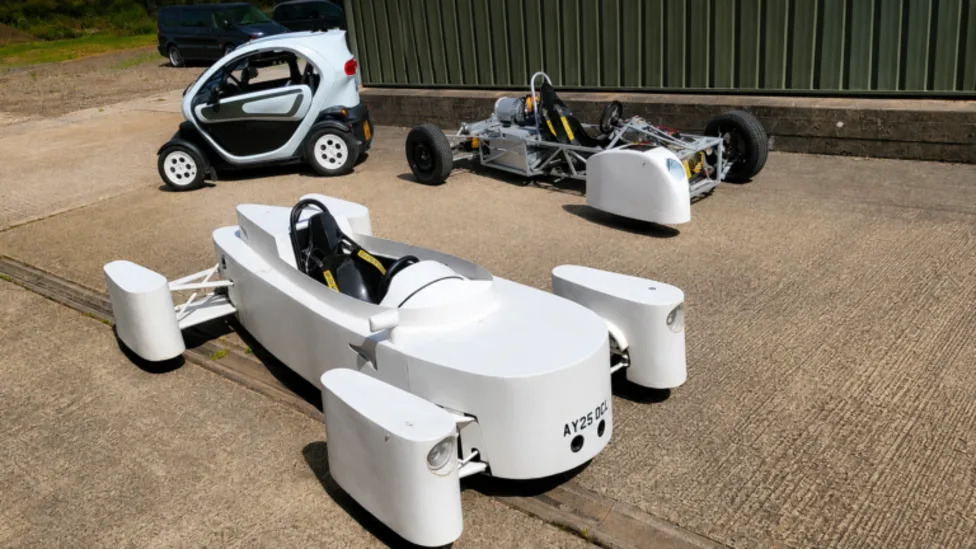
The Car Industry Won’t Build Lightweight Sports Cars, So He Built His OwnNo major automaker currently sells a new sports car for under $30,000. The 2026 Mazda MX-5 starts at $31,000, the Toyota GR86 at $30,800, and the Nissan Z has climbed past $42,000. Emissions compliance costs, electrification R&D, and post-pandemic materials inflation have all pushed manufacturers upmarket and away from the lightweight, driver-focused end of the spectrum. One builder in the UK decided that was someone else's problem.His solution is a 415 kg open-wheel sports car powered by a 2017 Honda CBR 500R motorcycle engine – a two-cylinder unit making around 50 horsepower, pulling to a 9,000 RPM redline through a six-speed sequential gearbox. The chassis is a space frame built primarily from one-inch square tubing, with double wishbone suspension front and rear. Ford hubs, Ford KA wheels, a Ford Sierra differential, and a modified Mazda MX-5 steering column handle the running gear. Parts availability was a deliberate design priority, not an afterthought.The exterior panels rely exclusively on simple single-axis bends, meaning any flat sheet material – aluminium, steel, plastic, or even salvaged alternatives – can be shaped without specialized tooling, putting construction well within the capabilities of a small garage operation. His own workshop, he notes, runs off a double plug socket. The wheel cover profiles draw on the airfoil studies of George Cayley from the early 1800s and the aerodynamic theories of German specialist Dr. Hoerner, with the design aiming for a 3.7:1 length-to-width ratio to reduce drag as much as possible.What You Actually Get for the WeightThe combination of the Honda engine and existing gear ratios caps the car's maximum speed at 72 mph, a figure intentionally kept in check to suit sprint-style driving within legal road speed limits. The builder claims 50 mpg under hard use, with 100-plus mpg theoretically achievable by swapping in a low-revving car engine. Rather than spend money on a dedicated reverse gearbox, he engineered a simpler solution – a starter motor drives a toothed wheel mounted directly to the differential to handle reversing.AdvertisementAdvertisementA battery-powered version is being developed alongside the combustion model, drawing power from a Hyper 9 electric motor and Jaguar E-Pace battery cells. The setup generates approximately 90 horsepower and 200 Nm of torque, and is expected to deliver a range of more than 200 miles on a single charge. The electric variant is expected to tip the scales at roughly 450 kg before accounting for the battery, which contributes an additional 120 kg – a total that intentionally keeps the vehicle near the upper boundary of the EU's L7e quadricycle category.The complete build process has been recorded in an ebook covering chassis blueprints, dimensions, component weights, and a parts inventory, which is on sale for £10. He's also proposed a race format he calls "hyper mile racing": cars under 450 kg, at least 75 percent wheel coverage, competing on a fixed fuel or energy allowance. A 20-lap race at Brands Hatch on one gallon of fuel. It's a genuinely interesting idea, and one the established motorsport calendar has left entirely unfilled."You only have to look at the cars being built today to see that the car manufacturers have no interest at all in building lightweight or sustainable cars for you," the builder says in his video. "If you want something lightweight or different, you're going to have to build it yourself."He's not wrong. Honda built the Project 2&4 – a 900-pound concept car wrapped around a motorcycle engine – and then shelved it. An LA startup called Shoreline Bespoke is developing something similar, but customer deliveries aren't expected until late 2026 at the earliest. The DIY community, meanwhile, has been filling the gap for decades. The LocostUSA forum hit a concurrent user record of 3,795 members online simultaneously in May 2026. The demand for this kind of car has never gone anywhere. The industry just stopped meeting it.AdvertisementAdvertisement"Out of all the skills required," the builder adds, "I would say that imagination and self-belief are far and away the most important." Given that everything else came from YouTube videos and conversations with friends, that's probably the most useful spec sheet he's published.



















 +6 others