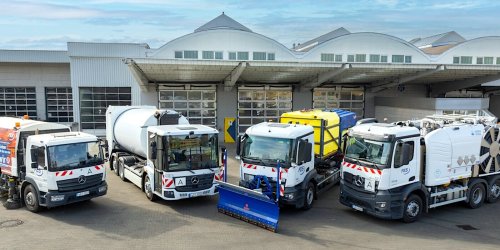
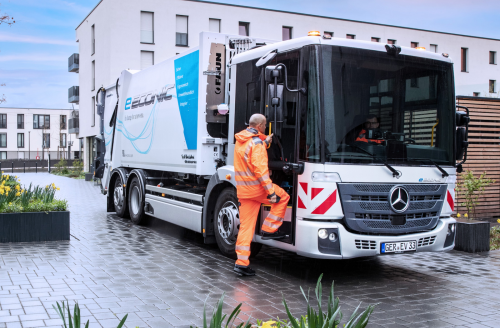
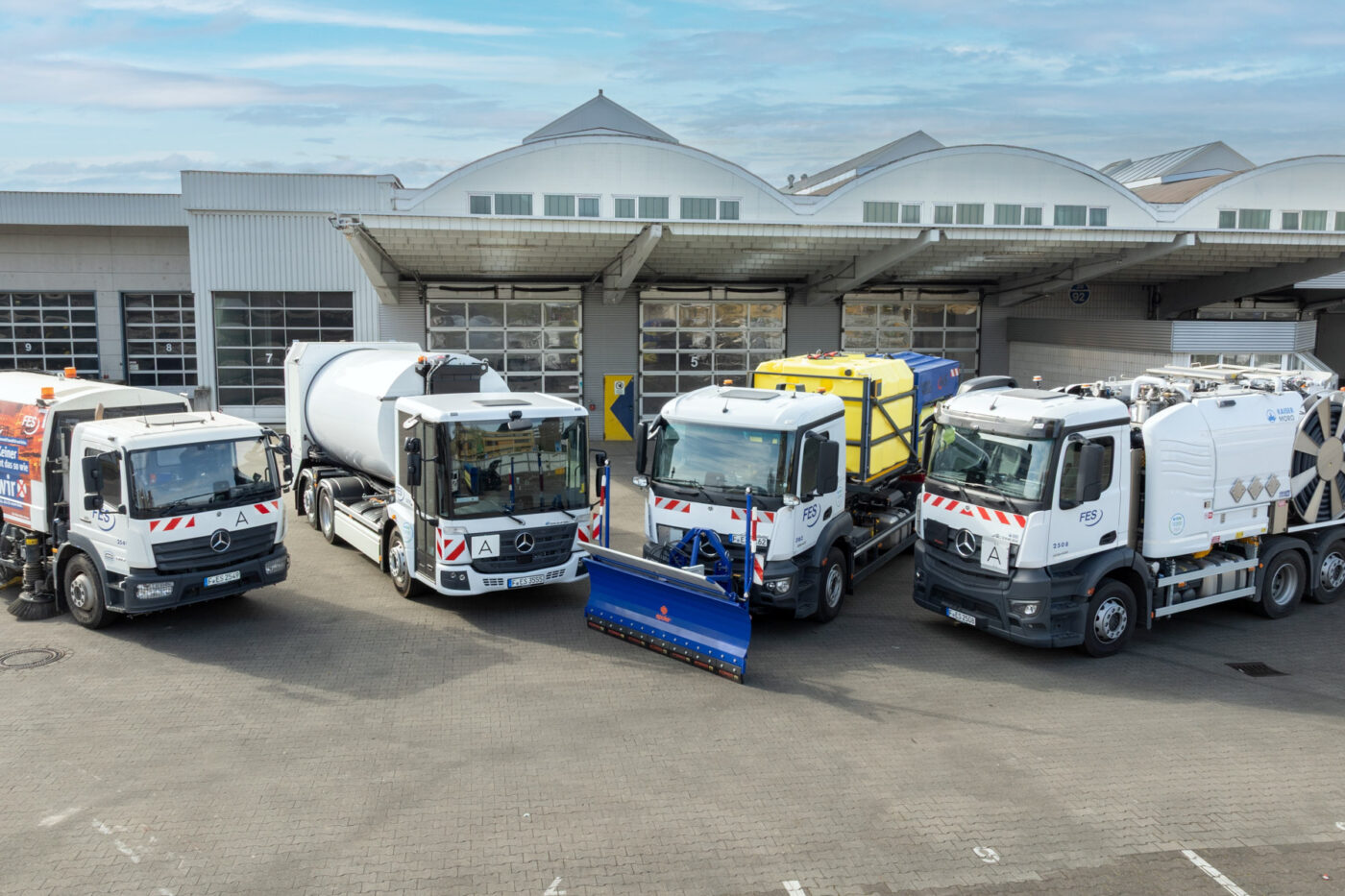
Image: Daimler TruckThe ten vehicles that FES has now ordered from Daimler Truck are not identical. According to the manufacturer, the eEconic models, ‘equipped with various body types, are deployed across different areas of municipal waste management and operate daily between city centre, residential districts and the River Main.’ Press images show examples used for street cleaning and winter maintenance.However, the powertrain remains the same across all vehicles: each is equipped with three battery packs, each with a gross energy content of 112 kWh, of which 97 kWh is net usable, totalling 291 kWh per vehicle. This capacity is designed to allow the eEconic to complete Frankfurt’s typical daily collection routes without intermediate charging, as stated by Daimler Truck. Since FES trucks operate primarily in stop-and-go traffic between the city centre, residential areas, and the Main riverfront, many braking manoeuvres can be utilised for recuperation through predictive driving, recovering electrical energy and extending range. The vehicles are typically charged overnight at the depot.As one of the largest municipal waste management companies in the Rhine-Main region, FES tested its first eEconic in 2022 as part of a customer-focused field trial—a common practice at Daimler Truck, where new models are tested in pre-series vehicles with long-standing customers before market launch.“The positive experience in daily operation has led the company to continuously order additional vehicles from the battery-electric range ever since,” the manufacturer stated. In 2023, for example, eight vehicles from a regular order were delivered.The eEconic was developed as the electric variant of the Econic, a low-floor truck. The low entry height (on the passenger side, away from traffic) is designed to facilitate frequent entry and exit, while the deep panoramic windscreen improves visibility of traffic conditions and all road users in urban environments. In terms of drive technology, the eEconic still uses Daimler Truck’s first-generation electric powertrain from the older eActros 300/400—whereas the manufacturer has already switched to batteries with LFP cells for its electric trucks in freight transport.However, in municipal waste management operations, the eEconic performs exceptionally well even with its established technology.“I personally spent a day with FES in waste collection operations to gain insight into the daily demands placed on our vehicles – and I have to say: our eEconic performed significantly better than I did,” said Christian Wilz, CEO of Mercedes-Benz Trucks Germany. “Quiet, zero-emission in operation, and technically perfectly equipped with the bodies of our partners.”Pascal Scheffler, Head of Technical Department at FES Frankfurter Entsorgungs- und Service GmbH, added: “Frankfurt, as a dynamic major city, places special demands on our waste collection vehicles: narrow streets, high traffic density and early morning operations in residential areas alongside cyclists and pedestrians. For us, the eEconic combines safety, driving comfort and a locally emission-free drive system during operation. The procurement is an important building block on our path towards an increasingly electrified fleet.”daimlertruck.com

















 +59 others