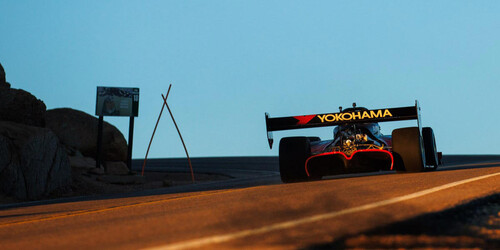
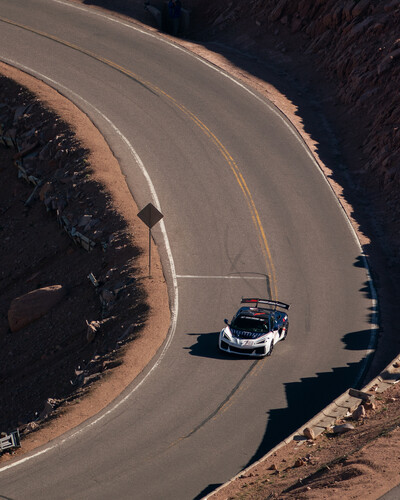
Robin Shute's "SendyCar" Is Pikes Peak At Its BestLarry Chen – 2026 PPIHCFour-time Pikes Peak International Hill Climb winner Robin Shute is headed back to the mountain with something new this year. His team, the Sendy Club, has retired a modified Wolf chassis for what might be the single most extreme car on the grid: a 1300-pound, 850-hp custom open-wheeler with a motorcycle-derived V-8. Fittingly, Shute simply calls the new racer the "SendyCar."It is one of the most extreme cars to ever enter the 110-year-old hill climb, but it is a natural progression for Shute and his partners on the program. His time here started when he was an engineer for Faraday Future, running a massive road-going EV back in 2017. The group behind that program then pushed to get an electric single-seater up the mountain the next year, but when that fell apart, what became the Sendy Club pivoted to an off-the-shelf Wolf single-seat prototype.The group modified it immediately, first with massive turbos and later with similarly oversized tires that necessitated modifications to the car's bodywork. Shute won the hill climb in 2019, 2021, 2022, and 2023 with that car, but the team had ambitions to build something a little bit more unique to replace it.AdvertisementAdvertisementEnter the SendyCar, a ground-up build with very few off-the-shelf parts. One piece carried over from another car is the central tub of a Tatuus Formula 4 car, a low-level open-wheeler designed mostly to train drivers transitioning out of karts before they make their way up to the faster end of the open wheel racing ladder. Behind it is that 2.3-liter engine–a custom block built by Synergy but derived from a BMW S1000 RR engine. A Borg-Warner 92-74 adds some serious punch, bringing sea level output up to about 850 hp. Shute estimates that this number is still going to be in the "high seven hundreds" even at Pikes Peak. He estimates that the long block weighs around 130 lbs and adds that it all spins at 13,000 rpm.Combine that engine with a chassis that weighs 1300 lbs before factoring in fuel and a driver and you have a car that Shute says will accelerate at a force of 2 g, even from 100 mph. It produces over 1100 lbs of downforce at the same speed, although that quoted calculation is at sea level and the car will be running at altitude this weekend.The aerodynamic elements were designed by Shute himself, who says that the process started by laying out the basic dimensions of the car in the CAD software AutoDesk Fusion. After dragging around T-spline surfaces in that program to build a shape, he would run it through the online CFD program Airshaper, see the result, and improve from there. He says that he went through "hundreds of runs" of this process before even producing the car. That's when things got challenging."We take the concept of the car," he says, "and the reality of building the thing struck in, and then it was continually updating the design to make it a physical, real object, a car. That's really tricky. You see these renders online of supercar types of cars, these concepts, it makes me wince a little bit because it's so far away from being reality. We can all make a pretty picture, especially now with AI, but to go and make it a working machine that is fast and competitive, that's a whole other ball game. You see that in the people that actually go and do it and make great cars, the people like McMurtry and all that, they're walking the walk and talking the talk."AdvertisementAdvertisementAlthough Shute was impressed with the car's performance when it made its first runs earlier this month, he thinks this year's race is more about iteration than it is about challenging any records. Next year, he plans to return with more refined aerodynamics that integrate more from the enclosed bodywork concept that he had first considered before cutting the car down into what it is today in the manufacturing process. He thinks he can cut 80 or even 90 lbs of weight out of it, too.Larry Chen – 2026 PPIHCThis year's runs are also about figuring out what problems are going to arise when actually driving the car at the limit up a 12-mile climb to the clouds. This, he describes, is simply the nature of building a car this extreme. "To make a 1300 lb car," Shute says, "you have to be aggressive with everything. It has to be engineered exactly how it needs to be, so there will be mistakes. If we made it sixteen hundred, seventeen hundred pounds, then everything would be fine, but then it would be slow. That's the world of engineering compromise."It is a years-long project, but one that seems to have a serious chance of eventually beating the overall record Romain Dumas set at this climb in a Volkswagen ID.R all the way back in 2018. Whether or not Shute ever achieves that particular goal, he is thankful that Pikes Peak provides him with the opportunity to go out and try something this daring."My skill sets are not so needed in the rest of racing. I don't come with big budget behind me, family legacy, or anything like that, I've had to find my own way in motorsport and make a career for myself. This is a place I can do that, and it just so happens that I love noodling around and designing the car. It's all these things coming into alignment, and it suits me. I think the car design probably interests me more than the driving even now, but the driving I also love... It's been incredibly stressful and I've put my all into it, as have a lot of other people with this car. I'm hugely thankful and grateful to have the opportunity myself, and have all the support from other people."You Might Also LikeIf You Can Only Own One Car, Make It One of TheseThese Are the Most Popular Cars by State