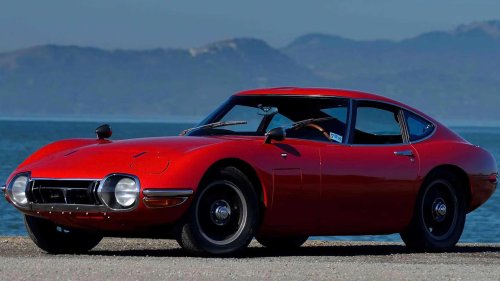
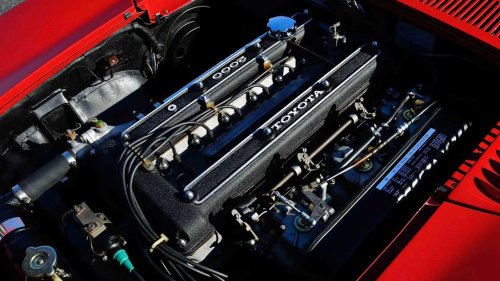

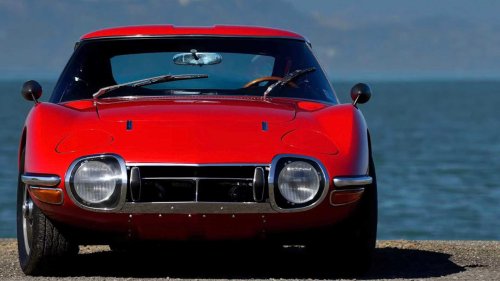



















The 70s is generally considered the golden age of Japanese automotive design. It was an era where Toyota took a bold leap into the world of high-performance sports cars. The result was a sleek, limited-production coupe that challenged established European rivals in both engineering and styling. Built in extremely small numbers between 1967 and 1970, fewer than 400 units ever left the factory. Of those, only a handful were made in left-hand-drive for the American market, making it one of the rarest Japanese cars ever sold in the United States.Today, this Japanese sports car impresses collectors and enthusiasts alike. It was a low-slung coupe designed to accommodate the average Japanese driver, and notably struggled to fit a 6ft 2" Sean Connery with the hard roof. So Toyota built two special examples so the Scottish movie star could drive it for a James Bond film.While its production numbers remained small, its impact was anything but. This Toyota helped redefine what Japanese manufacturers could achieve in performance and styling, setting a new tone for the decades to come. Today, it stands as one of the most iconic sports cars of the 1970s and a landmark moment in Toyota’s history. Some consider it to be the greatest Japanese car of all time, and praise doesn't get higher than that. The Toyota 2000GT Is The Most Iconic Japanese Sports Car 1967 Toyota 2000GT Front Three QuarterThe Toyota 2000GT was Japan’s first serious attempt at building a high-performance grand tourer that could compete with the likes of Porsche, Jaguar, and Ferrari. Unveiled in 1967, the 2000GT helped shift global perceptions of Japanese automakers by showcasing world-class engineering and design.Toyota built only 351 units of the 2000GT between 1967 and 1970. Out of those, just 62 came in the left-hand-drive configuration for the U.S. market, making those particular ones exceptionally rare today. This limited production run, combined with strong performance and historical significance, helped one example sell for $2.5 million at auction, making it the most expensive Japanese car ever sold.Under the hood, the 2000GT featured a 2.0-liter DOHC inline-six developed in collaboration with Yamaha. Paired with a five-speed manual transmission, four-wheel disc brakes, and fully independent suspension, all of which were uncommon features in its era.Its design came from a partnership with Yamaha as well. With a long hood, low stance, and fastback roofline, the 2000GT earned widespread admiration for its styling. It gained international fame after appearing in the James Bond film You Only Live Twice, albeit with a key modification that made it even more iconic.More than just a one-off success, the 2000GT set the tone for the Japanese performance cars that followed. It paved the way for icons like the Supra, the Honda NSX, and Nissan GT-R, while further establishing Toyota’s credibility in the sports car world. Even today, it remains the benchmark for Japanese design, engineering, making it highly collectible today. Why The Toyota 2000GT Is Iconic Today Pioneered Japanese performance and design First ever Japanese grand tourer ever built Limited production of 351 examples, and 62 for the left-hand drive models for the US market Features advanced tech: engine, suspension and disc-brakes Featured in a James Bond movie Laid the foundation for future Japanese performance cars Most expensive Japanese car: A Toyota 2000GT sold for $2.5 million Toyota's 2.0-Liter Engine Co-Developed With Yamaha 1967 Toyota 2000GT Engine Engine Specs (Source: Toyota)The Toyota 2000GT featured a 2.0-liter inline-six engine that set a new benchmark for Japanese performance cars in the late 1960s. Toyota collaborated with Yamaha to develop this engine, starting with the 1988cc 3M block based on Toyota’s existing M-series platform. Yamaha redesigned the cylinder head to a dual overhead camshaft (DOHC) setup, giving the engine modern breathing capability and an unrestricted rev range.The result was a high-revving 1988cc engine that produced 150 hp at 6,600 rpm and peak torque of 129 lb-ft at 5,000 rpm. Toyota used triple Mikuni-Solex 40 PHH side-draft carburetors, which provided precise fueling and crisp throttle response. This configuration was rare among Japanese cars at the time and aligned the 2000GT with European sports cars like the Jaguar E-Type and Porsche 911.Backing the engine was a 5-speed manual transmission, also ahead of its time, offering better gear spacing for performance driving. Four-wheel disc brakes and independent suspension at all four corners gave the car handling and stopping power that matched its straight-line speed.In an era where many competitors used simpler pushrod engines and drum brakes, the 2000GT stood out as a technically sophisticated, well-balanced machine that signaled Toyota’s arrival on the global performance stage. Toyota Built Two 2000GT Roadsters For James Bond via Uncrate In the early 1960s, Toyota built two special 2000GT roadsters for the 007 film You Only Live Twice. These cars were not intended for sale but were customized to fit the needs of the film. Originally, the 2000GT was a coupe, but Toyota worked with Yamaha to create the open-top versions seen in the movie.The two roadsters were developed specifically for the Bond film as protagonist James Bond, played by a 6'2" Sean Connery, could not fit into the confined cabin of the standard hard top.These roadsters featured special modifications, including reinforced bodies and unique styling tweaks, to meet the demands of film production. Unfortunately, one example was destroyed in a pace car accident, while the backup car was acquired back by Toyota and then restored. A Toyota 2000GT Is Worth No Less Than $682,000 On Any Given Day 1967 Toyota 2000GT Front Current Values (Source: Hagerty)If you ever come across a Toyota 2000GT, expect to pay at least $682,000, even in fair condition. According to Hagerty’s data, values rise sharply with condition, reaching up to $1.2 million for Concours-worthy examples. Just 351 units were ever built, and only 62 came to the U.S. market. The right-hand-drive 2000GT is worth 15% less in comparison. That scarcity directly influences current prices.In fact, the first 2000GT Chassis MF10-10001 sold for $2.5 million at auction, making it the most expensive Japanese car ever sold. It was also one of three models tuned by Carroll Shelby. These numbers show that the 2000GT isn’t just collectible. It’s a serious investment backed by limited production and historic global demand.