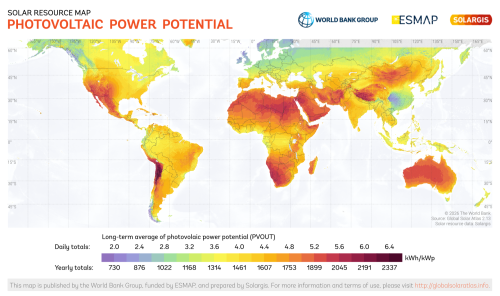
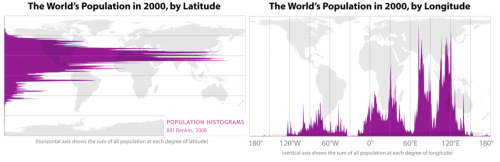
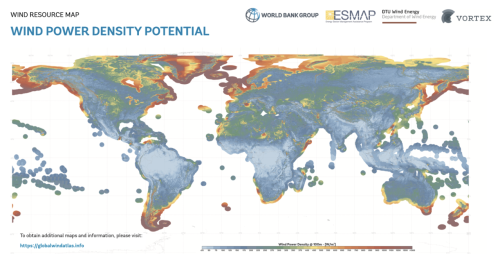
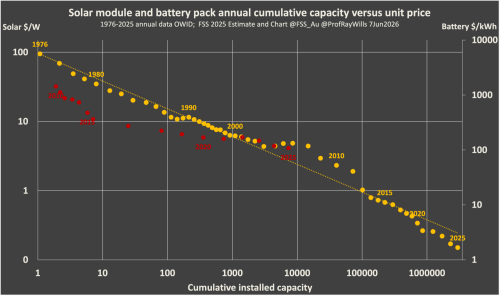



















By Prof Ray Wills (The University of Western Australia) and Prof Peter Newman (Curtin University) Most of the world is already rich in the two energy sources we need to decarbonise fast: sun and wind. Read together, the following four graphics show why the global shift to renewables is not constrained by resource scarcity, but by whether planning and investment move fast enough. Taken as a whole, they change how we see the world — and help explain why fears about a “cost burden” from renewables are not just overstated, they are backward. This first figure shows where we all live: about two-thirds of humanity live in the low to mid latitudes, and roughly 80% of you live in the Northern Hemisphere (we’re Down Under). Image from Radical Cartography With the next maps of solar and wind, they will be familiar to some, but they’re a timely reminder nonetheless. The solar map shows global solar irradiation. The Earth is, for the most part, a sunny place. Image from SolarGIS Most people on Earth live in sunnier, warmer climes, and most of us don’t really care much for the planet’s colder extremities (where’s the beach?). Large parts of Africa, Latin America, the Middle East, India, Southeast Asia including most of the Asian megacities, Australia and much of the US and southern Europe sit in the highest solar resource bands. In these sun-filled regions, solar is not a niche technology; it is likely the cheapest and most easily accessible new bulk energy source. The third map shows global wind power density. Image from Global Wind Atlas A large minority — running into the low billions — live in the 35–60° latitude bands, where the westerlies and storm tracks create excellent wind resources. That’s Western and Central Europe, much of North America, southern South America, parts of China, Japan and Korea. Strong, persistent winds wrap the coasts and storm tracks of every continent, and they often peak at different times of day and year than solar. Together, wind and solar can provide the majority of electricity almost everywhere, with each smoothing out the other’s variability. Add batteries, and you can push very high renewable shares toward 100% in many places, with modest contributions from other renewables and flexible demand where needed. The last chart brings in the economics — presenting solar (yellow) and battery (red) prices against cumulative deployment on a log-log scale. Most of us have seen it before in some form — but probably not on one chart like this. The battery data are, of course, start more recently, and the two data sets have their indicative years marked against the pricing and volume progress. Image from Future Smart Strategies The chart clearly demonstrates the effect of Wright’s Law: a consistent straight falling line showing every time we double capacity, costs drop again. This “learning curve” has already pushed solar and batteries down by orders of magnitude in price — and there is no sign that the trend has stopped. Indeed, for solar the continuous fall is going faster than the trendline. Also, between the sun belt and the wind belt, almost all of humanity lives in places that are naturally well-endowed with at least one of the two main renewable sources needed for a fully electrified system. Put the puzzle pieces together and what is clear is that — while moving to renewables is in no way just a simple task, and no one has a magic wand, and that there is planning and effort involved — neither is it inherently difficult. With integrated planning — treating generation, storage, transmission and demand as one system instead of separate silos — we can choreograph the fastest shift in electricity dispatch in human history in a deliberate, orderly way that keeps the lights on and bills down. Done well, that same planning builds energy sovereignty for regions and nations. More of our energy can come from our own sun and wind, with fewer imported fuels, more community agency, and lower exposure to resource-driven conflict. Large grids, abundant wind and solar, and growing fleets of batteries are not a cost burden; they are the mechanism that keeps driving costs down, overcoming the legacy of the costlier fossil-fuelled system of the last century. The faster we build, the cheaper the system becomes — and the sooner we can electrify everything and leave fossil fuels behind.