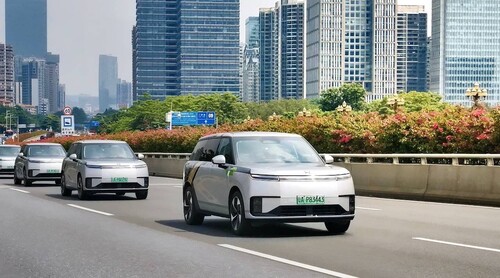
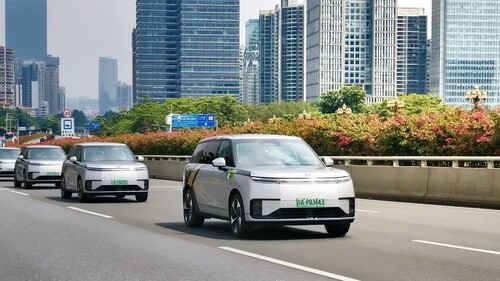
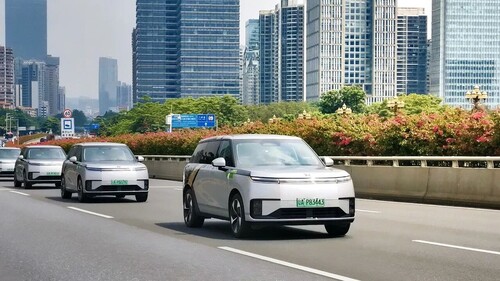
Gasgoo Munich- Pony.ai recently released its second-quarter financial report for 2026. Total revenue for the quarter hit 246 million yuan, up 68.8% year-on-year, while first-half revenue climbed to 478 million yuan — a 98.9% surge that nearly doubled the previous year's figure. Notably, Robotaxi business revenue reached 81.92 million yuan, soaring 691.2%. For the first time, this segment accounted for one-third of total revenue, with passenger fare income jumping 849.3% to mark the highest quarterly gain on record.Image source: Pony.ai (same below)The debate over whether Robotaxi commercialization is viable has raged for years, hinging on two questions: Is deployment fast enough? Are users actually paying? This earnings report offers a clear answer: nearly 2,000 vehicles are on the road, overseas deployment plans for over 4,000 units are locked in, and operations have expanded from pilot zones like Nansha into downtown Guangzhou. The tipping point for large-scale commercial landing seems to have arrived.Fare Growth Outpaces Revenue, Passing the Payment TestFor autonomous driving companies, revenue figures are just the surface; the real substance lies in whether end passengers are willing to open their wallets. B2B project-based revenue can be propped up by big contracts, but C2C fares are paid by users one ride at a time — you can't fake that. This metric "directly reflects the genuine willingness of end users to pay."Pony.ai's Q2 growth structure warrants a closer look. While overall Robotaxi revenue surged 691.2%, passenger fare income jumped 849.3% — outpacing the former by a significant margin.The report cites three drivers for this growth: the deployment of seventh-generation vehicles, the expansion of commercial operations, and progress in joint fleet partnerships. The fact that fare growth is outstripping overall growth suggests C2C payments are carrying more weight, signaling that the commercial loop is maturing.Zooming out, Pony.ai's Robotaxi revenue for the first half of the year totaled 140 million yuan — already surpassing the full-year total for last year. The company set a target at the start of the year to grow Robotaxi revenue by more than 3.5 times. CEO James Peng stated in the earnings call that he is confident they will exceed this goal.That confidence stems from fleet and operational data. As of June 30, Pony.ai's Robotaxi fleet numbered 1,975 vehicles. The seventh-generation Robotaxis, based on models from BAIC, GAC, and Toyota, are all in daily operation, with a year-end target of exceeding 3,500 units.More critical than the fleet count is where they are running. Pony.ai continues to scale up fleet size and density in Beijing, Shanghai, Guangzhou, and Shenzhen. Progress in Guangzhou is particularly symbolic: services have expanded from Nansha District to four central urban areas — Haizhu, Tianhe, Huangpu, and Panyu. The downtown operational area has grown by over 300 square kilometers since the start of the year, covering a population of more than 7 million.Shenzhen, meanwhile, is focusing on transport hubs. The service network covers Bao'an International Airport, Shenzhen Bay Port, and Shekou Cruise Home Port, handling high-value travel scenarios such as daily commuting, cross-border travel, and airport transfers.User numbers are also climbing. As of August 2026, registered users on the Pony.ai app in China surpassed 1.5 million, up from 1 million in March of this year. Adding 500,000 users in five months suggests Robotaxi is no longer just a novelty for tech enthusiasts, but is entering the daily transportation choices of ordinary people.Peng Jun revealed another key signal on the call: Pony.ai has achieved positive unit profitability in Guangzhou and Shenzhen. He also outlined a more specific domestic expansion roadmap, aiming to cover over 20 cities by year-end. Beyond deepening presence in Tier-1 cities, the company plans to enter Changsha, Hangzhou, and more cities in the Greater Bay Area this year.Peng noted that Tier-1 cities account for a significant share of national ride-hailing demand and have the most mature regulatory frameworks. The company will prioritize the highest-value markets before gradually expanding outward.Underpinning all of this is the joint fleet model. The technology provider supplies the autonomous driving solution, while operational partners handle execution. This allows fleet scale to ramp up quickly while keeping capital investment in check. Pony.ai stated that this model has validated the reliability of 24/7 operations and the unit profitability model in China's Tier-1 cities, providing a strong endorsement for replication in more cities and overseas markets.4,000 Overseas Deployments Locked; Tech Reuse Opens New Growth AvenuesWith its domestic model proven, Pony.ai is taking it global, moving from isolated pilots to the phase of implementing batch deployment plans.The most significant development in Q2 was this: through the joint fleet model, Pony.ai has locked in partners across multiple global markets, formally securing overseas deployment plans for a total of over 4,000 Robotaxis. The partnership with Uber is the largest, with plans to deploy more than 2,000 vehicles in five core European cities — accounting for half of the overseas total.Uber's value is self-evident: it possesses a mature global mobility network and user operations system capable of feeding stable orders to autonomous driving services. The division of labor is clear: Pony.ai provides the full-stack autonomous driving technology and operations system, Uber supplies the traffic and users, and local operators handle on-the-ground execution. It creates a "tech provider + platform + operator" synergy.The advantage of this model is high capital efficiency. There is no need to build a full ecosystem from scratch in every overseas market; instead, local partners can be leveraged to bypass policy and market barriers.The monetization logic of the joint fleet was also clarified on the call. CFO Lawrence Wang explained that Pony.ai earns revenue shares or technology licensing fees under this model, generating higher-margin recurring revenue throughout the vehicle's operational lifecycle.The earnings report confirms this: the revenue contribution from the joint fleet model increased quarter-over-quarter in Q2, becoming a new growth engine.Overseas implementation is blooming in multiple locations. Peng revealed that Pony.ai has become Uber's largest autonomous driving partner in Europe, and the two have launched Europe's first commercial Robotaxi service in Zagreb, Croatia, in collaboration with Verne.In June, Pony.ai began Robotaxi testing in Luxembourg with Bolt and Stellantis; in Singapore, services were opened to the public via ComfortDelGro's Zig app; operations in Qatar, the UAE, and South Korea continue to deepen. From Europe to the Middle East and Southeast Asia, this isn't a piecemeal showcase approach, but a systematic, region-by-region progression.The ability to push globalization this quickly relies on technical generalization capabilities. The industry has long worried that entering a new city requires massive localized R&D, preventing marginal costs from dropping — meaning the bigger the scale, the bigger the loss.Pony.ai's World Model 2.0 was designed to address exactly this. CTO Lou Tiancheng stated that the World Model 2.0 allows the company to deploy fleets in multiple countries and cities simultaneously with fewer R&D resources, without needing to increase engineering investment proportionally. At the same time, technology-driven operational optimizations are reducing per-vehicle operating costs.The dividends of technology reuse extend beyond Robotaxi.Pony.ai's Robotruck business generated Q2 revenue of 90.44 million yuan, up 40% year-on-year and 30.7% quarter-over-quarter, attributing growth to deepened cooperation with Sinotrans.Pony.ai's fourth-generation autonomous heavy trucks have entered mass production as planned and completed automotive-grade validation. They are being deployed in high-value scenarios such as trunk line logistics, bulk commodity transport in the Northwest, and port horizontal transport. Currently, the company is working with China Merchants Port at Shenzhen's Mawan Port to launch commercial deployment of fourth-generation heavy trucks, achieving mixed fleet operations between autonomous trucks and human-driven vehicles.A fully automotive-compliant, fully redundant L4 autonomous light truck for urban distribution scenarios was released in April. It fully reuses Robotaxi technical capabilities and targets B2B urban delivery scenarios like express sorting and supermarket restocking. It is currently in preliminary testing. Pony.ai plans to deploy nearly 1,000 autonomous heavy trucks in the next 2-3 years, and 100,000 autonomous light trucks by 2030.The intelligent solutions business continues to provide stable revenue, with Q2 income of 73.4 million yuan, up 3.9% year-on-year. Clients cover low-speed delivery, intelligent sweepers, logistics, and humanoid robots. First-half deliveries of autonomous driving domain controllers more than doubled, demonstrating the value of technology spillover.The financial position can sustain long-term investment. As of June 30, Pony.ai held cash equivalents and short- and long-term wealth management investments totaling 9.435 billion yuan. Net loss narrowed by 14.9% year-on-year and 15.3% quarter-over-quarter in Q2. CFO Lawrence Wang noted that the growth rate of operating expenses is far lower than revenue growth, with operating leverage continuously improving. The company will maintain a prudent capital strategy.For an autonomous driving industry still in a period of scaled investment, expanding scale while narrowing losses indicates that self-sustaining capabilities are forming. The path to commercialization is becoming increasingly solid.