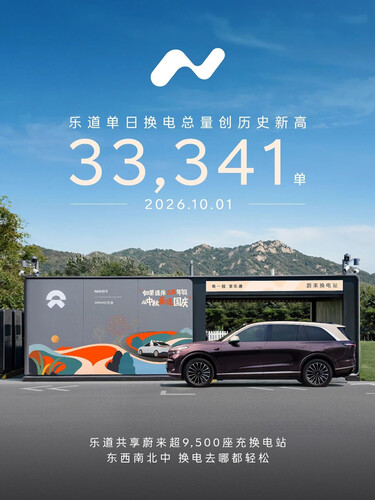
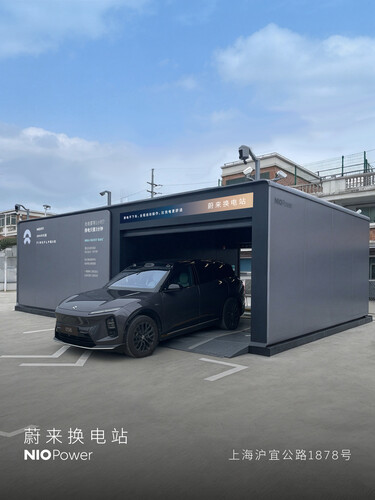
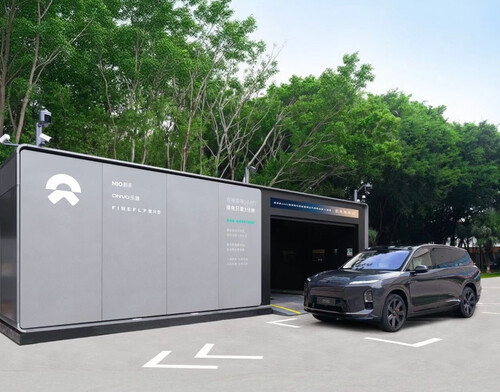
Mia Macdonald · 5 months ago@miamacdonald361NIO Aims to Add 1,000 Battery Swap Stations in 2026 Liked by+45 othersPost commentRelated PostsNIO, Geely Partner on Charging & Swapping; Momenta, DSAT to co-develop ADAS; RoboSense, NVIDIA Deepen Physical AI Collaboration 26 · Benjamin Morgan · 25 days agoDongfeng Motor and Huawei hold executive talks; Chery adjusts executive positions; NIO ES9 deliveries exceed 30,000 units 84 · Henry Mitchell · 25 days agoNIO, Geely form charging and battery swap alliance through cross-investments 51 · Parker Bouchard · 25 days agoNIO sells 30% of battery swap unit to Geely at more than $2 billion 16 · William White · 26 days agoGeely invests in Nio to launche EVs compatible with its battery-swapping network 74 · Evan Leblanc · 26 days agoBYD Recalls 183,000 Cars In China Over Brake Defect 77 · Nathan Anderson · 28 days agoAutomakers' Supply Chain Balancing Act: Signing with "CATL" While Cultivating "Backups" 54 · Benjamin Girard · 29 days agoChinese Automotive Innovation, Why Is It Globally "Needed"? 44 · Nathan Turner · 29 days agoRankings of electrification component suppliers in China (Jan.–Jul. 2026) Ⅱ丨Gasgoo Automotive Research Institute 60 · Parker Hall · 29 days agoNIO Launches World's First Zero-Carbon Off-Grid Solar-and-Storage Swap Station 86 · Lucas Pelletier · 29 days agoGeely Unveils Next-Gen AI Charging Technology; NIO opens zero-carbon off-grid battery swap station; CPCA: Passenger-Car Retail Sales Down 22% YoY From Sept. 1–20 25 · Jacob Morgan · 29 days agoNIO opens zero-carbon off-grid battery swap station in Xinjiang 88 · Caleb Nelson · 29 days agoChina's EV charging war escalates as Geely touts 2.2-MW tech for 4-minute full charges 13 · Chloé Rogers · 1 months agoNIO ES9 Achieves 30,000 Deliveries in 119 Days 28 · Jacob Côté · 1 months agoChina's New-Energy Vehicle Startups at Midgame: How Long Will the Window of Opportunity Last? 48 · Connor Scott · 1 months agoNIO ES8 Launches Lanyue Package Featuring 22-Inch Forged Wheels and Floating Wheel Center Caps 75 · Isabelle Lewis · 1 months agoNIO New ES8 Deliveries Reach 150,000 Units on First Anniversary 81 · Amélie Martin · 1 months agoNIO Expands Battery-Swapping Network Along Silk Road Route 23 · Liam Girard · 1 months agoRankings of electrification component suppliers in China (Jan.–Jul. 2026): Automaker in-house production gains ground丨Gasgoo Automotive Research Institute 80 · Audrey Wright · 1 months agoRankings of ADAS component suppliers in China (Jan. - Jul. 2026): Dual-chamber air suspension gains traction in mainstream vehicle models | Gasgoo Automotive Research Institute 34 · Parker Hall · 1 months ago




 +45 others