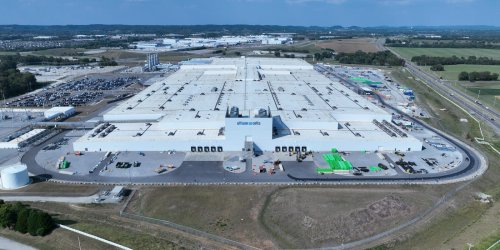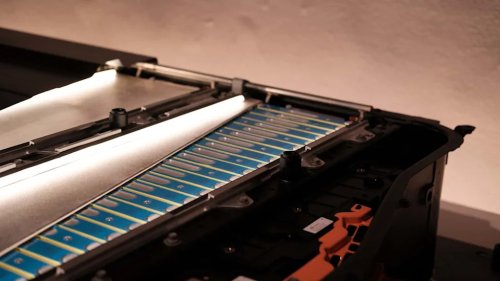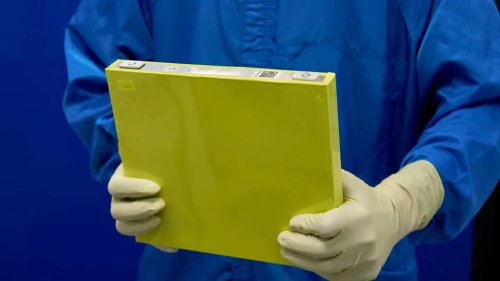
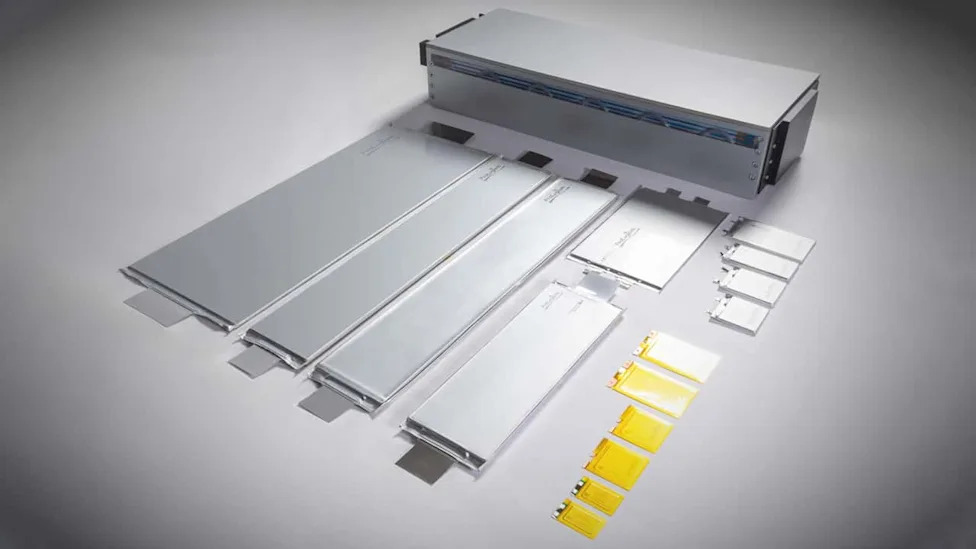



















ProLogium Solid-State Lithium-Ceramic Battery Assembly LineTaiwan's ProLogium seems to have cracked the code, with the first mass-produced solid-state cells promising impressive energy density.ProLogium claims it has started mass-producing all-solid-state battery cells.The Taiwanese company, backed by Mercedes-Benz, is rolling out the first large-format pouch cells at its gigawatt-capable facility in Taoyuan.ProLogium's latest Lithium Ceramic Battery promises 5-to-80% charging times in under 10 minutes.All-solid-state battery cells, which promise longer driving ranges, faster charging times, and increased safety, are now being mass-produced. That's what Taiwan's ProLogium, which has seen investments from Mercedes-Benz and other big industry names, claims.And yes, Finland's Donut Lab made some bombastic claims at the beginning of the year, but so far we haven't seen concrete evidence that the startup has fulfilled its promise of selling solid-state batteries to the masses.AdvertisementAdvertisementProLogium, meanwhile, has some big names backing up its claims. Its Generation 3.5 large-format 185.4 ampere-hour Lithium Ceramic Battery (LCB) cell, which is now rolling off the Taoke assembly line at its facility in Taoyuan, Taiwan, has been tested by Germany's TÜV, showing a gravimetric energy density of 381 watt-hours/kilogram and a volumetric energy density of 903 watt-hours/liter.ProLogium Lithium-Ceramic Battery Cell LineupThat's roughly 30% better than the mainstream nickel-manganese-cobalt (NMC) cells powering most electric cars on the road in the United States today, which usually top out at around 300 Wh/kg at the cell level. Meanwhile, the more cost-effective lithium-iron-phosphate cells, which are increasingly finding their way into EVs around the world, have a gravimetric energy density between 150 and 200 Wh/kg.When Donut published the first specs of its promised solid-state battery cell, it said that it delivered 400 Wh/kg.Separately, UL Solutions, which tests and certifies the safety of EV chargers, batteries, cables, and much more, tested ProLogium's large-format cell under China's new GB/T 43568-2026 methodology, which was introduced in July to better differentiate between all-solid-state cells and units that still use some form of liquid electrolyte.AdvertisementAdvertisementAs part of the test, the cell was kept in a vacuum for six hours at a constant temperature of 248°F (120°), and the recorded weight loss was less than 0.05%, which is well below the 0.5% maximum threshold that allows companies to label their products as all-solid-state batteries.ProLogium's Gen 3.5 cell uses a composite solid electrolyte and a ceramic separator with a proprietary edge-frame structure that creates an additional separator around the electrode perimeter to help isolate potential burrs while providing sealing and insulation.The company says its previous Gen 3 cell can fast-charge from 5% to 80% state of charge in eight and a half minutes, and that it won't catch fire if shot with a bullet, at temperatures as high as 338°F (170°F), and when overcharged at twice the rated voltage.The initial production capacity of the facility that's making the first Gen 3.5 large-format pouch cells is 0.5 gigawatt-hours. That's roughly 6,000 EV battery packs, each with 80 kWh of capacity, so not a lot compared to traditional lithium-ion EV battery plants, but ProLogium has big expansion plans. The Taiwan facility is set to double production by 2030, and a second production facility in Dunkirk, France, is designed for an initial annual output of 4 GWh, with a maximum capacity of 44 GWh. The French factory is expected to go online in 2028, with production ramping up through 2030.AdvertisementAdvertisementThen, there's the Gen 4 battery cell, which is right around the corner, according to ProLogium. With a fully inorganic superfluidized electrolyte system, the next-gen battery promises even faster charging times and better low-temperature performance. And better yet, factories that build Gen 3.5 cells will need to upgrade just 10% of their line equipment to start assembling Gen 4 cells, which means costs stay down.More Stories Like This'Most Companies Are Struggling': Executive Shares An Uncomfortable Truth About Solid-State EV BatteriesFactorial Taps Hyundai Supplier To Solve Solid-State Batteries' Biggest ProblemHonda Has A New Partner For Solid-State EV BatteriesThis Dodge Charger EV Prototype Packs An Experimental Semi-Solid-State Battery