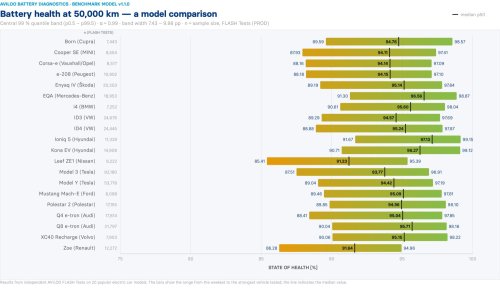
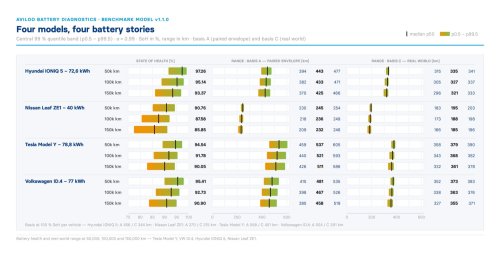
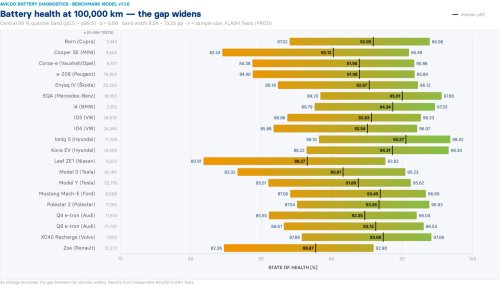
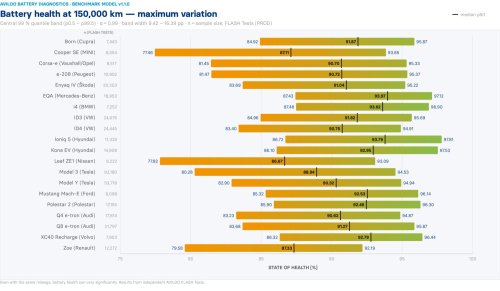
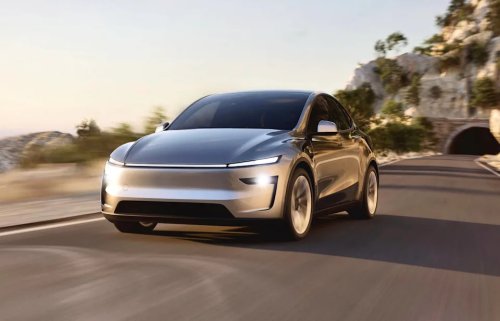
Top performers include the Hyundai Ioniq 5, Audi Q8 e-tron, and BMW i4. Mercedes CLA retained 94 percent health, but the Model Y retained just 90.3 percent. The largest ever EV battery degradation study also revealed several weak options. Battery degradation has long been one of the reasons new car buyers have held out on purchasing an EV. However, data from a new study reveal that the top-performing EVs lose less than 5 percent of their range after 93,205 miles (150,000 km) of driving, meaning battery packs will easily last the average life of most new cars. The study, published by Aviloo, has been labeled the largest independent study of used EV batteries ever conducted. More than 500,000 battery tests have been published, and the results show how 20 of the industry’s most popular EVs perform. Read: A Seven-Year-Old Tesla Model 3 Survived 380,000 Miles, Its Range Did Not Aviloo The Hyundai Ioniq 5 performed best after 31,068 miles (50,000 km) of testing, retaining 97.1 percent of its original usable capacity. Other strong performers after 31,068 miles included the Mercedes-Benz CLA at 96.6 percent, the Hyundai Kona EV at 96.3 percent, the Audi Q8 e-tron with 95.7 percent, the BMW i4 with 95.6 percent, and both the Volvo XC40 Recharge and VW ID.4 at 95.2 percent battery retention. Aviloo After 93,205 miles of driving, the Mercedes-Benz CLA came out on top with a battery health of 94 percent. This placed it ahead of the Hyundai Ioniq 5 (93.6 percent), Hyundai Kona EV (93 percent), Volvo XC40 Recharge (92.8 percent), Ford Mustang Mach-E (92.5 percent), and the Polestar 2, also at 92.5 percent. Teslas Disappoint Aviloo Several popular EVs did not perform as well as the competition. Most notable was the Tesla Model Y, which retained just 90.3 percent of its battery capacity after 93,205 miles, and the Tesla Model 3, which retained 88.9 percent of its battery capacity. Other poor performers included the Renault Zoe (87.3 percent), Mini Cooper SE (87.1 percent), and Nissan Leaf (86.7 percent), all of which have relatively small batteries. Aviloo Importantly, the results of this study don’t mean every Mercedes-Benz CLA will have 94 percent battery health after 93,205 miles, or every Peugeot e-208 will have 90.7 percent battery health. The study examined the median across all vehicles and found that good and bad examples of the same car can have battery health ratings that vary by as much as 13.5 percent. Nevertheless, the study demonstrates just how good current EV batteries are. Model31,000 mi /50,000 km62,000 mi /100,000 km93,000 mi /150,000 kmDrop 31K-93K miMercedes-Benz EQA96.6%95.0%94.0%2.6 ppHyundai Ioniq 597.1%95.3%93.8%3.3 ppBMW i495.6%94.3%93.6%2.0 ppHyundai Kona EV96.3%94.3%93.0%3.3 ppVolvo XC40 Recharge95.2%93.7%92.8%2.4 ppFord Mustang Mach-E95.1%93.5%92.5%2.6 ppPolestar 295.0%93.4%92.5%2.5 ppCupra Born94.8%93.0%91.9%2.9 ppVolkswagen ID394.6%92.8%91.8%2.8 ppAudi Q8 e-tron95.7%93.1%91.3%4.4 ppŠkoda Enyaq iV95.1%92.7%91.0%4.1 ppVolkswagen ID495.2%92.5%90.8%4.5 ppPeugeot e-20894.2%92.0%90.7%3.4 ppVauxhall/Opel Corsa-e94.1%92.0%90.7%3.4 ppAudi Q4 e-tron95.0%92.4%90.6%4.4 ppTesla Model Y94.4%91.9%90.3%4.1 ppTesla Model 393.8%90.8%88.9%4.8 ppRenault Zoe91.6%88.9%87.3%4.3 ppMINI Cooper SE94.1%90.1%87.1%7.0 ppNissan Leaf ZE191.2%88.3%86.7%4.6 pp SWIPE