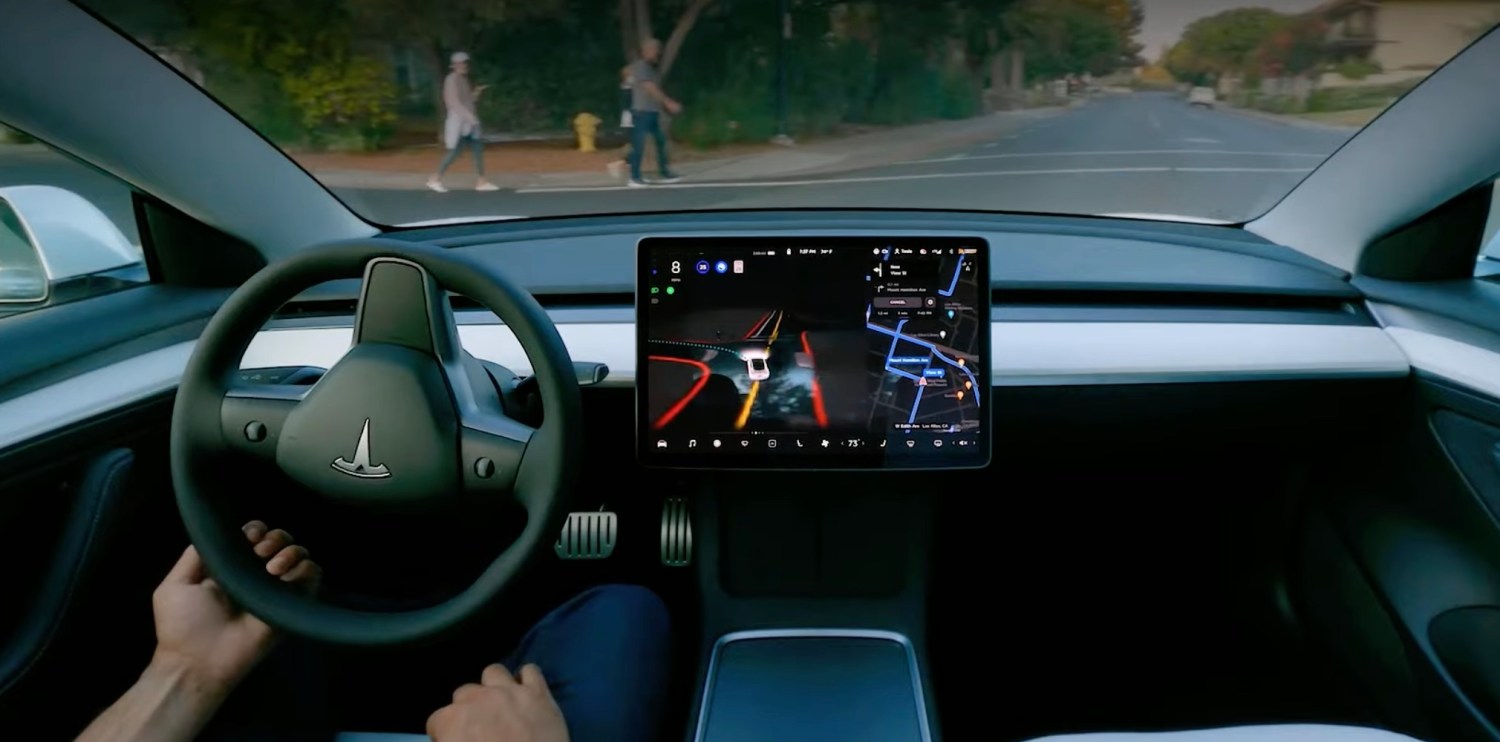






Elon Musk claimed that Tesla’s unsupervised “Full Self-Driving” will be “widespread in the US by the end of this year” during a virtual appearance at the Smart Mobility Summit in Tel Aviv today. Tesla currently operates fewer than 30 unsupervised robotaxis across three Texas cities. The claim marks the latest in a decade-long pattern of Musk promising imminent autonomous driving breakthroughs that fail to materialize on schedule. Another year, another promise Speaking via video link from Austin at 2:30 a.m. local time, Musk told the audience that Tesla already has “some vehicles operating with no people inside and no safety monitors in three cities in Texas” and that the service will “probably be widespread in the US by the end of this year.” Based on Musk’s history of self-driving prediction, “probably” is doing the heavy lifting here. Advertisement - scroll for more content He also described the current FSD software in unusually vivid terms, saying “the car feels like it is sentient” and that drivers can “feel the sentience growing in the car” as Tesla improves the software. But Musk’s track record on self-driving timelines is one of the most well-documented histories of broken promises in the tech industry. Here’s a partial list: 2015: Musk predicted “complete autonomy” within two years — by 2017. 2016: Tesla announced all vehicles had hardware for full self-driving. Musk promised a fully autonomous drive from LA to New York by end of 2017. It never happened. 2017: Musk said at a TED talk that by “November or December of this year, we should be able to go from a parking lot in California to a parking lot in New York, no controls touched at any point during the entire journey.” 2018: On a shareholder call, Musk promised a cross-country fully autonomous ride within “three to six months.” 2019: Musk told investors Tesla would have “over a million robotaxis on the road” by 2020 and that FSD would be “feature complete” by year-end. 2020: Musk stated: “I remain confident that we will have the basic functionality for level 5 autonomy complete this year.” 2022-2024: Musk continued making annual claims that full autonomy was imminent. January 2025: Musk promised unsupervised FSD would launch by June 2025. June 2025: The robotaxi service launched in Austin — but with safety monitors inside the vehicles, not unsupervised. January 2026: Musk moved the goalpost again, saying Tesla needed 10 billion miles of data for safe unsupervised driving — up from the 6 billion he had previously cited. April 2026: During Q1 earnings, Musk pushed unsupervised FSD for consumer vehicles to Q4 2026 “at the earliest,” admitting that “complex intersections,” “bad road markings,” and “weather challenges” were slowing the rollout. Now, less than a month after that Q4 2026 admission, Musk is back to telling a conference audience that unsupervised FSD will be “widespread” in the US by year-end. The whiplash is remarkable. The reality on the ground tells a different story. Tesla’s unsupervised fleet consists of ~30 vehicles across Austin, Dallas, and Houston, according to the Robotaxi Tracker platform. Dallas and Houston each have five and six vehicles respectively. Scaling from ~30 vehicles in three Texas cities to “widespread” across the US in seven months would require an expansion rate Tesla has shown no evidence of being capable of. Musk can’t keep his safety claims straight During the interview, Musk said the path to self-driving cars that are safer than humans “is very clear” and that he expects FSD to be “at least an order of magnitude safer than humans driving.” He described this as a future goal — the system is on a “path” to get there. But just six weeks ago, Musk claimed on X that FSD is already “10X safer” than human drivers and that the “statistics are unequivocal.” So which is it? Is FSD already 10X safer than humans, or is there a “clear path” to achieving that level of safety in the future? Musk oscillates between the two positions depending on his audience — treating it as an accomplished fact when deflecting legal criticism, and as a future milestone when talking to a tech conference about the road ahead. Neither version is supported by Tesla’s own published data. Tesla’s quarterly Vehicle Safety Report — the only public safety data the company releases — has been criticized for years for fundamental methodological problems that make any comparison to human driving meaningless: Road-type mismatch: FSD and Autopilot are used overwhelmingly on highways — already the safest roads per mile. Tesla compares that to NHTSA’s baseline, which blends all road types including city streets and rural roads where crashes are far more frequent. Crash-definition mismatch: Tesla only counts crashes where an airbag deploys. NHTSA’s baselines include all police-reported crashes — only about 20% of which involve airbag deployment. Tesla is comparing severe crashes to all crashes. Vehicle and driver mismatch: Teslas are among the newest cars on US roads, owned by wealthier, older drivers who crash less regardless of what software is running. Tesla stopped publishing these reports for over a year without explanation, and when it resumed, the data actually showed that Autopilot safety had regressed. Waymo, by contrast, has published peer-reviewed safety data with matched human baselines on the same roads — and insurers like Swiss Re have independently verified its fleet data. Tesla has the telemetry to produce a comparable analysis. It has chosen not to. Electrek’s Take We’ve been tracking Musk’s self-driving promises since 2015, and the pattern is so predictable it’s almost boring at this point. Promise imminent autonomy, miss the deadline, quietly move the goalpost, then promise it again at the next conference. The only thing that changes is the year. What stood out in this interview is the contradiction between how Musk describes FSD’s safety depending on who he’s talking to. At the Smart Mobility Summit, the system is on a “path” to being safer than humans — a reasonable framing for technology still in development. But on X last month, FSD was already “10X safer” and the “statistics are unequivocal.” Those two statements can’t both be true, and Musk knows it. He uses the aspirational framing when talking to engineers and policymakers, and the accomplished-fact framing when he needs a talking point against lawsuits. He can get away with it because Tesla’s autonomous driving effort is murky by nature as it is often discussed differently when talking about its long-standing goal of deliveirng unsupervised self-driving in consumer vehicles — something Tesla sold to customers since 2015 and has never delivered — and now its “robotaxi” effort, which consist of a private fleet operating in small geo-fenced and mapped out areas under supervision or teleoperation. The ~30-vehicle fleet is the number that matters right now. Not Musk’s predictions, not the “sentient” car rhetoric, and not the vague promise of “widespread” deployment by year-end. Tesla has been operating unsupervised vehicles since early this year, and it has scaled to about 30 cars in three cities. At that pace, “widespread in the US” by December is as much a fan fiction as it is a prediction. If Musk wants to be taken seriously on self-driving timelines, the path is straightforward: publish the data, stop making claims that contradict your own previous statements, and let the fleet size speak for itself. Until then, the only thing “widespread” about Tesla’s unsupervised FSD is the gap between the promises and the product. That said, I do agree with his claim that the majority of mileage will be autonomous within 5 to 10 years. If you’re a Tesla owner looking to offset your charging costs, home solar is one of the smartest investments you can make. With electricity rates climbing nearly 10% last year, home solar protects you against future rate increases. And with lease and PPA options, you can go solar with zero upfront cost and start saving immediately. If you want to find the best deal, check out EnergySage. It’s a free service with hundreds of pre-vetted installers competing for your business, so you save 20 to 30% compared to going it alone. No sales calls until you pick an installer. Get your free quotes here. Stay up to date with the latest content by subscribing to Electrek on Google News. You’re reading Electrek— experts who break news about Tesla, electric vehicles, and green energy, day after day. Be sure to check out our homepage for all the latest news, and follow Electrek on Twitter, Facebook, and LinkedIn to stay in the loop. Don’t know where to start? Check out our YouTube channel for the latest reviews.