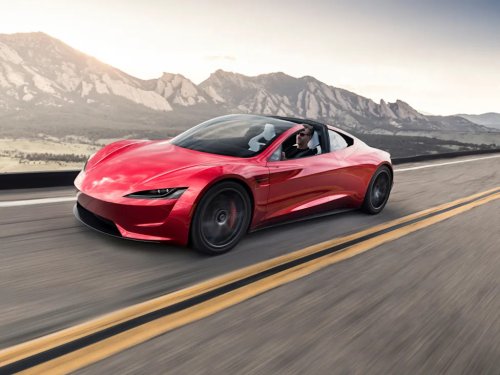
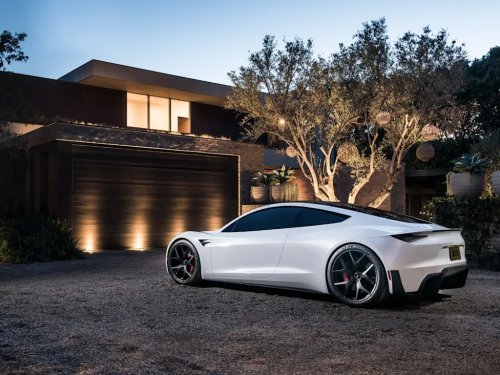
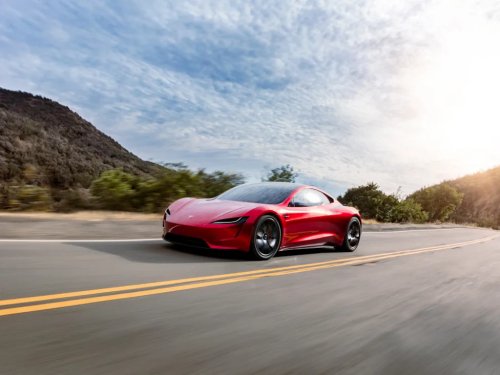
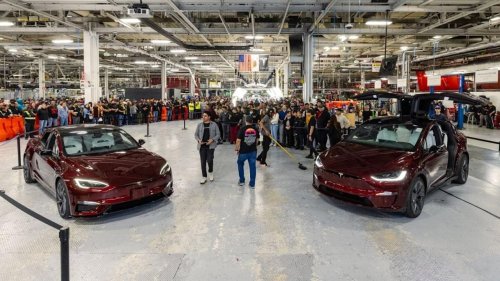
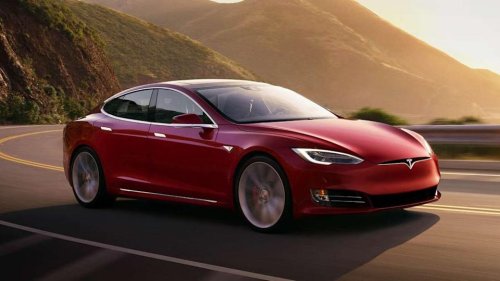
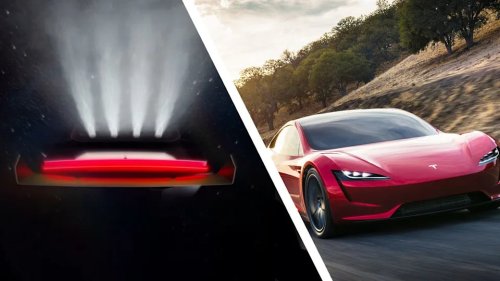
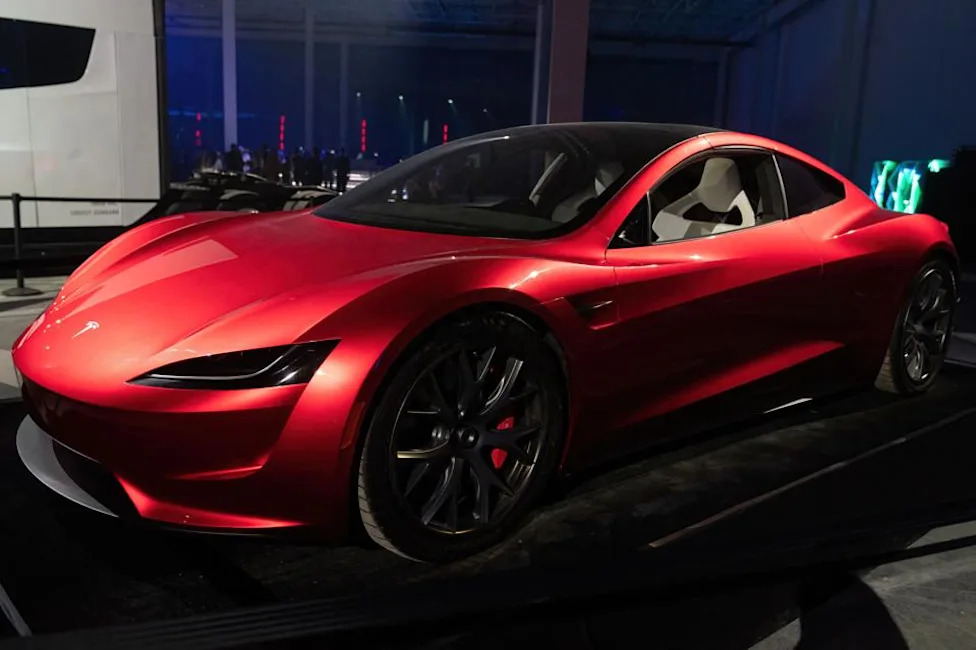
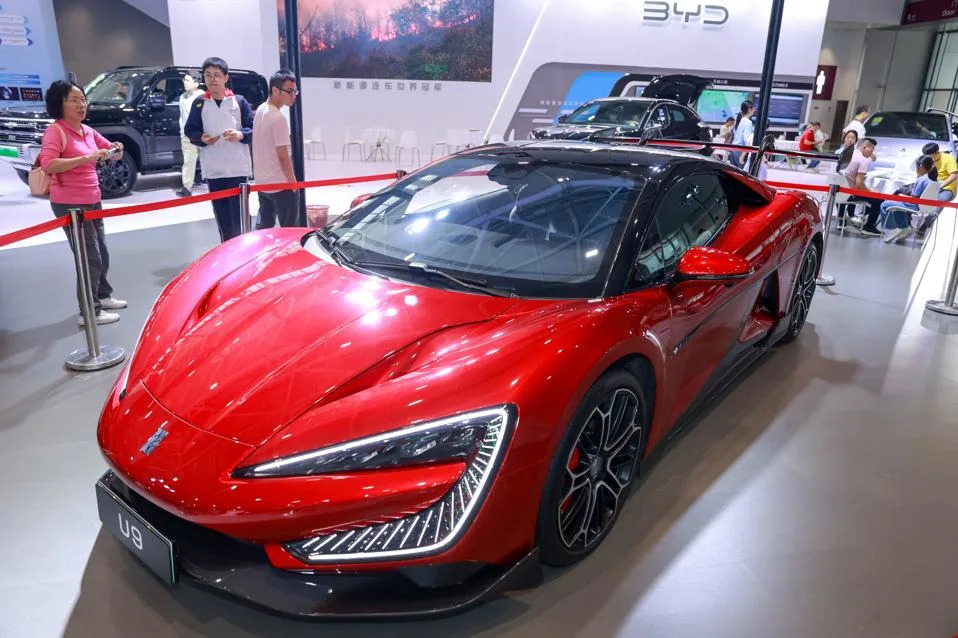
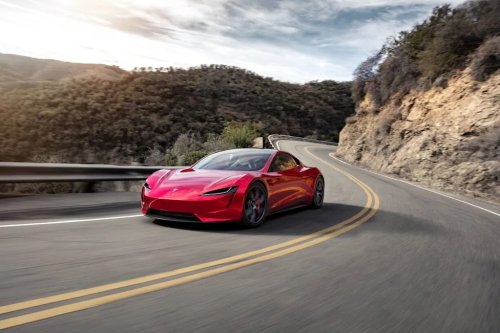
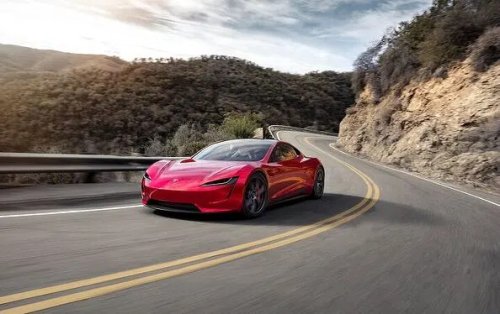
Musk Is Putting SpaceX Thrusters On A Tesla—What Could Go Wrong?ForbesPeter Lyon, ContributorUpdatedSun, September 13, 2026 at 5:25 PM UTCAdd us on GoogleThe Tesla Roadster on display at the Tesla Giga Texas manufacturing facility during the "Cyber Rodeo" grand opening party on April 7, 2022 in Austin, Texas. (Photo by SUZANNE CORDEIRO / AFP) (Photo by SUZANNE CORDEIRO/AFP via Getty Images)AFP via Getty ImagesJust when you thought electric supercars had run out of party tricks, Elon Musk has apparently decided to add rockets.Tesla says it will unveil its long-delayed, second-generation Roadster on October 1, nearly nine years after the spectacular prototype first appeared. But the production car may be dramatically different from the sleek red machine shown in 2017. According to Reuters, Tesla is preparing a limited-edition version equipped with cold-gas thrusters developed in collaboration with Musk's rocket company, SpaceX.Bringing space tech to the roadYes, thrusters. On a road car. So what does that actually mean?AdvertisementAdvertisementBefore anyone imagines flames erupting from the rear bumper like a James Bond Aston Martin, cold-gas thrusters do not burn rocket fuel. They discharge highly pressurized gas through carefully positioned nozzles to produce short bursts of thrust. Spacecraft use similar systems for attitude control and precision maneuvering.Musk first floated the idea in 2018, saying an optional "SpaceX Package" could incorporate approximately 10 small thrusters arranged around the Roadster. Depending on their positioning, they could theoretically improve acceleration, braking and cornering—or perhaps even allow the car to momentarily lift itself from the ground.Reuters suggest Tesla may demonstrate the system at SpaceX's test facility in McGregor, Texas. The car could be operated remotely because of the obvious risks posed by compressed gas, violent acceleration and deafening noise. Tesla has not confirmed the final technical configuration or whether a thruster-equipped Roadster could ever be licensed for public roads.When Tesla originally unveiled the Roadster, it claimed the four-seat electric sports car would accelerate from zero to 60 mph in 1.9 seconds, cover the quarter mile in 8.9 seconds, exceed 250 mph and travel 620 miles on one charge. Its enormous 200-kWh battery was also expected to make it considerably heavier than traditional supercars.BYD Yangwang U9 electric hypercar. (Photo by VCG/VCG via Getty Images)Those figures sounded absurd in 2017. Today, however, electric hypercars from Rimac, Pininfarina and China's BYD-owned Yangwang have made sub-two-second acceleration almost commonplace—at least among automobiles costing seven figures. The Roadster's long delay allowed the competition to catch and, in some cases, overtake Tesla's original targets.AdvertisementAdvertisementThat helps explain the thrusters. Tesla no longer needs merely to build another very fast electric car. It needs to create a spectacle no rival can easily duplicate.Cold-gas propulsion could give the Roadster an advantage where electric motors meet their greatest limitation: tire grip. Even if a powertrain produces thousands of horsepower, it cannot accelerate harder than its tires can transmit that force to the road. Rear-facing thrusters would introduce additional propulsion without relying entirely on contact with the asphalt.Will Tesla's price stay at $200,000?But considerable questions remain. Where will Tesla package the high-pressure tank? How many bursts will it provide before needing to be recharged? How will pedestrians, nearby cars and emergency crews be protected? And what regulatory authority will approve a machine capable of blasting compressed gas around a public street?Price is another mystery. Tesla originally discussed a $200,000 starting price and a $250,000 Founders Series, but those figures date from 2017. The SpaceX-equipped edition could cost considerably more and may ultimately become a tiny, track-only technological showcase rather than a regular production model.AdvertisementAdvertisementThe bigger issue is credibility. The Roadster was initially scheduled to arrive in 2020 and has repeatedly slipped down Tesla's calendar. Musk has promised unveiling dates before, while production timing remains unclear.Still, the Roadster serves a purpose beyond sales. Tesla's original Roadster proved that an electric car could be desirable. The new one is intended to demonstrate that an EV can outperform—and thoroughly out-crazy—almost anything powered by gasoline.If Tesla delivers, the result could redefine the supercar. If it does not, the Roadster will remain the world's fastest automobile that never quite reached the starting line.This article was originally published on Forbes.com

















!['What the [Expletive] Is That?:' Customer Complains Car is 'Shaking Like Crazy.' Then His Mechanic Takes a Closer Look At The Tire](https://cdn.topcarnews.net/thumb/id/aHR0cHM6Ly9jZG4ubW90b3IxLmNvbS9p-bWFnZXMvbWdsLzQwRTk0cS9zMS9tYXpk-YS1taWF0YS1vbi1zdHVkZGVkLXdpbnRl-ci10aXJlcy10ZXN0LmpwZw/79e14514a276098b50ad4c871b42cc60.jpg?t=20261004&post_id=3458)
!['What the [Expletive] Is That?:' Customer Complains Car is 'Shaking Like Crazy.' Then His Mechanic Takes a Closer Look At The Tire](https://cdn.topcarnews.net/thumb/id/aHR0cHM6Ly9jZG4ubW90b3IxLmNvbS9p-bWFnZXMvbWdsL01rWVFNNC9zMS9pbWdf-ODY0Mi5qcGc/6f1ec4b4318a8b257cc3e8a877ffe35f.jpg?t=20261004&post_id=3458)
!['What the [Expletive] Is That?:' Customer Complains Car is 'Shaking Like Crazy.' Then His Mechanic Takes a Closer Look At The Tire](https://cdn.topcarnews.net/thumb/id/aHR0cHM6Ly9jZG4ubW90b3IxLmNvbS9p-bWFnZXMvbWdsL2xFM3dsVy9zMS9pbWdf-ODY0OC1jb3B5LmpwZw/347bc674f00c1700fd29d2c57e842287.jpg?t=20261004&post_id=3458)
!['What the [Expletive] Is That?:' Customer Complains Car is 'Shaking Like Crazy.' Then His Mechanic Takes a Closer Look At The Tire](https://cdn.topcarnews.net/thumb/id/aHR0cHM6Ly9jZG4ubW90b3IxLmNvbS9p-bWFnZXMvbWdsL2JnMTJHdi9zMS9tYXpk-YS1taWF0YS1vbi1zdHVkZGVkLXdpbnRl-ci10aXJlcy10ZXN0LTAxLmpwZw/93bb67d2c8cc97fba8d2ff15175061ca.jpg?t=20261004&post_id=3458)
!['What the [Expletive] Is That?:' Customer Complains Car is 'Shaking Like Crazy.' Then His Mechanic Takes a Closer Look At The Tire](https://cdn.topcarnews.net/thumb/id/aHR0cHM6Ly9jZG4ubW90b3IxLmNvbS9p-bWFnZXMvbWdsL3BiM3E5by9zMS9tYXpk-YS1taWF0YS1vbi1zdHVkZGVkLXdpbnRl-ci10aXJlcy10ZXN0LTAyLmpwZw/99624eda68d3f45fcbd7939f0443e37f.jpg?t=20261004&post_id=3458)
!['What the [Expletive] Is That?:' Customer Complains Car is 'Shaking Like Crazy.' Then His Mechanic Takes a Closer Look At The Tire](https://cdn.topcarnews.net/thumb/id/aHR0cHM6Ly9jZG4ubW90b3IxLmNvbS9p-bWFnZXMvbWdsL1hCNlBYVi9zMS9tYXpk-YS1taWF0YS1vbi1zdHVkZGVkLXdpbnRl-ci10aXJlcy10ZXN0LTAzLmpwZw/544d73fd805018640d3a35252e9dbb76.jpg?t=20261004&post_id=3458)