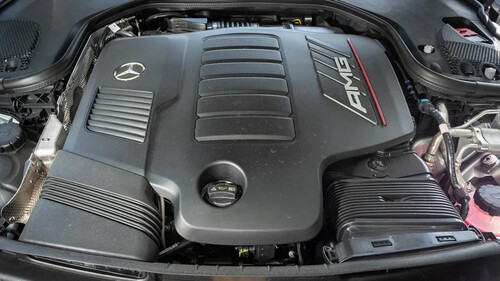
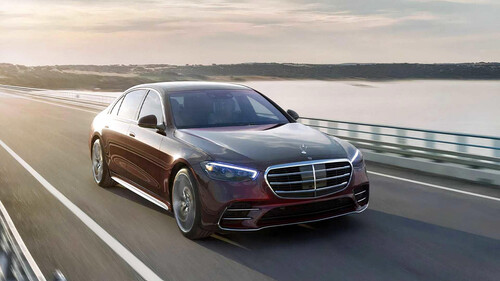
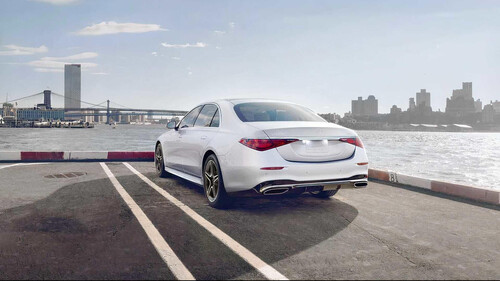
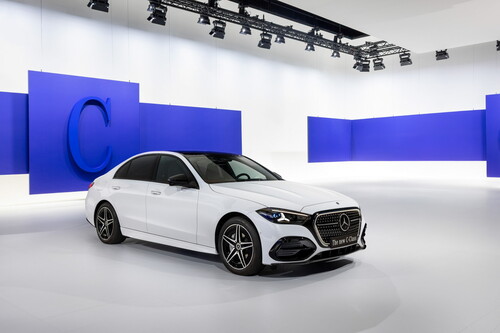
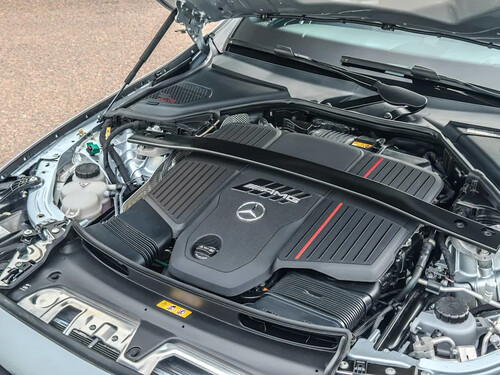
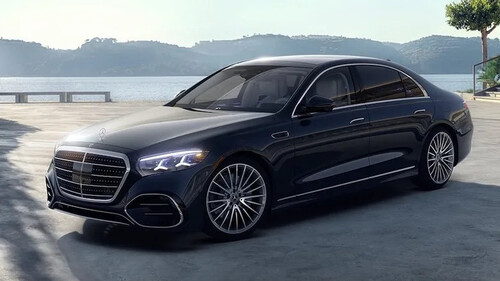
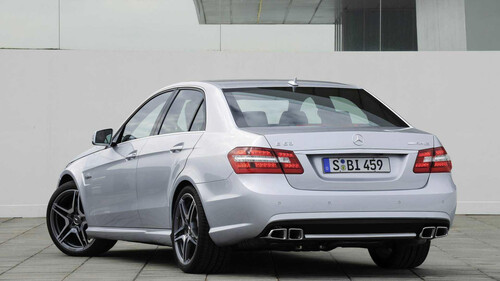
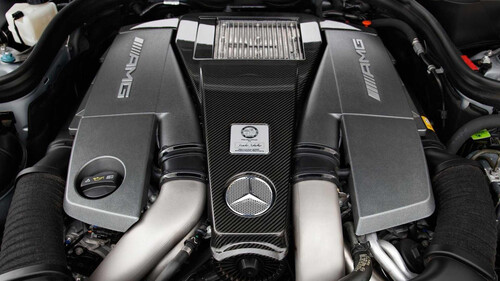
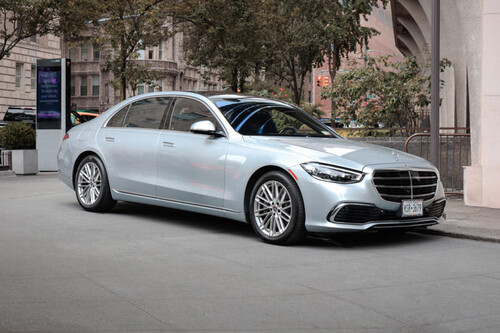
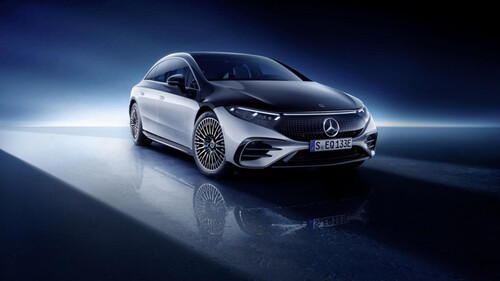
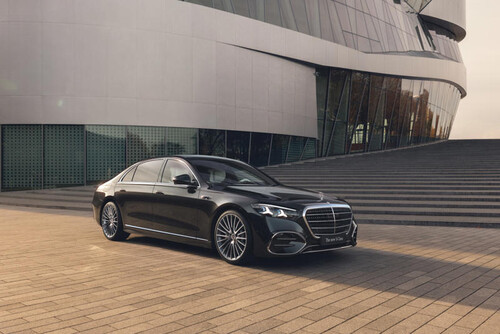
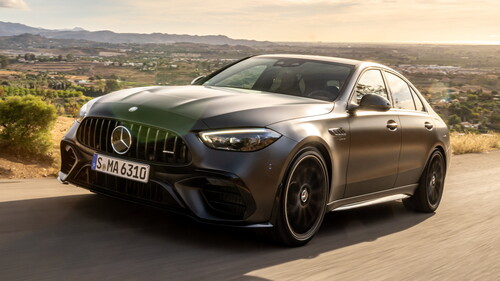
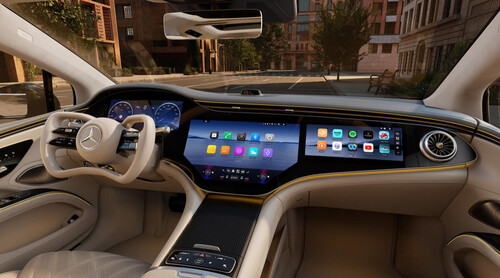
There was a time when you couldn't imagine a world without multi-cylinder Mercedes sedans. You could even argue that Mercedes-Benz built its entire reputation around purposeful, competent cars with those sturdy eight-cylinder engines. The V8 was the order of the day for the longest time, as the German company would once shoehorn those engines into its long-legged E-Class, sporty C-Class, or flagship S-Class machines in full AMG trim.But that approach is no longer the favorite at Mercedes, and if you restrict the focus to traditional three-box sedans, there's only one V8 sedan nameplate left. The S-Class Is The Only Traditional V8 Mercedes-Benz Sedan Left Mercedes-BenzIn the US market, the S580 4Matic sedan is the only sedan from this manufacturer to use a 4.0-liter V8 turbo, with mild hybrid assistance, putting out 496 hp and 516 lb-ft of torque from the engine itself. The AMG S 63 E Performance takes the same basic V8 architecture and puts it into a plug-in hybrid performance flagship, while the Mercedes-Maybach S 580 also has the same 4.0-liter V8 biturbo.These V8 variants therefore live under the same body style umbrella and make up the entire V8 story. While some may point out that the AMG GT in 63 and 63 S E Performance spec also have a V8 engine, the fine details matter. Mercedes presents those vehicles as four-door coupes and not conventional sedans.The S-Class now carries a lot of symbolic weight as the only user of V8 engines. After all, this is not merely the biggest and most expensive mainstream Mercedes sedan, it now represents a bridge back to bolder times. It's the single surviving link to the era when V8 power was ubiquitous across the Mercedes range and not just reserved for the top shelf. Mercedes Used To Be Synonymous With The V8 Sedan Mercedes-Benz It's quite eye-opening to see how much Mercedes leaned on the V8 engine to help propel its performance sedans. For example, the C63 sedan was one of AMG's defining products. It had a 6.2-liter naturally aspirated V8 in the early W204 era, with a 4.0 liter bi-turbo V8 following in the W205. Likewise, the E63 sedan spent a lot of time as a V8-powered super-sedan flagship, and then the CLS 63 AMG came along to break new ground with a more style-led V8 four-door approach.This spread of V8 options certainly defined the Mercedes image across the United States and tended to set the company apart from big rivals like BMW. While the M3 from BMW was one answer to compact performance, the thunderous V8 in something like the C63 was uniquely Mercedes-AMG.Mercedes didn't merely build one V8 sedan but created a hierarchy of options to propel cars in different segments. For example, you had the E63 as an executive express with real supercar pace, or the S-Class, which had plenty of muscle but posed as the polished flagship. That hierarchy stood the test of time and was further reinforced by official AMG positioning across multiple classes.And this means that engineering enthusiasts will undoubtedly treat the survival of the S-Class V8 as quite a big deal. They will also note that Mercedes is, to all intents and purposes, making a cultural shift here. It’s not simply swapping one engine for another in a vacuum but is purposefully trimming a long-established part of its identity down to a single remaining sedan family. The Cars That Died Tell The Whole Story Mercedes-Benz To understand the significance of this development, it pays to take a closer look at what the current Mercedes sedan range actually offers. To start with, you've got the AMG C 63 SE Performance sedan, which no longer features a V8 at all. Instead, you'll get a handcrafted 2.0-liter inline-four that comes with an electric motor and is good for a combined 671 hp and 752 lb-ft of torque. Meanwhile, the current AMG E 53 hybrid sedan uses an AMG-enhanced 3.0-liter inline-six with an electric motor, producing 577 hp.While the C-Class and E-Class sedan lines are still there and still have AMG badges on the back, they have a very different cylinder count, which starts to tell you the fuller story. And the shift is equally noticeable in the C-Class because that was arguably the best example of an AMG V8.You can look all the way back to 2012 to see the V8 character in something like the C63, which back then turned out 451 hp. Mercedes stuck with the V8 in that particular car all the way through the later twin turbo era but today, the C63 is not a V8 sports sedan at all. It's technically faster, but it's a four-cylinder hybrid and somehow lacks the emotion of the old formula.The Mercedes E-Class story is a little complicated, as the old E63 has disappeared from the current lineup. The company still sells an AMG E-sedan, but it doesn't have a V8. Now you've got the six-cylinder AMG E53 hybrid instead, which is very different from the last proper E63 sedan, which had a 4.0-liter bi-turbo V8 monster under the hood. The S-Class Survived When The Others Didn't Mercedes Mercedes understands that a certain segment of its market expects a certain type of package when they come to buy their new Mercedes or replace an existing one. And this may be why the company has decided to keep the V8 architecture within the S-Class after all. Those particular buyers are looking for silence, torque, prestige, and effortless speed in their Mercedes product, and the trusty V8 engine goes a long way to satisfying that need.Mercedes clearly believes that buyers are not so concerned about engines in the smaller sedan part of the market, and that may be partly why it retired the V8 there. But in the big bruiser league, the S 580's 4.0-liter V8 biturbo is a natural fit, while the AMG S 63 E Performance absolutely fits the profile of a high-output flagship. It runs out 791 hp and 1,055 lb-ft and has plenty of authority to match its raw acceleration.There may also be some regulatory and commercial logic in play, though. From a purely financial point of view, those bigger and more expensive flagships can absorb more complicated systems far more easily than compact or midsize sedans. The AMG S 63 E Performance is certainly towards the top of the range at $189,800 in the US, and so Mercedes can justify what it needs to keep a V8 alive in the stricter emissions world. Financially, it can add an improved battery, a rear motor, and extensive chassis hardware to that car, but it's much harder to do so lower down the range without losing valuable margin. The Flat-Plane V8 May Spread, But Probably Not To Every Sedan Mercedes It's interesting to look at this V8 story in context because Mercedes may even be investing in the future of the formula. It’s introduced a revised V8 in the updated S-Class, and this now comes with a flat-plane crankshaft. In its new guise, the flat-plane crankshaft idea brings a new firing order and develops 530 hp and 553 lb-ft. And while this is a very unusual and even bold move in the market, Mercedes appears confident that its approach will improve both efficiency and responsiveness.The S-Class is the first traditional Mercedes sedan to carry the new engine, and with further development coming down the line, the flat-plane V8 will go into the updated GLE and GLS V8 models. The AMG CLE 63 may also be a recipient, although it seems unlikely that the V8 will reappear in the C 63, leaving the S-Class as the only true Mercedes sedan home for that engine formula.It's good to see that Mercedes is still building V8-powered four-doors and still working on the architecture, rather than ditching the idea altogether. But you do have to look carefully to find these engines now, and they're no longer the default when it comes to old-school sedans. Instead, the S-Class is the last traditional three-box holdout for the V8, which makes it a rolling reminder of what the brand used to be. And while there may be brighter days ahead for the V8 in its new flat-plane guise, the S-Class is still there to hold the fort.Sources: Mercedes.