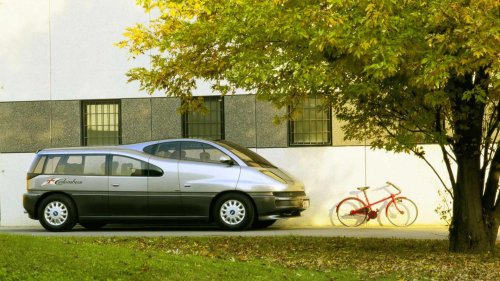
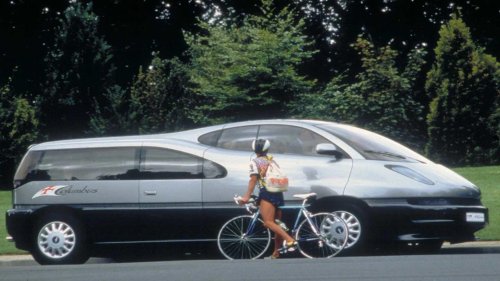
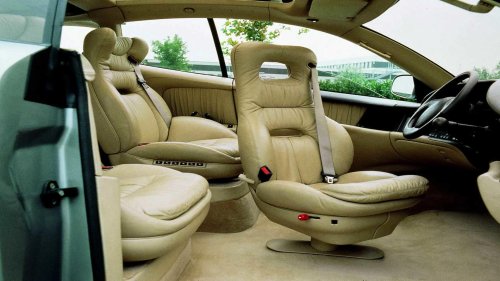
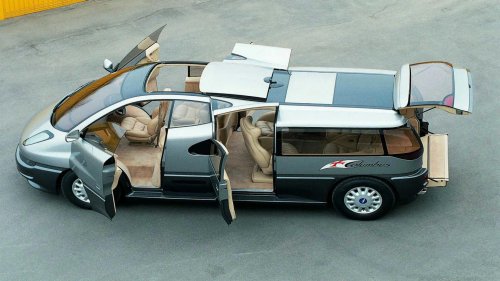
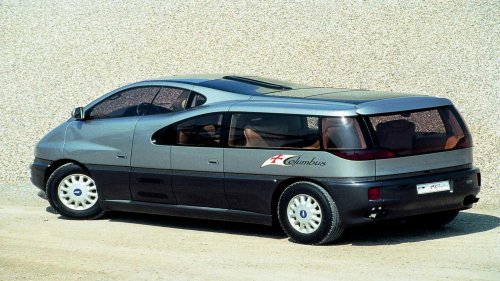
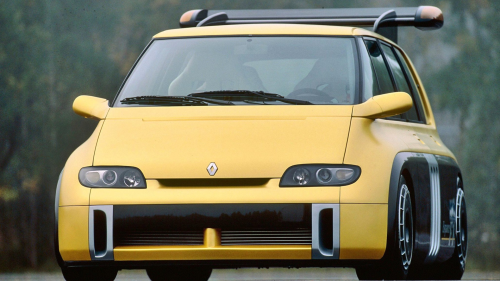
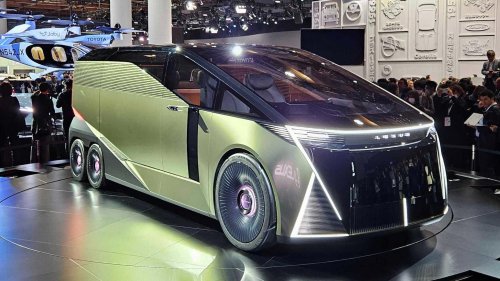
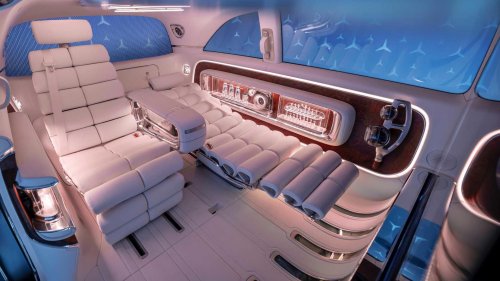



















Okay, we get it. Not all inventions are destined for greatness. But how much poorer would the world be if it weren’t for the occasional Frankensteinian freakish flight of fancy by some madcap fabricator? Without doubt, it only takes one retina-searing glance at the Italdesign Columbus to realize that even tossing the rule book has its limits. If a Pagani Zonda were to get rear-ended by a bus, the Italdesign Columbus would be the result.Italdesign.it At the 1992 Turin Auto Show, the Italian design company Italdesign – under the guidance of the chimeric Giorgetto Giugiaro (creator of the Volkswagen Golf, Lancia Delta, Lotus Espirit, DeLorean DMC-12 and many other automotive icons) showcased an imagining of the unimaginable: a luxurious double-decker seven-seater minivan named after one of history’s greatest, uhm, voyagers. Far from the narrow-minded, soul-destroying suburban orthodoxy of Chrysler’s (or Toyota’s, for that matter) people movers, the phantasmagoric Columbus smashed through the narrow-mindedness of box-on-wheels vehicle design and dreamed big – by going big.The Turin Auto Show ran from 1900 until it was canceled in 2020 owing to the Covid-19 pandemic. It was reinvented in 2022 as part of the Autolook Week motorsport festival held annually in September. Size Matters - So Does The Engine Italdesign.itAs far as mission statements go, christening a car after the pioneer of the Age of Exploration was suitably grandiose, though not without intent, as the Columbus was conceived to celebrate the 500th anniversary of the "discovery" of America.Possibly pushing the seafaring analogy one or two nautical miles too far, the company’s website characterizes the people-carrying concept as “a sailing ship for dry land”. Stretching 19 feet in length and around 7 feet in height and width, at least its creators weren’t stretching the truth about its monstrous measurements: the carbon-bodied Columbus was too small to be considered an RV, but simply colossal as a microbus.To move such (visual) mass, Italdesign turned to BMW and opted for its five-liter, V12 engine used in the 750i and 850i of that period; and mounted it transversely in the middle of the 150-inch wheelbase to permanently power all four 20-inch-sized wheels through a 5-speed manual gearbox (what, no auto for what was meant to be the Maybach of minivans?). To better manage the Airbus-aping coach’s low-speed maneuverability, the rear wheels could steer at an angle of up to 15 degrees. And thanks to that generous dose of power, top speed was calculated as a theoretical 130 mph - for those who dared. ... But That Upper Cabin! Italdesign.it It’s interesting to note – and we’re sure purely coincidental – that the Columbus and McLaren F1 (and today, the Speedtail), both featured a central driving position and just happened to be launched in the same year.While in the McLaren the pilot seat is intimately flanked by a pair of passenger seats an in inverted V shape, in the Columbus there’s a similarly configured upper deck housing the captain’s chair and two passengers, whereafter below on the lower level there’s another quartet of passenger pews to form a 1+2+2+2 arrangement - an additional pair could be added to total nine. All passenger seats are able to rotate, recline or be removed entirely to form a C-130 Hercules-rivaling loading cavity.Each seat, apart from the driver, had its own individual AC controls and TV monitor – network TV was on offer – and failing that, there was also (presumably a centralized) VHS entertainment system.As if threading the gargantuan Columbus into your home hangar wasn’t enough of a daily nightmare, its designers did not deem the spatial limitations of the average garage a suitable deterrent from equipping it with even-wider-opening wing doors – instead of infinitely more practical space-saving sliding ones.Italdesign.it And, as if that wasn’t bad enough, the second row of doors were horizontally split, whereby the bottom section opened conventionally, although the top halves unfolded skywards, gullwing-style. Most certainly, it would not have been possible for occupants to close the doors after ingress while seated. With the cabin enclosed by more heat-transferring glass than the Bank of America Tower in New York, that shortage of shade would have made for a hellish hothouse in summer, further aggravated by the Columbus’ sliding sunroof. Flopped And Dropped Italdesign.it So why did Italdesign ever consider the Columbus as a feasible prospect when it was so obviously a no-go? Did it just so happen that on that day that the Columbus was presented for sign-off, it was the head of planning’s turn to fetch espressos? It’s plausible that, given the exalted level of nicheness that coachbuilders such as Giugiaro operate at (or perceive themselves to), that regular sensibilities and aesthetics were thrown into the wind.Additionally, the automotive avant-garde aversion that was the Columbus might have also been conceived in response to rival compatriot boutique car builders Bertone, who in 1988 at the same auto fair revealed their interpretation of a gull-winged minivan. The Bertone Lamborghini Genesis appeared to be a more complete version of the Boonie Bug kit car.The Bertone, however, was considerably more looney than the Boonie; as it was powered by the Countach’s 455 hp V12 that sent all of its power to the rear wheels through a 3-speed automatic gearbox. It, too, had rotating (front) seats and, as if symbolic of the zenith of automotive luxury of that time, was also fitted with a TV set.1995 Renault Espace F1 frontAs neither the Columbus nor the Lamborghini Genesis made production, they’ve been largely forgotten, to say nothing of being left in the shadow (and dust) – by Renault’s equally outrageous hypervan, the Espace F1 of 1994. Built to celebrate the company’s involvement in F1, the Espace was fitted with the 1993 championship-winning, 800-hp, naturally aspirated 3.5-liter V10 engine. With zero concessions towards luxury, it was the antithesis to the lardy lameness of the Columbus in every respect, bringing hope to a genre that was otherwise defined by boredom, mediocrity and just so every now and then, a little lunacy in the name of unrequited luxury – or velocity. The Future Of Minivans In 2026 lexus-ls-concept-minivan-13It's nearly a quarter of a century later, and the future for minivans isn't quite as crazy - or is it? Lexus came to the party recently with a six-wheel minivan concept ostensibly meant to replace the LS. The odd-looking design is said to prioritize space and comfort, while offering privacy and luxury by the bucket loads. But Lexus isn't the only one with some interesting ideas for turning your mom-van into something special.Genesis, the Korean luxury brand, is reportedly working on a minivan for Chinese ultra-luxury buyers. It's said to be an extended range EV with adjustable rear seats, massive screens, and autonomous driving. Mercedes-Benz offers something similar with the Vision V Concept, which we show below.Mercedes-Benz Still, the question remains. How much interest is there in minivans? Perhaps the crazier, more luxurious, and weirder they are, the better chance they have of actually making it to production - unlike the ill-fated Columbus.