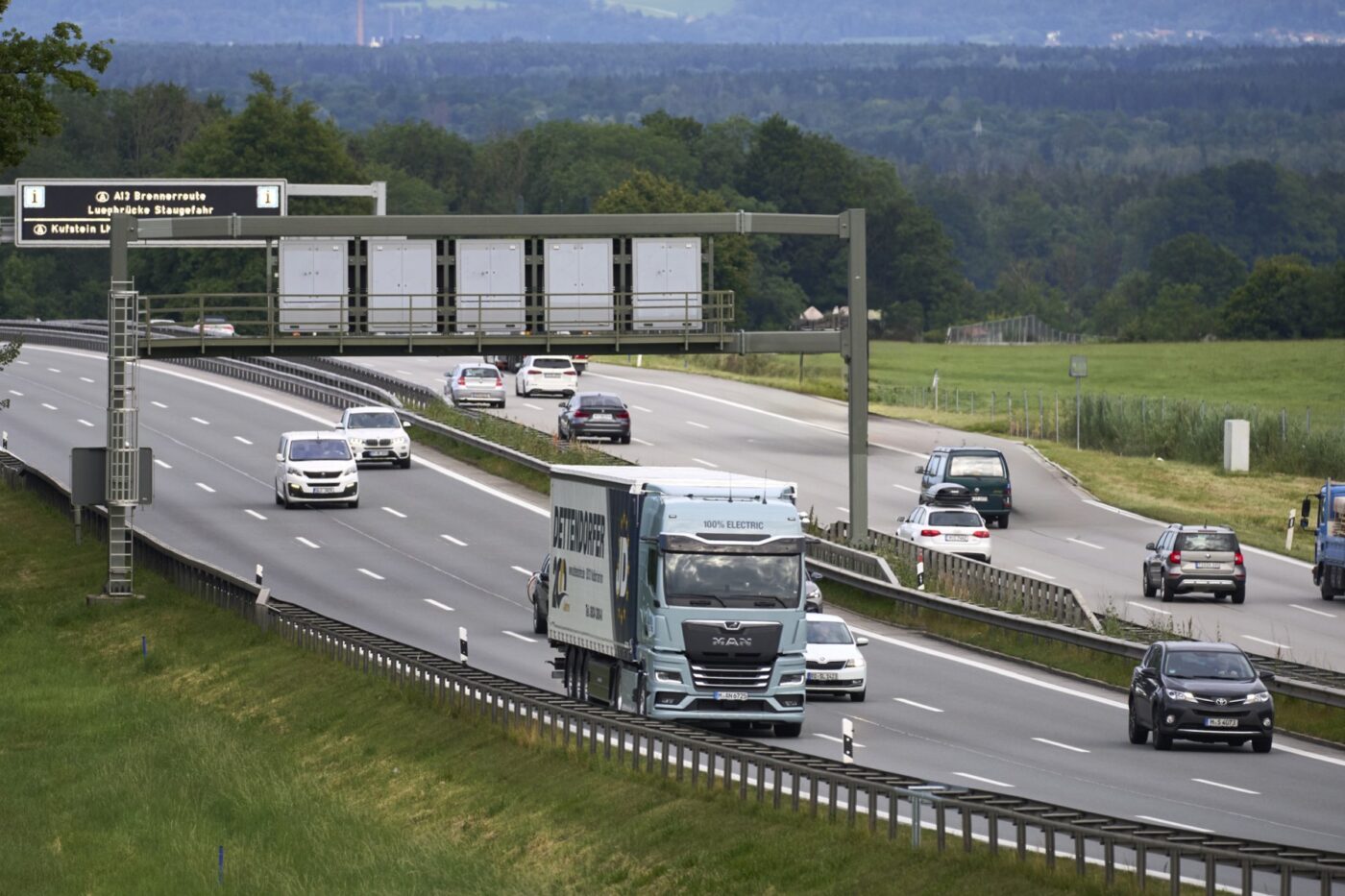



















Image: MANMAN and Dettendorfer Energie are leading this initiative, with the Green Brenner Initiative also supported by additional partners from the business, energy, and infrastructure sectors, as the stakeholders emphasise. The shared vision: to accelerate the adoption of battery-electric trucks on the Brenner route between Austria and Italy. After all, in alpine regions, zero-emission transport is ‘not only ecologically sound, but also economically attractive,’ as the credo states.“The Brenner is a stress test for European freight transport – and at the same time concrete evidence that electric mobility in heavy goods transport can already make a significant contribution to alleviating the traffic problem today. Until the completion of the Brenner Base Tunnel, e-trucks can make an important contribution to easing the burden,” said Frederik Zohm, Executive Board Member for Research and Development at MAN Truck & Bus.The initiators aim to establish the Brenner corridor as a model region for zero-emission logistics — ‘explicitly not as competition, but as a complement to rail,’ as MAN emphasises. Until the completion of the tunnel, the concept is intended to serve as a fast transport alternative and later address transport demand that cannot be avoided or shifted to rail.The stakeholders therefore stress that the initiative should be understood as part of an integrated transport system. ‘The initiative sees itself as part of an integrated transport system. It specifically addresses road freight transport, which will continue to be necessary in the future as transport volumes keep rising. Scaling up the initiative depends in particular on the expansion of charging infrastructure and grid capacities along the European transit corridor.’MAN is aware of this, among other things, from a four-week field trial that the commercial vehicle manufacturer conducted last year with the large haulage company Dettendorfer. The partners demonstrated that an electric truck on the Brenner route can save significant amounts of CO₂ and, due to high recuperation and lower toll costs on this route, can be particularly economical.Meanwhile, Dettendorfer has partnered with the energy provider Energie Südbayern to establish the joint venture Dettendorfer Energy, which coordinates the duo’s charging hub ambitions. Under Dettendorfer Energy, two truck charging hubs are now operational: one at the Inntal motorway service area in Raubling and a second in Langenbruck, south of Ingolstadt. For the Green Brenner Initiative, the e-mobility joint venture of the large haulage company is now also actively involved alongside MAN.Georg Dettendorfer, Managing Director of Dettendorfer Spedition Ferntrans GmbH & Co KG and also of the new Dettendorfer Energy GmbH, comments: “For logistics companies, practical viability is ultimately what counts. This is precisely where the initiative comes in: we are demonstrating that emission-free transport in the Alpine region is not only ecologically sound, but also economically attractive – and that is the case today, not in ten years’ time.” His medium-sized company, based in Upper Bavaria, operates around 240 tractors – some of which are already electrified.Georg Dettendorfer is convinced that hauliers operating electric trucks on the Brenner Pass can achieve significant cost savings from an annual mileage of around 110,000 kilometres. “Energy costs for electric trucks are around 40 per cent lower compared to current diesel prices.” An additional efficiency advantage arises from recuperation in alpine terrain: “On the Brenner route, the e-truck can recover a substantial portion of the energy used – up to around 40 per cent – through energy recuperation on downhill stretches, thereby significantly reducing overall energy consumption,” according to the partners’ experience.The stakeholders also point to toll savings as a further economic advantage, estimating cost reductions of around 80 per cent. According to the partners, the total cost of ownership for a battery-electric truck over three years should therefore be around 20 per cent lower than that of a comparable diesel truck.They also argue that battery-electric trucks strengthen regional value creation, as energy generation and consumption increasingly take place locally. MAN further emphasises lower brake wear and reduced noise emissions: ‘During acceleration, electric trucks produce 12.6 dB less noise than their diesel counterparts and are subjectively perceived as significantly quieter – about half as loud.’ According to the company, this effect is especially noticeable in the narrow valleys of the Brenner Pass.However, the partners do not specify in their announcement how they concretely plan to incentivise more electric trucks on the Brenner route. It remains unclear whether the initiative will include charging infrastructure projects, how many electric trucks are targeted daily, and which further partners are already on board or still needed. MAN merely states in general terms that the daily use of 300 electric trucks would correspond to an annual CO₂ saving of around 28,000 tonnes.press.mantruckandbus.com