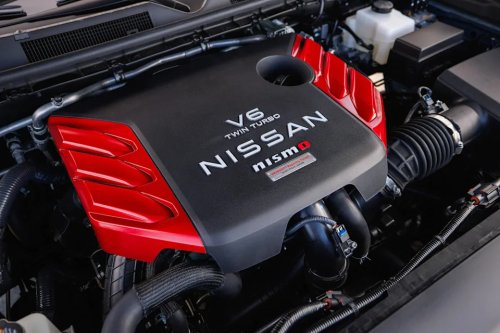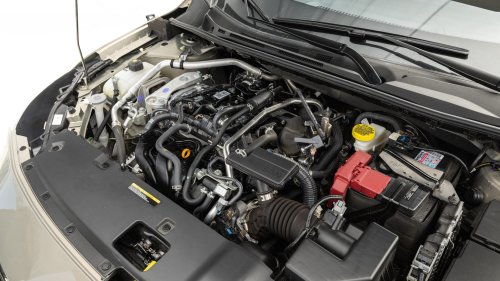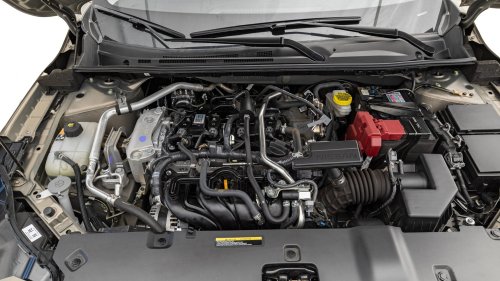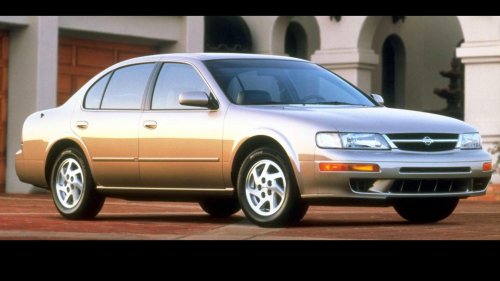

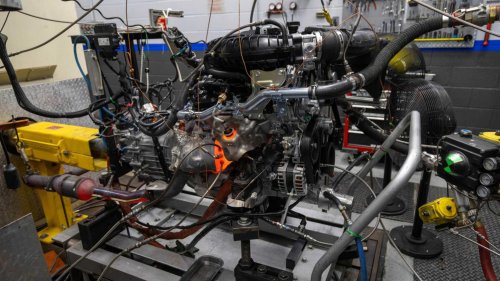
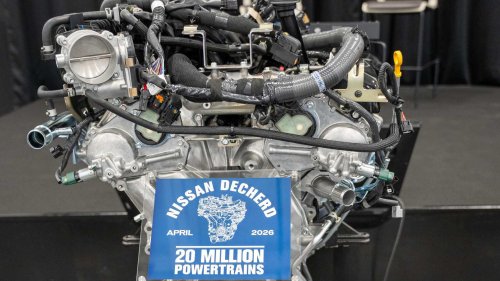
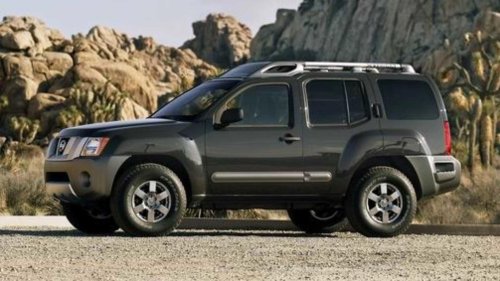

















For many drivers, even before there were hybrids and modern battery-electric powertrains, the V6 engine represented the powertrain sweet spot between the raspy four-banger and the powerful but thirsty V8. Anyone who has admired V6 versatility is likely familiar with Nissan's VQ engine family, which was introduced in Japan in 1994 about the same time that the fourth-generation 1995 Nissan Maxima full-size sedan arrived in the US and launched a V6 dynasty.NissanThat first silky, smooth, naturally aspirated VQ engine, making 190 horsepower at 5,600 rpm and 205 pound-feet of torque at 4,000 rpm, displaced 3.0 liters. But plans were already in place to crank up the displacement a few years later when Nissan would open its first US engine plant in Decherd, Tennessee, in 1997 to support vehicle assembly 70 miles to the north in Smyrna.In the 29 years since then, the Decherd engine plant has produced 20 million VQ engines, a milestone reached in late April when a 3.8-liter VQ-ZV9 V6 rolled off the line, headed for the engine bay of a Nissan Frontier pickup manufactured in Canton, Mississippi. But amid major changes at Nissan, how many more VQs will leave the plant before it's gone for good? 14 Trophies In A Row, Plus 2 More Nissan "As we continue to localize manufacturing for the US market, Decherd (pictured below, VQ testing) remains central to Nissan's growth strategy," said Christian Meunier, chairman of Nissan Americas. Nissan has invested $2 billion in the plant as part of a broader $14 billion investment in US manufacturing. "The Decherd team is already preparing for what's next, with the capability to assemble future ICE and electrified powertrains that will drive the next generation of Nissan and Infiniti vehicles built for, and sold in, the US."Nissan So, where does the VQ rank among V6 engines? That first 3.0-liter VQ was so good that it motivated editors at Wards Automotive in Detroit to create the Wards 10 Best Engines competition in 1995, and the VQ stayed on the list for 14 straight years, until 2008, in displacements ranging from 3.0L to 3.7L. Your humble author owned a 1996 Maxima SE with a five-speed manual transmission that was my personal favorite, because of the engine."The VQ was unlike any V6 we had driven to date," recalled former Wards Editorial Director and 10 Best Engines judge Dave Zoia. "The 3.0-liter DOHC VQ seemed to spin up so linearly and effortlessly and deliver the power to the Maxima’s wheels so instantaneously that we began to debate whether this was the best V6 of all time."NissanAfter 14 years, the VQ fell off the 10 Best Engines list as the Wards judges noticed that increasing bore and stroke had led to compromises in refinement at high rpm. But Nissan kept woodshedding the VQ engine, and it returned to the list in 2012 in the Infiniti M35h hybrid displacing 3.5 liters.And the VQ triumphed yet again a few years later, landing on the 2016 Wards 10 Best Engines list when the all-new Maxima arrived with a 300-horsepower VQ V6 assembled in Decherd. "Like the 3.0L that dazzled us in the Maxima in 1995, the improved VQ makes for light, lively, and refined power delivery, and the sterling midrange torque is still there," I wrote as a 10 Best Engines judge and senior editor back then. "And we can't recall ever getting 30 mpg from this engine long ago.” 85 MPH In Third Gear? Nissan Over the course of 29 years, the Decherd plant's 20 million engines have come in variants displacing 3.5 liters (for the 350Z, Altima, Maxima, Murano, Quest minivan, the Infiniti G35, I35, and QX60), 3.8-liter (for the Frontier), and 4.0-liter (for the Frontier, Xterra, and Pathfinder).How much longer will the VQ be moving the metal for Nissan? The brand has been downsizing its U.S. engine portfolio for years, while introducing more hybrids and all-electric powertrains. The 5.6-liter Endurance V8 has been replaced by a 3.5-liter twin-turbocharged V6, but it's not a VQ. This is an engine from the VR engine family that makes 425 hp in the 2026 Nissan Armada and 450 hp in the 2026 Infiniti QX80. But the next-generation Nissan Xterra will have a 3.8-liter V6, and there's a good chance it will be a VQ.But it's worth celebrating simpler times when engineers could focus solely on optimizing internal combustion, like with the VQ. Wards 10 Best Engines judge Drew Winter says there was a good reason it won so many awards: "Nissan made significant improvements to the engine every year, which was unheard of at the time." And editor Bill Visnic, the driving force behind Wards 10 Best Engines in 1995, described the VQ's high-rpm smoothness in the Maxima as downright uncanny in 1998. "It’s not unusual to be zinging along the freeway at 85 mph and realize you haven’t felt the need to shift out of third gear."