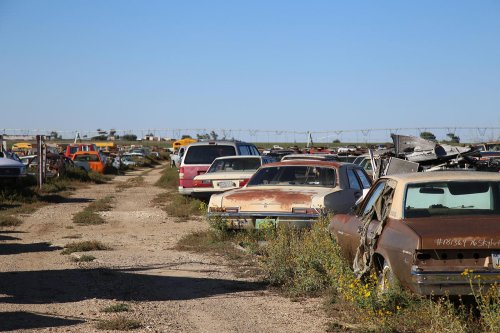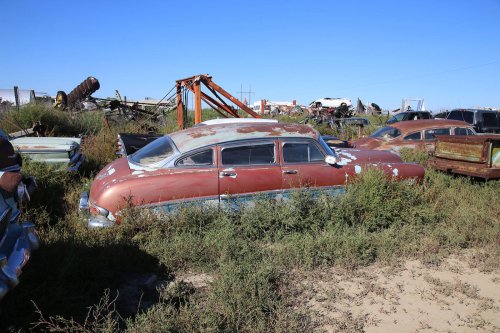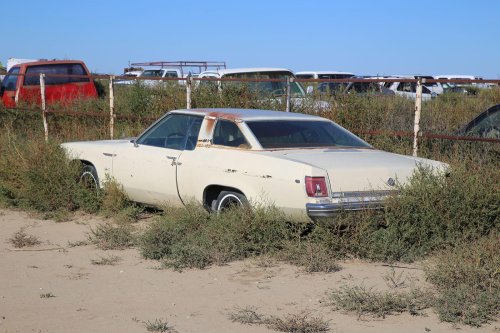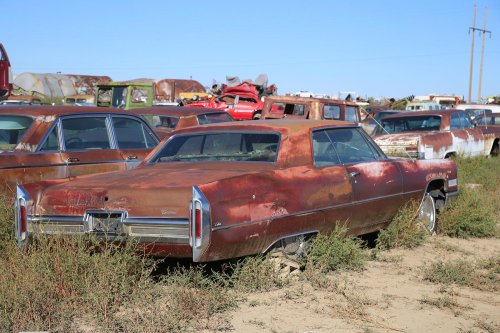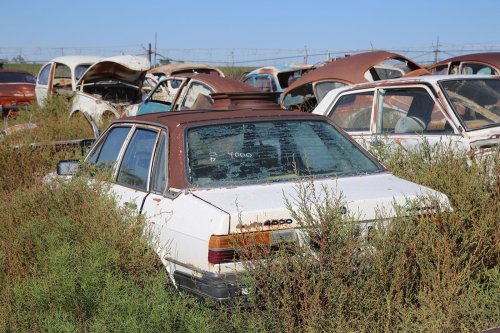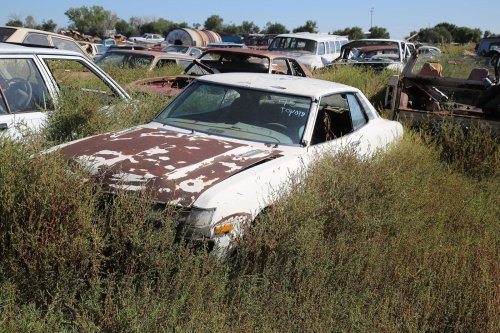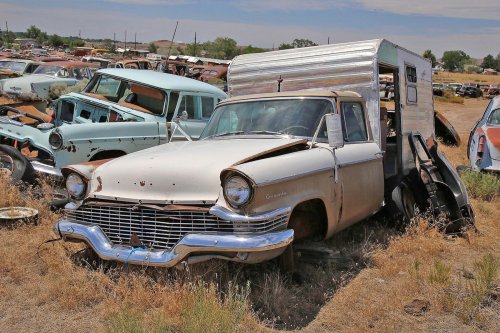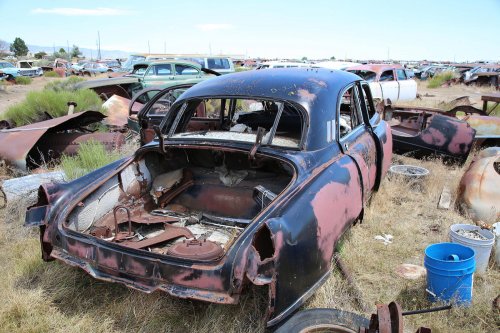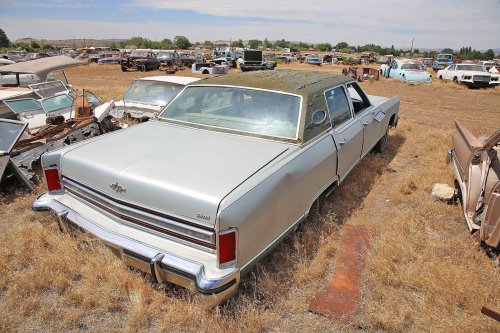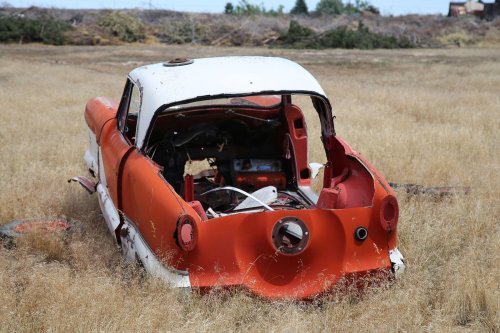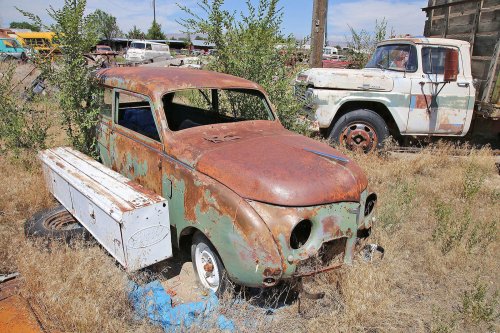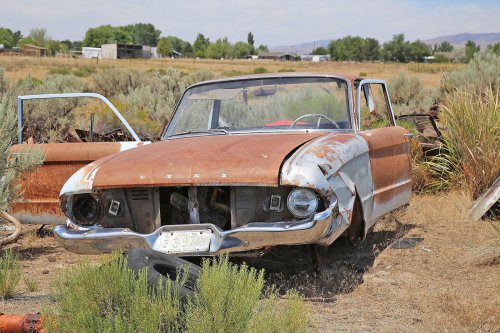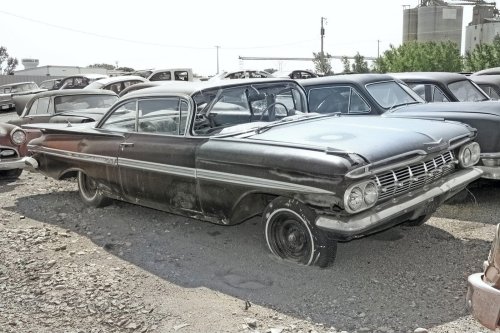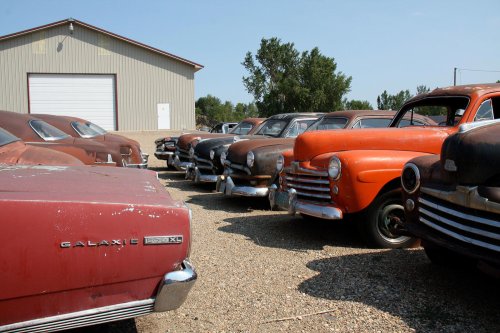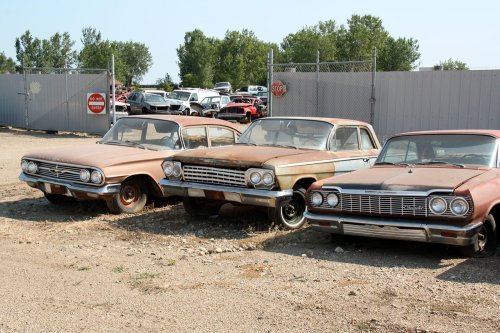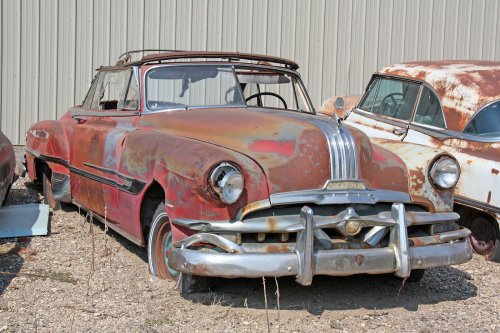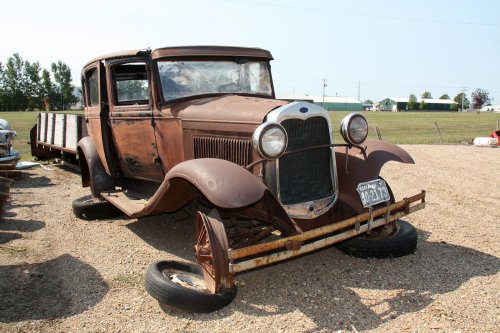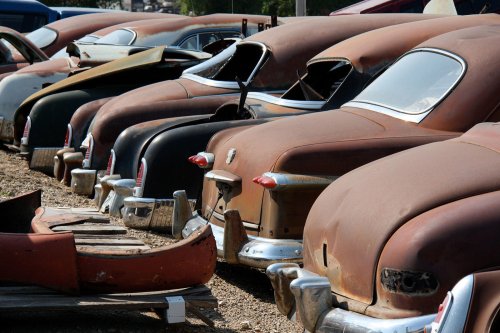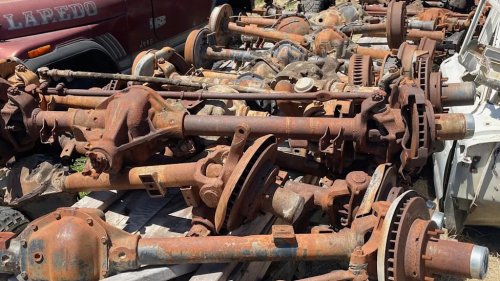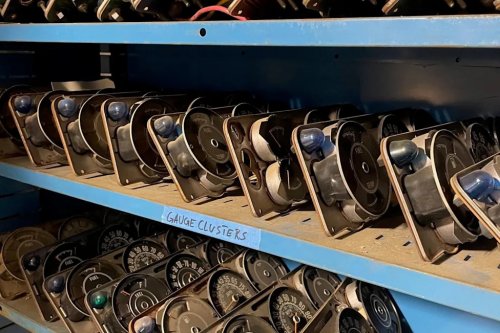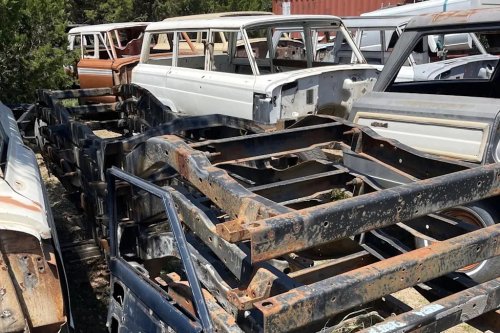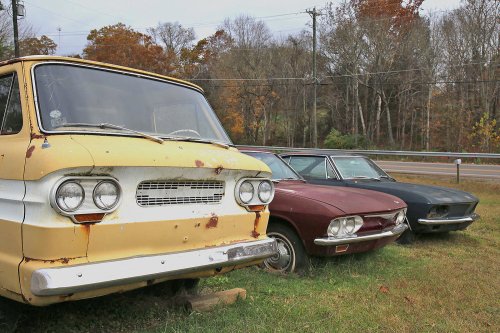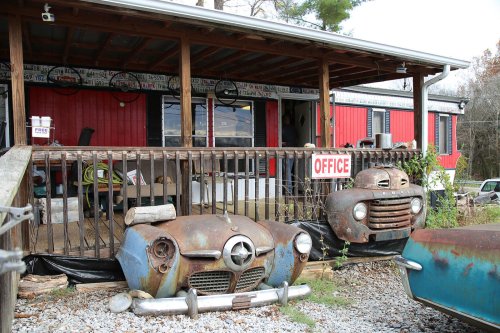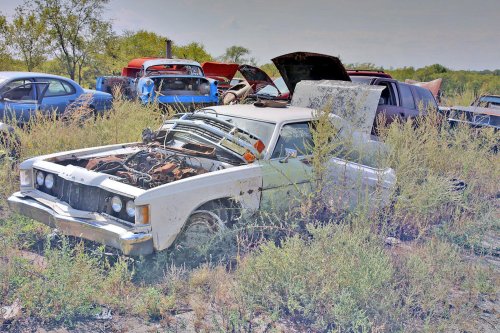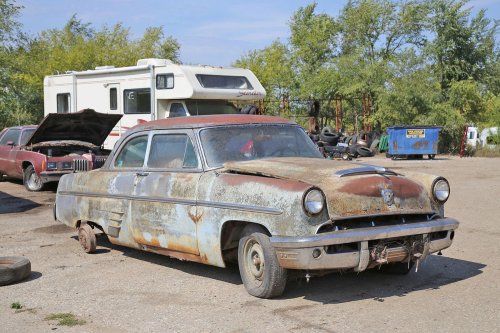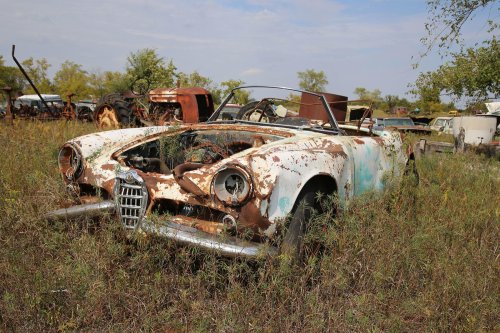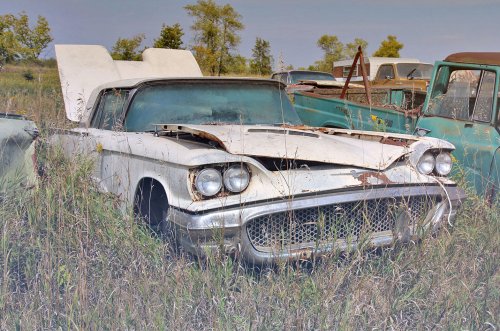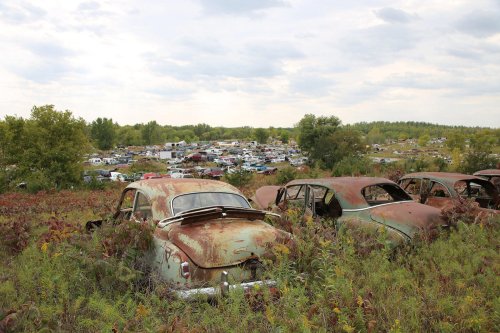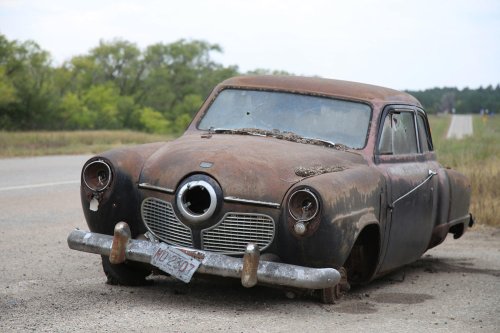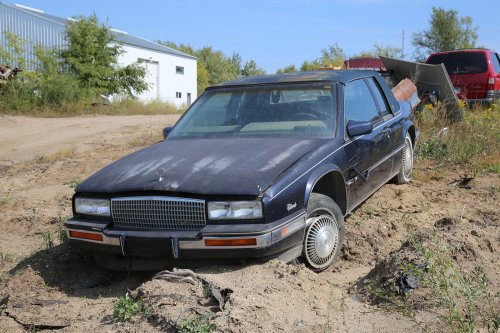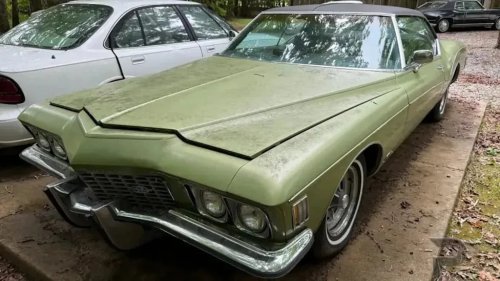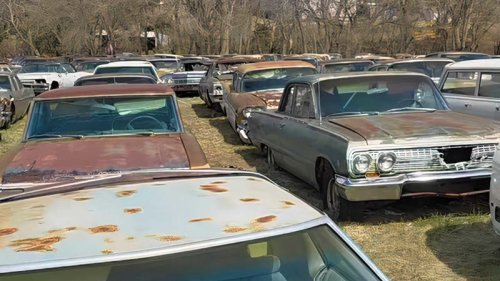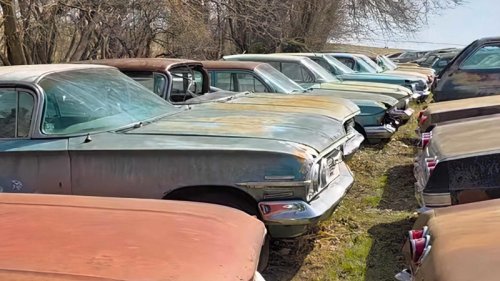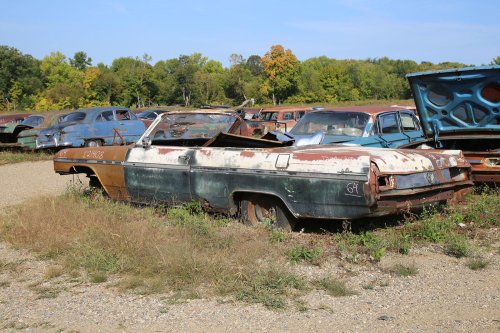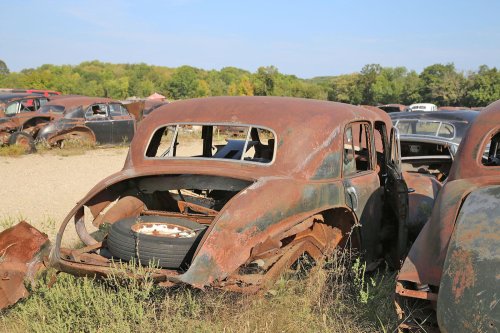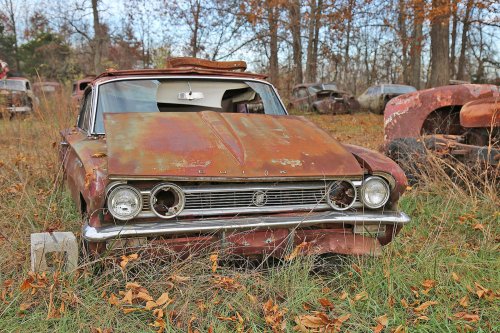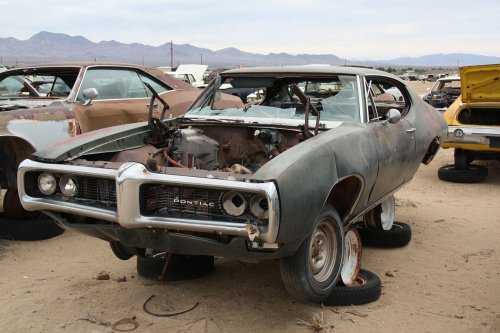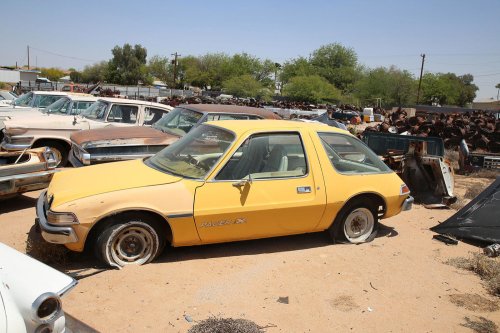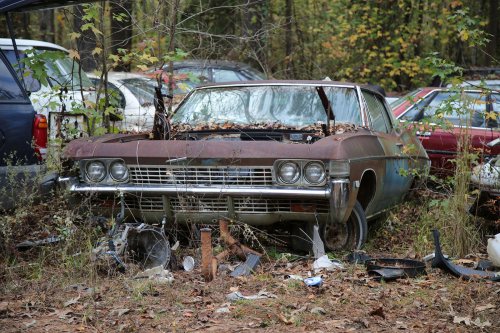






















































Hidden Valley Auto Parts of Maricopa, Arizona is one of our favorite salvage yards.The family-run business was founded in 1961, and has been located at its present 10 acre site since 2006. Here you’ll find several hundred cars, the majority of which are more than 20 years old – and when we visited we managed to snap some interesting relics. Let’s take a look:THE YARDMany of the yard’s cars are rust-free, thanks to the favorable desert climate, so the chances of finding decent parts are high. But the key reason why we like this place, is because the staff are so welcoming, knowledgeable and friendly – and know and love their carsHidden Valley Auto Parts is open from Tuesday to Friday, from 8am to 5pm, and is located about 40 miles south of downtown Phoenix.CHEVROLET - 1931This is the first vehicle that greets you at Hidden Valley Auto Parts’ entrance, and it’s the oldest by far. It’s a 1931 Chevrolet, and someone with a sense of humor has listed its attributes, and also some of its failings on the windows: ‘Original tires; lots of air conditioning; mother-in-law seat; two spares (you’ll need them); super quiet; reversed-doors and floors; too much to name’. Like it says in the window, the first $4500 takes this gem.INTERNATIONAL - SCHOOLBUSWhereas most classic car salvage yards tend to elevate a Henry J, Nash Metropolitan, or Crosley to advertise themselves to passing motorists, this is what can be seen when you drive past Hidden Valley Auto Parts. At the bottom we have a post-War International school bus, probably a 1948. As for what the contraption is on top, your guess is as good as ours.AMC RAMBLER CLASSIC 770 - 1964Hidden Valley Auto Parts has a pair of rare 8-cylinder 1964 Rambler Classic 770s, a two-door hardtop and this four-door sedan. The sedan is actually the rarer of the two, finding 9451 buyers, which is 2400 less than the two-door. This car was quite a mover back in the day, with its 4.7-liter V8 powering it to 60mph in 8.6sec. The car-buying public perceived these to be economy cars, but the 19 MPG average fuel consumption said otherwise.BUICK SUPER - 1958On average, Maricopa, Arizona gets 8in of rain per year, compared with a national average of 38in. That’s why this 1958 Buick Super still looks this good, and why classic car enthusiasts travel for thousands of miles to buy cars and spares from Hidden Valley Auto Parts. Although 1958 Buicks were plastered in chrome, what they lacked were the trademark ventiports. These were eliminated in 1958 and 1959, but would return in 1960.FORD FAIRLANE 500 - 1962One of the things we love about this yard is the eclectic mix of vehicles, and their variance of age. Consequently you never know what you’re going to encounter while exploring the aisles. This two-door 1962 Ford Fairlane 500 is 38 years older than the Mercury Sable parked next to it.Judging by the appalling state of those seats, the Ford parted company with its doors many years ago. While that hot Arizona sun is great for sheet metal, it’s not so great for upholstery.CADILLAC ELDORADO - 1968The Cadillac Eldorado was in production for an impressive 50 years (1952 to 2002), and during this time morphed several times. This 1968 example is an eighth generation car, and was Cadillac’s first foray into the personal luxury car market. It was equipped with the new 7.7-liter V8, which produced a healthy 375 hp. It was appreciated by the car-buying public, who drove 24,528 of them out of the showrooms, setting a new sales record for the Eldorado.PLYMOUTH SPORT SUBURBAN - 1970This sorry-looking station wagon looks like it’s starring in an episode of the Dukes of Hazzard. It was just landing, having completed a spectacular jump, when someone pressed pause…It’s a 1970 Plymouth Sport Suburban, which came with distinctive wooden panels and hideaway headlamps. Just 13,500 of them were built, and it’s a rare beast today.BUICK REGAL - 1973This reminds us of the “Daddy, the top came off” cop car in Smokey and the Bandit. Of course that was a 1977 Pontiac Le Mans, whereas this is a 1973 Buick Regal coupe. These fifth--generation cars were incredibly popular, 174,560 examples rolling off the line that year. Clearly there aren’t too many parts left on this one, and a date with the crusher is surely imminent. Although Regal sales stopped in the US in 2020, the name is still alive and well in China.DODGE A100 VAN - 1964Someone clearly had big plans for this van, but for whatever reason gave up on them. They went to the bother of cutting out the holes for the mushroom windows, and fitting those cool wheels, but never got around to kitting it out with the obligatory suede dashboard, deep shag pile carpets or groovy paintwork. It’s a 1964 Dodge A100, and it’s a shame it ended up here.CADILLAC LIMO - 1975How the mighty have fallen. Back in 1975 this Cadillac Fleetwood 75 limousine was the height of luxury, but now look at it. At the time it was the most expensive US-built sedan, having a $14,231 price tag ($82,000 in today’s money). In case you were wondering, that works out at $56.43 per inch. To put this into perspective, a Volkswagen Bug would have set you back $18.45 per inch.Just 795 of these were built, making this one of the rarest cars we’ve featured in Junkyard Gems.DODGE MONACO - 1970Just 3522 of these 1970 Dodge Monaco two-door hardtops were built, and we wonder how many had the 440 crammed under the hood. Whatever the answer, this is an extremely rare car. It’s also in great condition, with very little rust. Back in the day it was capable of reaching 60mph in just 7.8sec, doing the quarter mile in 15.7sec, and continuing to a theoretical top speed of 133mph. Needless to say the engine is long gone.AMC RAMBLER AMERICAN - 1969This 1969 Rambler American two-door sedan’s deformed rear end makes it look a bit like a ‘bustleback’ Cadillac Seville. It’s certainly unusual collision damage, and we wonder how it was inflicted. Somehow the trunk lid has escaped unscathed. At some point in its history the car’s color was changed from white to black, and clearly on a budget.MERCURY MARQUIS-1972Launched as a rebadged Ford LTD, the Marquis was Mercury’s flagship car until the Grand Marquis arrived on the scene in 1975. This sorry looking example is a 1972 Marquis Brougham, one of just over 20,000 sold that year. Undoubtedly the most famous Mercury Marquis was the ‘Beast’, which featured in the 1989 movie Uncle Buck.AMC AMBASSADOR - 1961The AMC Ambassador was sold from 1957 to 1974, spanning eight generations. However, the Ambassador name has a far longer history, having previously been used on Nash’s full-size cars.As identified by its unusual front end styling, this Rambler Ambassador hails from 1961. The sales literature described it as looking “European”, but the car-buying public clearly didn’t think this was a good thing, as sales slumped. That said, 1961 was a good year for Rambler in general, which knocked Plymouth into fourth place to become the third best-selling US car brand.PONTIAC FIREBIRDLA-based detective Jim Rockford from the Rockford Files drove a 1978 Firebird Esprit just like this. Well actually he changed his car for the latest model in each season, starting in 1974, but he definitely had one like this for the 1978 show (albeit in the color Copper Mist). The Esprit was the luxury model, and consistently proved to be a good seller. It accounted for 36,926 of the 187,294 Firebird/Trans Am sales in 1978.CHEVROLET CHEVELLE - 1974Produced from 1973 to 1976, the Laguna was the top-of-the-range Chevrolet Chevelle. If you wanted to combine luxury and speed, then the model for you was the S-3, which replaced the SS as the performance Chevelle. Listed at $4504 (about $30,000 in today’s money), it wasn’t cheap, but could be specified with up to 235 hp. This is a 1974 example, but unfortunately there isn’t a lot left of it.INTERNATIONAL TRAVELALL - 1971This 1971 International Travelall 1010 is one vehicle that definitely won’t be saved, on account of most of its back half having disappeared. The Travelall, which was a truck-based station wagon, was International’s answer to the Chevrolet Suburban. It was produced from 1953 to 1975, spanning four generations. It’s a rare car today, and we’re sure the surviving rust-free panels will find a new home soon.JAGUAR XJ6It’s not often that we manage to photograph the front and rear of a car in the same photograph…We’re glad we did though, as we normally struggle to tell the difference between a Series 1 and Series 2 Jaguar XJ6 from the rear. It’s a Series 1 4.2-liter, one of 25,505 produced in left-hand-drive, the majority of which were exported to the US.LINCOLN CONTINENTAL MK3 - 1969This Lincoln Continental Mk3 was built in 1969, the first of three full years that this personal luxury car was on the market. With its fancy chrome grille, moulded spare tire trunk and hidden headlights (very well hidden in the case of this car), there was no mistaking it as the flagship of the Ford range. But while it looked special, the car had been designed on a strict budget, and was largely based on a Ford Thunderbird. The public didn’t seem to care (or know), and it was well received, selling more than 23,000 examples in 1969.AMC RAMBLER AMERICAN - 1968The sheet metal on this 1968 Rambler American really is incredible, with barely a blemish and absolutely no rust. While it’s a terrible shame it couldn’t have been saved, those body panels will undoubtedly help to keep other Ramblers on the road. It’s a 400 four-door sedan, one of just 11,116 built that year, and that’s a six-cylinder engine under its non-existent hood.BUICK SPECIAL - 19631963 Buick Special buyers had a choice of two engines – a 3.2-liter Fireball V6 or the 3.5-liter V8. This was the first American car to be offered with a V6, but despite being cheaper and more fuel efficient than the V8, was only specified in a third of Specials sold that year. Meanwhile, the all-aluminum V8, only lasted until 1964, with Buick deeming it too expensive. But this wasn’t the end of its story, as it would later be purchased by Rover in the UK, which modified, built it well into the 21st century, and was used in a large variety of British cars including various Rover sedans and the Range Rover. What engine was fitted in this Special two-door is academic, as it’s long since disappeared.CADILLAC SEVILLE - 1980The 1980 Seville was certainly a brave move, and combining a traditional Cadillac front end with a ‘bustleback’ resulted in one of the most distinctive US cars of all time. The Seville was supposed to appeal to young professionals – the sort of people who were often seen behind the wheel of a BMW or a Mercedes-Benz. But unfortunately very few of them noticed it, and even less actually bought one. During its six years in production (1980 to 1985), the second generation Seville sold an average of 33,000 units per annum. In comparison, first generation cars managed more than 43,000.CHRYSLER LEBARON - 1980“If your lifestyle coincides with the name of this great Town & Country, it’s time you looked into Chrysler LeBaron,” read the 1980 LeBaron sales literature. “The Town & Country takes you into two worlds with the best of both worlds.” However it failed to mention that it looked like, and handled like a wardrobe.Some 11,100 of these ‘woodies’ were sold, a mix of six-cylinder and V8 cars. This example looks pretty solid, with very little tin worm, and even less wood worm…CHEVROLET BELAIR - 1958Chevrolet sold 1.14 million cars in 1958, which was a drop of 500,000 over the previous year. However this wasn’t Chevrolet’s fault, as an economic recession hit the entire industry hard as America’s post-war boom came to an abrupt halt. In fact, of the 19 domestic marques active in the market that year, only Rambler reported an increase in sales, and that was because it appealed to budget-conscious buyers. This 1958 Bel Air still has plenty of useful parts left on it.CADILLAC FLEETWOOD - 1977You’ll need a big garage if you’re going to try to save this 1977 Cadillac Fleetwood limousine. You’ll need a big bank balance too, because it’s in a sorry state. Power came from a 7.0-liter V8, which took the 4820 lb luxury barge to 60mph in just under 12sec. It will come as little surprise to learn that fuel efficient driving was not its forte, and unless you feathered the gas pedal, you were lucky to reach double figures. 1977 was a good year for Cadillac, which set a new sales record (335,785 units), and also produced its 6 millionth car.CHRYSLER NEW YORKER - 1976Chrysler’s upmarket New Yorker survived from 1940 through to 1996, making it one of the longest-running US car names. The actual winner of this competition is the Chevrolet Suburban, which has been with us since the 1930s.This appears to be a 1976 New Yorker Brougham, which took over from the recently discontinued Imperial as the division’s flagship car. It inherited many of the Imperial’s features, including its covered headlights. It’s one of 23,984 hardtop sedans built that year.DODGE CORONET WAGON - 1968Here’s a 1968 Dodge Coronet station wagon, well at least half of one anyway. 1968 was a great year for Dodge, which achieved 627,533 sales. This figure was second only to the 632,658 it managed in 1966. It would only climb to these giddy heights one more time, and that was in 1977.Note the original roof rack, which appears to be in perfect condition.FORD GALAXIE - 1965It would appear that at some point in its life, someone attempted to restore this 1965 Galaxie. Perhaps they ran out of time, enthusiasm or money, or simply realized that they’d taken on too big a project. Either way, it was disposed of at Hidden Valley Auto Parts, where it has proved to be a valuable source of spares. The Galaxie was initially launched in the late 1950s, at the height of the space race, hence its topical name.LINCOLN CONTINENTAL TOWNCAR - 1974Judging by the paint blistering on this 1974 Lincoln Continental Town Car’s fender, it’s 7.5-liter V8 must have caught fire. Presumably that’s how it ended up in Hidden Valley Auto Parts. Although this one is a bit lighter, on account of it losing its wheels and hood, when it left the factory it would have weighed-in at a hefty 5414lb. As a result you’d need a heavy right foot to get it to 60mph in under 13sec.Close to 30,000 people handed over $8238 (about $53,000 today), and wafted out of a Lincoln showroom in one of these.FORD THUNDERBIRD - 1958According to Ford’s market research, while buyers liked the first generation Thunderbird (1955 to 1957), they wanted some changes – namely more seats and additional luxury. Ford obliged, and sales soared. Over the second generation’s three years of production (1958 to 1960), close to 200,000 were built, making it three times as successful as its predecessor. This is a 1958 example, the poorest seller of the second generation cars. But then, it was launched into an economic recession.MERCURY COUGAR - 1970A 1970 Mercury Cougar is reasonably desirable – but not in this condition.It’s a late first-generation car, which like the second generation, was of course based on the Ford Mustang. Later cars would share their chassis with different Ford models. With a 30-plus-year production run, and almost 3 million units sold, the Cougar was undoubtedly Mercury’s best-selling car.LINCOLN PREMIER - 19601960 was the final year for Lincoln’s massive Premier, which had been introduced in 1956. Sales fell steadily during its five-year production run, starting at 41,531 and dropping to just 6574 in 1960, when this one was built. In fact, this is an ultra-rare two-door hardtop coupe, one of just 1364 to find a buyer. You’d be hard pushed to find another one of these in a salvage yard.PONTIAC BONNEVILLE - 1967Decent 1967 Pontiac Bonneville convertibles aren’t cheap, but then this sorry example is far from decent. Not only is the bodywork quite rusty for an Arizona car, but the interior has been completely ravished by the sunshine. This is one of several rare cars at Hidden Valley Auto Parts, with just 8902 being built.CHEVROLET MALIBUThe 1976 Malibu Classic Coupe was not a pretty car. Nor was it particularly quick (0 to 60mph in 16.3sec) or fuel efficient (17 MPG at best), yet somehow Chevrolet still managed to shift almost 113,000 of them. They don’t have a big following, which explains why this one retains so many of its corrosion-free parts.FORD CROWN VICTORIA CVPI - 1992Many Ford Crown Victoria Police Interceptors (CVPI) found their way onto the used market, where they proved a big hit with taxi companies. Is that what happened to this 1992 example, or was it scrapped straight after retiring from the force? It appears to still have its 4.6-liter V8, and presumably its uprated transmission too. The final CVPI was built in 2011, and went into service with the Kansas Highway Patrol – cop cars live a hard life and thus CVPIs in use today are rapidly dwindling in number; you should feel almost proud to find yourself pulled over by one…CHRYSLER NEW YORKER ‘CONVERTIBLE’ - 1976Hidden Valley Auto Parts has some unusual cars, but this 1976 Chrysler New Yorker convertible is undoubtedly the rarest of the lot. In fact, so much so, that we can confidently say you’ll never find another one. This is of course because Chrysler never built a 1976 New Yorker convertible, and what you’re looking at is a home conversion – and not a good one either. Making your own convertible requires a lot more work than simply hacking off the roof. When you remove the tin-top you lose two-thirds of the body’s rigidity, and we’d like to bet that whoever converted this one didn’t do anything to remedy that. A junkyard is the best place for it.CHEVROLET CAMARO - 1998This photograph makes us feel really old. It seems like only yesterday that the fourth generation Chevrolet Camaro was launched, and we first started hankering after one, when in actual fact it was 30 years ago. Ignoring the terrible paintwork, this 1998 example has plenty of great body panels on offer. It’s a popular car, and surely it won’t take long until it’s stripped of everything useful.FORD THUNDERBIRD - 1963Third generation Ford Thunderbirds were much sleeker than their predecessors, and sold well too. They included a number of world firsts, including a rear-view mirror that was attached to the inside of the windshield. While this was an instant success, and features on most cars today, its Swing Away steering wheel (which moved 8in to the right to aid entrance and exit), did not catch on. This is a 1963 car, the final year for this generation.AMC AMBASSADOR SST - 1968The 1968 AMC Ambassador was the first US car to have air-conditioning as standard, which was something not even Cadillac or Lincoln offered. That said, owners could still save a couple of hundred bucks by deleting it, but not many in Arizona did. This four-door sedan is one of 13,387 that was specified in top-of-the-range SST trim.FORD STEPVAN - 1957This 1957 Ford Step Van is oozing with character, and would make a wonderful rat rod. You’d definitely want to keep that misshapen roof exactly as it is.That said, you might have a problem convincing Hidden Valley Auto Parts to sell it, as it’s become a storage shed. Look at all those rare, hard-to-find steering wheel inserts hanging on the outside. It’s probably a real Aladdin’s Cave inside.