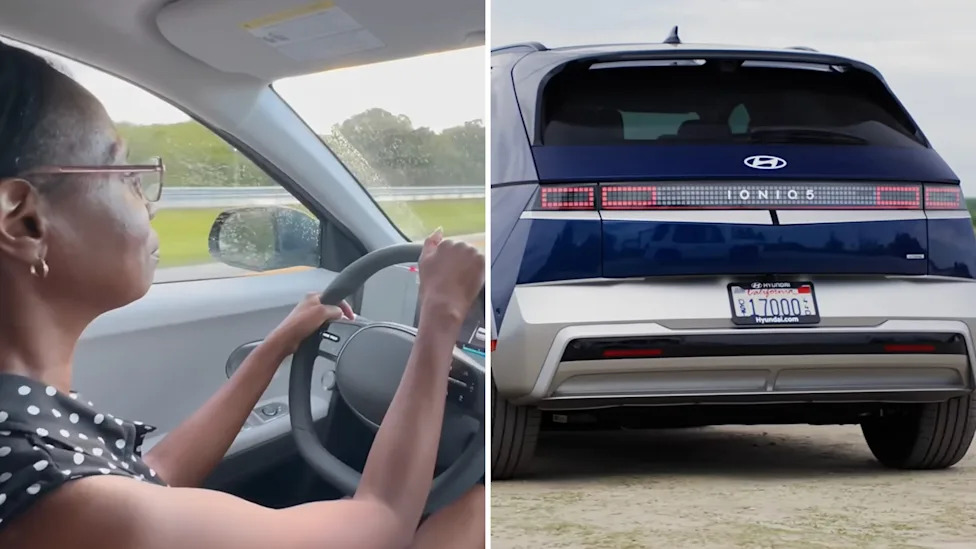



















Hyundai's 2028 Self-Driving Plan Hinges on a Level That Doesn't Officially ExistThe Auto WireEve NowellTue, September 15, 2026 at 4:12 PM UTCAdd us on GoogleHyundai's 2028 Self-Driving Plan Hinges on a Level That Doesn't Officially ExistHyundai Motor Group spent a day at 42dot's headquarters in Gyeonggi Province explaining how it plans to catch up in autonomous driving, and the most revealing thing in the whole presentation was a piece of punctuation.The Group's roadmap, laid out at what it called HMG Autonomous Driving Media Day, targets production vehicles with "Level 2+" capability in the first half of 2028, "Level 2++" in the second half of 2028, and a second wave of Level 2++ cars running Hyundai's own Atria AI software in the second half of 2029.Go looking for Level 2+ in the SAE taxonomy and you won't find it. J3016, the standard NHTSA itself leans on when it talks about driving automation, defines six levels, zero through five. There is no plus sign. There is definitely no double plus sign.Related ArticlesToday at The Auto Wire: Full Recap (September 13, 2026)McLaren Won't Confirm Its £450 Million Plan. Its Careers Page Already Has.AdvertisementAdvertisementWhat the extra characters mean in practice is capability, not legal status. A Level 2++ car can handle unprotected left turns and urban cut-ins and construction zones, and you are still the driver. Every single second. NHTSA's own breakdown of who regulates what is blunt about it: the federal government handles vehicle safety standards, defects and exemptions, while states handle driver licensing, traffic law and inspection. Nothing in that arrangement notices a plus sign.Why an automaker would deliberately stop shortThat's not an oversight. It's the strategy.The moment a manufacturer certifies Level 3, it is formally taking over the dynamic driving task inside the operational design domain, and it inherits the consequences of doing that badly. Homologation gets harder, warranty exposure changes shape, and the legal department starts attending powertrain meetings. Level 2++ delivers something close to the customer experience of conditional automation while the liability stays in the driver's seat.Hyundai is not unique here. Nearly everyone shipping impressive hands-off highway systems in volume has found the same loophole appealing. What's notable is that Hyundai has now put dates on it, publicly, and those dates are 2028. That is two full model years away for a capability tier that already exists on roads in China and California.The hardware bill is the real storyTrack one of the dual-track plan leans on NVIDIA, extending a partnership the Group announced in March. Sensor architectures across Hyundai, Kia, 42dot and Motional get standardized around DRIVE Hyperion 10.AdvertisementAdvertisementLook at what that reference platform actually specifies: 14 cameras, nine radars, one lidar, 12 ultrasonic sensors, four interior cameras and an exterior microphone array, running on two DRIVE AGX Thor processors rated up to 1,000 INT8 TOPS and 2,000 FP4 TFLOPS apiece. Hyperion 8, the outgoing generation built on Orin, ran 12 cameras and roughly 508 combined TOPS and topped out at Level 3 scalability.Count the exterior sensors. Thirty-six of them, plus a microphone array whose obvious job is hearing sirens before you do. Now imagine backing into a pole.Every one of those devices has a mounting tolerance measured in fractions of a degree, and nearly all of them live in the parts of a car that get hit. Radar behind a bumper cover means that cover stops being a painted plastic shell and becomes a tuned, radar-transparent structure where aftermarket paint thickness and a badly sourced replacement can quietly degrade detection. Windshield-mounted cameras turn glass replacement into a calibration job. A roof or fender lidar is a four-figure part sitting exactly where parking-lot damage happens.This is how modern ADAS quietly moves the total-loss threshold. A 15 mph impact that used to be a bumper, a bracket and an afternoon becomes a bumper, three radars, a calibration procedure and a scan tool subscription. Insurers price that, and it lands on your renewal whether or not you ever switch the system on.AdvertisementAdvertisementThe compute side has its own physics problem. Two Thor-class processors generate serious heat and draw serious current, which is why this is tied to a software-defined vehicle architecture rather than offered as a retrofit. If you own a Hyundai or Kia today, none of this is coming to your car over the air. The electrical architecture isn't there.The flywheel, decodedThe centerpiece of the presentation was what Hyundai calls the Data Flywheel: collect real driving data, train models, validate, deploy, repeat. The Group says Hyundai and Kia move more than seven million vehicles a year across roughly 190 countries, and that about 40 dedicated data-collection vehicles run around the clock.Forty cars is a rounding error. The seven million is the point, and it's also the hard part, because harvesting useful data from customer vehicles means consent frameworks, cellular bandwidth and compliance with a different privacy regime in every market. The Group's answer is a Data Union framework built on standardized sensor and data structures, so Hyundai, Kia, 42dot and Motional accumulate data in a common format rather than trading incompatible raw dumps. Standardizing on one sensor suite isn't just a procurement win. It's what makes the training data fungible across four organizations.Two techniques in the stack deserve translation. Hard example mining means the system automatically flags the situations the model handles badly and pushes those to the front of the training queue, which matters because a million miles of empty highway teaches an AI nothing. And the Group says it rebuilds real drives as three-dimensional scenes using 3D Gaussian splatting, a rendering method that reconstructs a photorealistic environment from captured data and lets engineers replay the same intersection from viewpoints the car never actually occupied. You can re-run the near-miss with your vehicle three feet further left, at night, a hundred times, without endangering anyone.Related ArticlesStellantis's $13 Billion Bet: America Isn't Like Everywhere Else AnymoreVolkswagen Didn't Build Too Few EVs. It Built Too Many Factories.AdvertisementAdvertisementThere's also a Special Event Recorder that automatically captures significant events during autonomous operation. Hyundai frames it as a training tool. It is also, inevitably, an evidence tool, and anyone who has followed crash litigation involving driver assistance knows those logs eventually end up in front of a judge.The part that will matter in court42dot also detailed work on Vision-Language-Action models, which combine visual perception, language-based reasoning and action generation in one framework. The Group says VLA work is currently in simulation-based validation, with real-vehicle testing and full development running from late 2026 into early 2027, alongside its existing end-to-end models.The demonstration footage showed the model narrating its own reasoning on screen: what it did and why. That's explainability, and it's the single most consequential thing in the presentation for the long run. A conventional end-to-end network maps sensor input to steering and throttle through weights nobody can interrogate. A system that emits a written rationale is a system whose decision-making can be read aloud to a jury.That cuts both directions, and Hyundai surely knows it.What Hyundai already has runningThe Group also plans a real-world Level 4 pilot with Korea's Ministry of Land, Infrastructure and Transport in Gwangju by year end, using an Atria AI-equipped test vehicle.AdvertisementAdvertisementMeanwhile Motional, which Hyundai majority owns, has been carrying paying passengers. Its IONIQ 5 robotaxi went live on Uber in Las Vegas in March with a vehicle operator aboard and driverless operation targeted by year end, and the car is described as among the first SAE Level 4-capable vehicles certified under FMVSS. Folding Motional into the same Hyperion sensor standard is the quiet cost play in all of this: robotaxi and retail vehicle sharing a sensor bill of materials spreads validation and part volume across both.Minwoo Park, who heads the Advanced Vehicle Platform division and runs 42dot, told the room that "Development speed and safety are not conflicting values." Fair enough. The 2028 and 2029 dates are the receipt, and they're far enough out that nobody has to be right today.For the person actually buying a carDon't shop on this roadmap. Nothing announced changes what's on a dealer lot now, and current Hyundai and Kia driver-assistance hardware will not become Atria AI later.Do shop on the consequences. When these systems arrive, ask what sensors are embedded in the bumpers and glass, ask your body shop what calibration after a collision costs, and price insurance before you sign. And keep the plus signs in perspective. Until a manufacturer publicly certifies Level 3 and accepts the driving task, the legally responsible driver is the one holding the steering wheel.AdvertisementAdvertisementHow much hands-off driving would you actually trust a car to do on your own commute — and would you still accept the blame if it got it wrong? Or is "Level 2++" just marketing with extra punctuation?Join our Newsletter, follow our Instagram page, and connect with us on Facebook.