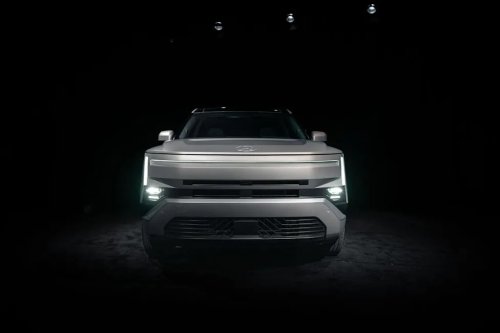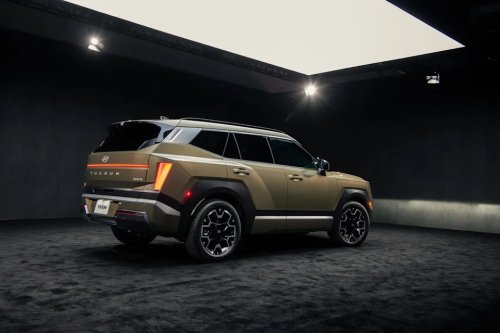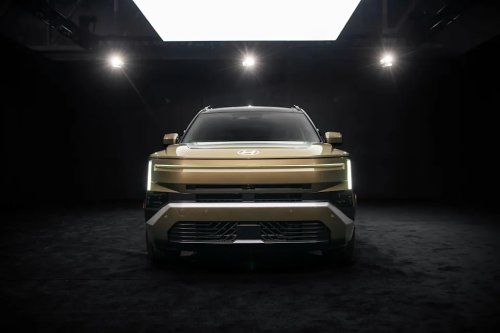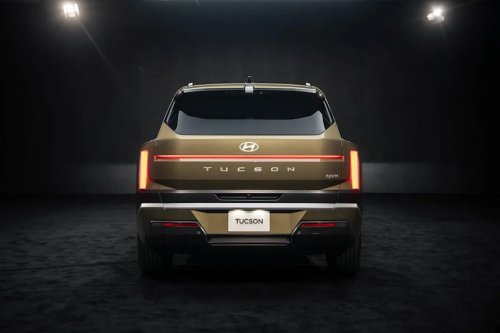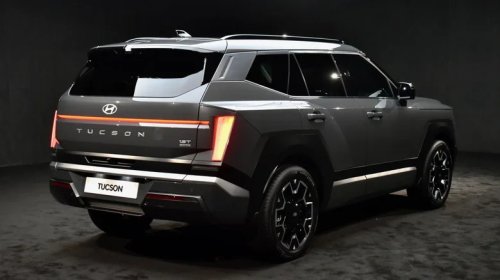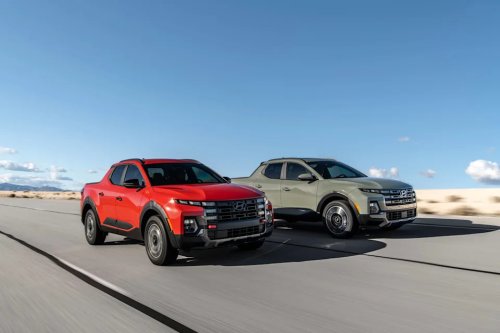



















Hyundai Patent Shows Braced Swing-Out Truck Tailgate That Carries Real WeightTruck tailgates stopped being simple around 2019, and the arms race has been mostly about counting positions rather than solving anything structural. Hyundai's newest filing at the U.S. Patent and Trademark Office, published as US 2026/0233788, is the rare one that goes after an actual engineering problem instead of a marketing bullet point.The short version: the application shows a pickup gate with a section that swings outward on vertical hinges like a barn door, plus a panel that folds down off that swinging section to sit flush with the bed floor — and, critically, a tubular brace that deploys from inside the gate frame to carry the weight. Cables and overhead hinges are what everybody else uses to hold a load-bearing panel. Hyundai's drawings put the load path underneath, where it doesn't eat into the opening you just went to all this trouble to create.Why the brace is the whole storyAdvertisementAdvertisementA conventional drop-down tailgate is a beautifully dumb piece of engineering. It hinges at the bottom and hangs from two cables or torsion links at the top, so any weight you put on it resolves into tension in those cables and compression at the hinge. That's why Ram can advertise a 2,000-lb rating on the Multifunction Tailgate when it's dropped flat — the geometry does the work.Related ArticlesWhy a Clutch Pedal Is Now an Engineering Nightmare for Low-Volume Sports Cars2027 Jeep Wrangler Smoky Mountain Edition: What Buyers Should Know Before OrderingTurn that panel ninety degrees and everything changes. A side-hinged door has no cable to hang from. Every pound you hang off its outboard edge becomes a bending moment on two vertical hinges and a torsional load on the gate structure they're bolted to. Put 200 pounds two feet out from the hinge line and you're asking those pivots to eat roughly 400 lb-ft. Do it a few thousand times over a truck's life, in the rain, with road salt, and you get sag, then wind noise, then a door that won't latch.That's precisely why the existing barn-door gates are access devices, not load-carrying ones. Ram's doors swing 88 degrees and let you reach the bed with a trailer hooked up. Ford's Pro Access Tailgate does something similar on the F-150. Neither is asking you to stand on the swung-open portion. Hyundai's filing addresses that gap by triangulating the load back into the gate frame with a deployable strut, which is the same principle as a properly braced shelf bracket and roughly a century older than any tailgate on this list.AdvertisementAdvertisementThe number that makes it matter on a small truckLook at what a tailgate is actually worth on a compact pickup. By Hyundai's own numbers, the Santa Cruz bed is 52.1 inches at the floor and 74.8 inches with the tailgate open. That's nearly 23 inches — almost a third more usable length — purchased entirely by dropping a panel.On a truck that small, the gate isn't an accessory. It's a load floor you deploy on demand, and its stiffness is what determines whether "eight-foot lumber" is a real capability or a thing you do once and then stop doing. A braced, foldable extension that can be deployed on just one side means you could carry long cargo down the middle of the bed while keeping the other half of the gate closed as a load stop. That's genuinely more useful than a sixth position.Where it runs into the lawAdvertisementAdvertisementThe obvious follow-up question — can you drive with it open? — is where enthusiasm meets the U.S. Code, and it's worth understanding before anyone gets excited.Start with the camera. FMVSS 111 requires a rear visibility system covering a defined zone behind the vehicle, displayed within two seconds of selecting reverse and remaining visible through the backing event. On plenty of trucks that camera lives in the tailgate handle or the gate's upper edge. Swing the panel outward and the camera swings with it, pointing at the shoulder instead of the road. Any production version of this needs the camera relocated to the bumper or the CHMSL housing, which is a packaging cost nobody puts in a press release.Related ArticlesA UK Petition Wants to Ban Driverless Taxis. Britain's New Permitting Rules Show Why 400,000 Drivers Are NervousA Dealership Handed Out A Salesman's Number. Federal Threat Charges FollowedThen the lighting. FMVSS 108 governs required lamps and prohibits added equipment that impairs them, and on most pickups the rear license plate and its lamp are mounted to the tailgate. A gate that's designed to be driven with a section open has to keep that plate lit, visible, and legible — a state-level enforcement issue that will produce tickets long before it produces a federal question.AdvertisementAdvertisementFinally, overhang. For commercial vehicles, warning flags are required when a load extends more than four feet past the rear, and each must be at least 18 inches square. Most states have an analogous rule for private vehicles with varying thresholds. Extending your load floor doesn't extend your legal envelope, and a braced platform makes it much easier to accidentally exceed one.What it costs when it breaksComplexity in a tailgate has a documented price. In recall 24V894, GM told NHTSA that water intrusion into a touchpad switch assembly could unlatch power tailgates on 2024 heavy-duty Silverados and Sierras, with 65,368 GMC units alone in scope, after a complaint involving a gate that fell open and hit a trailer. That's a single switch. Hyundai's concept adds a second hinge axis, a folding platform, a deployable strut, and however many latches it takes to keep all of it honest — every one of them a wear point in the wettest, dirtiest, most-abused panel on the vehicle.Practically, that means three things for buyers. Multi-piece gates are heavier, and weight on a tailgate comes straight off payload. They're expensive to replace, which matters because tailgates are among the most frequently stolen and rear-ended components on any pickup — worth a look at whether your comprehensive deductible makes sense relative to a $2,500 assembly. And they demand maintenance most owners never think about: hinges and latch pawls want lubrication, drain paths want to stay clear, and any hollow tubular brace that stows inside a gate cavity is a corrosion trap waiting for a salted winter.AdvertisementAdvertisementDon't order one yetA published application means Hyundai's lawyers filed it, nothing more. Automakers patent aggressively to fence off design space they may never build, and this one shows up while the smaller end of the truck market is the most competitive it's been in twenty years. What it does tell you is that Hyundai's engineers looked at the barn-door gate everyone else shipped and identified the same weakness a structural engineer would: nobody solved the load path. Solving it is what would separate a clever feature from a useful one.