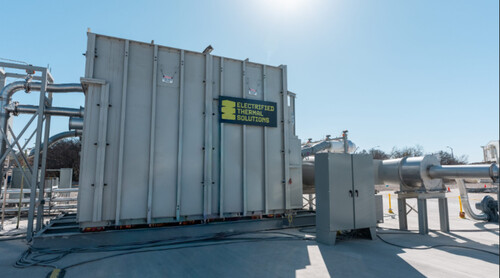
Oh the irony, it burns. Last year’s sharp U-turn in federal energy policy has been a rolling disaster for the energy transition, and yet US innovators in the clean tech space continue to attract investor dollars. The latest example is the long duration energy storage startup Antora Energy, which has just added a $550 million, oversubscribed Series C round of funding to support its “hot blocks” thermal battery system. The Long Duration Energy Storage Difference The “long” in long duration refers to energy storage that surpasses the capability of conventional lithium-ion batteries used. The Li-ion batteries used in grid operations typically range from 2-4 hours of duration, though longer periods of up to eight hours are beginning to emerge. That’s enough to smooth out availability gaps for wind and solar power in routine daily cycles, but not enough to meet industrial requirements. Back in 2018, the US Department of Energy earmarked funds to support new long duration technologies through the DAYS program. Short for Duration Addition to electricitY, the program was administered by the Energy Department’s ARPA-E office for kickstarting transformative innovations in the private sector. As defined by the Energy Department, at the bottom end of the scale long duration applies to systems that last at least 10 hours. Multiple days, weeks, months, and seasons also come under the umbrella of long duration. The DAYS program focused the crucial10-100 hours period, with an eye on achieving significant, near-terms results in key areas including the delivery of more wind and solar power. “Whereas most new energy storage systems today deliver power over limited durations, for example to alleviate transmission congestion, stabilize voltage and frequency levels, or provide intra-day shifts of energy, the extended discharge times of DAYS projects will enable a new set of applications including long-lasting backup power and greater integration of domestic energy resources,” ARPA-E noted. The DAYS program represents an effort to extend the availability of long duration, utility-scale energy storage beyond the limits of pumped hydropower storage. Pumped storage is a mature, proven technology that has long held the lion’s share — about 95% — of utility-scale, long duration energy storage capacity in the US. Though some opportunities are emerging to expand capacity, over the coming years pumped storage is largely restricted by geography and water resources (see more pumped storage background here). Follow The Money In contrast to conventional, chemistry-centric batteries, Andora has developed a system consisting of solid blocks of carbon. Heated to white-hot strength by electricity, the insulated blocks can deliver power in the form of heat for industrial processes. They can also convert heat back into electricity, to be delivered on demand. The Antora system is ideally suited to harvesting and storing excess wind and solar power, taking advantage of lower electricity demand during off-peak hours. “Antora’s batteries charge when electricity is abundant and deliver when it’s needed most, meeting surging energy demand from large new loads without raising costs for consumers,” the company emphasizes. Antora caught the attention of the DAYS program early on, winning a technology development assist of $7.9 million from ARPA-E in 2019 while also bringing in dollars from private sector investors. ARPA-E followed up in 2024 with a $14.5 million grant under its “SCALEUP” program, which is earmarked for previous grant recipients that have established a dependable pathway to commercial uptake. ARPA-E provided an enthusiastic summary in a recap of the project that same year: “Antora’s American-made thermal batteries represent a breakthrough in energy storage, storing energy as heat in blocks of solid carbon—a low-cost, earth-abundant storage medium with robust U.S. supply chains.” Antora also emphasizes that its factory-made modules apply equally to a wide range of industrial activities including chemicals and food production, steelmaking, data centers, and grid operations among other large loads. Of particular interest, part of the $14.5 million grant was earmarked for a technology trial with the New York utility Con Edison, which has been looking to decarbonize its vast steam system. In 2024, Antora also closed a $150 million Series B round with the firm Decarbonization Partners taking the lead. In addition, In the latest news, on July 30 Antora announced that $550 million is the final figure for its Series C round of funding. “The oversubscribed round was co-led by G2 Venture Partners and Eclipse, with participation from new investors including Ribbit Capital, Salesforce Ventures, Activate Capital, John Doerr, Westly Group, StepStone Group, and Liberty Mutual Strategic Ventures,” Antora reported. Existing investors also played a substantial role in the Series C round. Along with Decarbonization Partners, the roster includes Impact Science Ventures, Trust Ventures, Breakthrough Energy Ventures, and Lowercarbon Capital. Next Steps For Thermal Energy Storage With another $550 million in its pocket, Antora has assembled an ambitious to-do list. “The round will accelerate the deployment of large-scale projects across the country, enable Antora to expand production and establish a second U.S. manufacturing hub, and further strengthen the company’s domestic supply chain,” the company explains. In the same report, Antora also reminded everyone that the company’s project in South Dakota is “one of the largest battery storage projects in the world,” weighing in at 5 gigawatt-hours over multiple days. The project took just 12 months to complete, from the start of construction to commissioning (see more details here). That should give pause to data center developers and other large-load stakeholders that are depending on new natural gas power plants. A 12-month construction timeline for energy storage easily beats natural gas, with the further limitation that a years-long backlog awaits anyone ordering a new gas turbine today. In regions where low-cost wind and solar are accessible, natural gas will have a tough time competing. The renewable energy angle, of course, depends partly on federal policy makers. It also depends on state and local elected officials. While some states have pressed on with their renewable energy goals, others have raised new barriers. Be that as it may, Antora has ensconced itself, and its newly expanded manufacturing campus, in the renewables-friendly state of California, where it calls attention to new employment opportunities in traditional manufacturing trades including welders, electricians, pipefitters, and machinists. Photo: The US energy storage startup Antora Energy is scaling up with a $550 million assist from leading investors (screenshot courtesy of Antora).