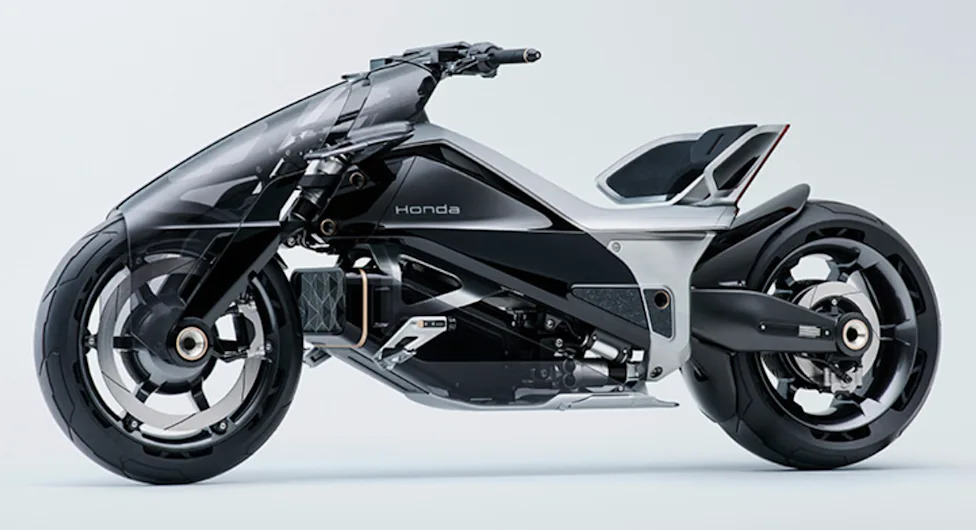
Honda's Award-Winning EV Outlier Hides a Two-Wheel-Drive Bet Worth Arguing AboutDesign awards are usually where concept bikes go to be politely applauded and then forgotten. Honda's latest one is worth a closer look, though — not because of the trophy, but because of what's hiding in the spec.Honda announced on August 20 that its EV Outlier Concept was named a Red Dot winner in the Design Concept category of the 2026 Red Dot Design Award, with a companion brand film for its electric motorcycle business taking a win in Brand & Communication Design. The award has been running since 1955 and is administered by Design Zentrum Nordrhein Westfalen in Essen, Germany.The Outlier itself first appeared publicly at the Japan Mobility Show in October 2025. It looks like a design-studio fever dream — smoked translucent bodywork, a seating position somewhere between sportbike and bobsled, no visible mirrors. But underneath the styling language is a packaging decision that would fundamentally change how a motorcycle behaves, and Honda has been unusually specific about it.Two driven wheels, and why that's harder than it soundsThe Outlier runs in-wheel motors at both ends. Honda's own designer interview with project leader Yuya Tsutsumi confirms the front and rear units can be controlled independently, and the instrument cluster's lower screen includes front motor torque adjustment as a rider-selectable parameter.Related ArticlesAn Ohio Seller Wants $5,000 for 14 Geo Metros, Rust and Rare Convertibles IncludedMan Charged in Greg Biffle Burglary Allegedly Picked Targets by Reading the NewsAdvertisementAdvertisementTwo-wheel drive on a motorcycle is not a new idea, but it has never gone mainstream for a good reason: the front tire is already the busiest component on the vehicle. It steers, it handles the majority of braking, and it operates on a contact patch that shrinks and migrates as the bike leans. Every unit of longitudinal force you ask it to transmit comes out of the same finite friction budget it needs for cornering. Add drive torque to that job and you're spending grip the tire may need a half-second later.The upside is real, though — driving the front wheel can stabilize a bike under power on low-grip surfaces and pull the machine through a corner rather than pushing it. The reason it's rarely done mechanically is that routing torque up through a steering head is a packaging nightmare. Electrification erases that problem entirely: run a cable to the hub and you're done. This is the single most legitimate argument for electric motorcycles being a genuinely different vehicle rather than a range-anxious substitute.The unsprung mass problem nobody in the press release mentionsHere's the counterweight. An in-wheel motor lives outside the suspension, which makes it unsprung mass — and unsprung mass is the enemy of both ride quality and mechanical grip. When a wheel hits a bump, the suspension has to accelerate that entire assembly upward and then settle it back down. Heavier wheel, slower response, longer time with a compromised contact patch.Motorcycles are more sensitive to this than cars because they have less suspension travel to work with and a far worse consequence for losing front-end grip. There's a second-order issue too: a heavier front wheel has more rotational inertia, which means more gyroscopic resistance to steering inputs. The bike will feel more reluctant to turn in and more stubborn about changing direction mid-corner.AdvertisementAdvertisementHonda's designers appear to have addressed the visual side of this by mounting the suspension horizontally toward the lower mid-chassis, but the physics don't care where the damper sits. Any production version of this layout would need genuinely serious work on hub motor mass and damping calibration.For owners, the maintenance math also inverts. Electric drive kills the chain, sprockets, and final drive adjustment — an unambiguous win over a conventional bike. But putting the motor inside the wheel means a curb strike, a deep pothole, or a parking-lot tip-over stops being a wheel-replacement job and starts being a powertrain job, with hub sealing against water ingress as a permanent service concern.The mirrors would be illegal hereThe Outlier ditches conventional mirrors for a camera-based system integrated into the instrument binnacle — clean, futuristic, and a non-starter in the United States as drawn.FMVSS 111 is explicit on this point. Under section S10.1, a motorcycle must have either a unit-magnification mirror with at least 8,065 square millimeters of reflective surface or a convex mirror with at least 6,450 square millimeters, mounted on a stable support with its horizontal center at least 279 millimeters outboard of the bike's centerline, and adjustable by tilting in both directions. A screen doesn't reflect anything. Nothing in the standard currently provides an equivalency path for camera monitor systems on two-wheelers.AdvertisementAdvertisementThat's a live regulatory gap worth watching, because Japanese and European rulemaking has been more accommodating toward camera-based rear vision generally. Anyone who eventually imports a machine like this should assume bolt-on mirrors are part of the deal.The one detail that changes crash logicThe Outlier uses what Honda describes as a bucket-type backrest, intended to absorb motor-drive acceleration and let the rider pivot through corners using the hips as a pivot point.Related ArticlesUber's $10 Billion Self-Driving Gamble Hits a Wall: Europe's 250-Car-Per-Country LimitThe Camaro Restoration Disaster That Proves an Empty Gas Tank Is More Dangerous Than a Full OneThat's an interesting ergonomic idea and a genuinely complicated safety one. Conventional motorcycle crash protection is built on the assumption that the rider separates from the machine — that's why riding gear exists and why bikes don't have seatbelts. A structure that locates and retains the rider's torso starts moving toward a different accident model, one that raises questions about whether the machine follows the rider through a slide. Concepts get to skip that conversation. Production bikes don't.Concept versus realityWorth keeping the two threads straight. In April, Honda's WN7 electric naked bike and UNI-ONE mobility robot took Red Dot's Best of the Best in Product Design, and the WN7 uses a completely different structural philosophy — a battery case at the center of the body that forms part of the frame. That's a shipping product solving a real stiffness-and-packaging problem.AdvertisementAdvertisementThe Outlier is the other thing entirely: a bet on what happens after 2030, when electric packaging freedom is taken for granted rather than treated as a novelty. Honda says the design brief was that the machine be unconstrained by boundaries. Fair enough. The boundaries will be waiting whenever it grows up.Images Via: Honda


















 +31 others